
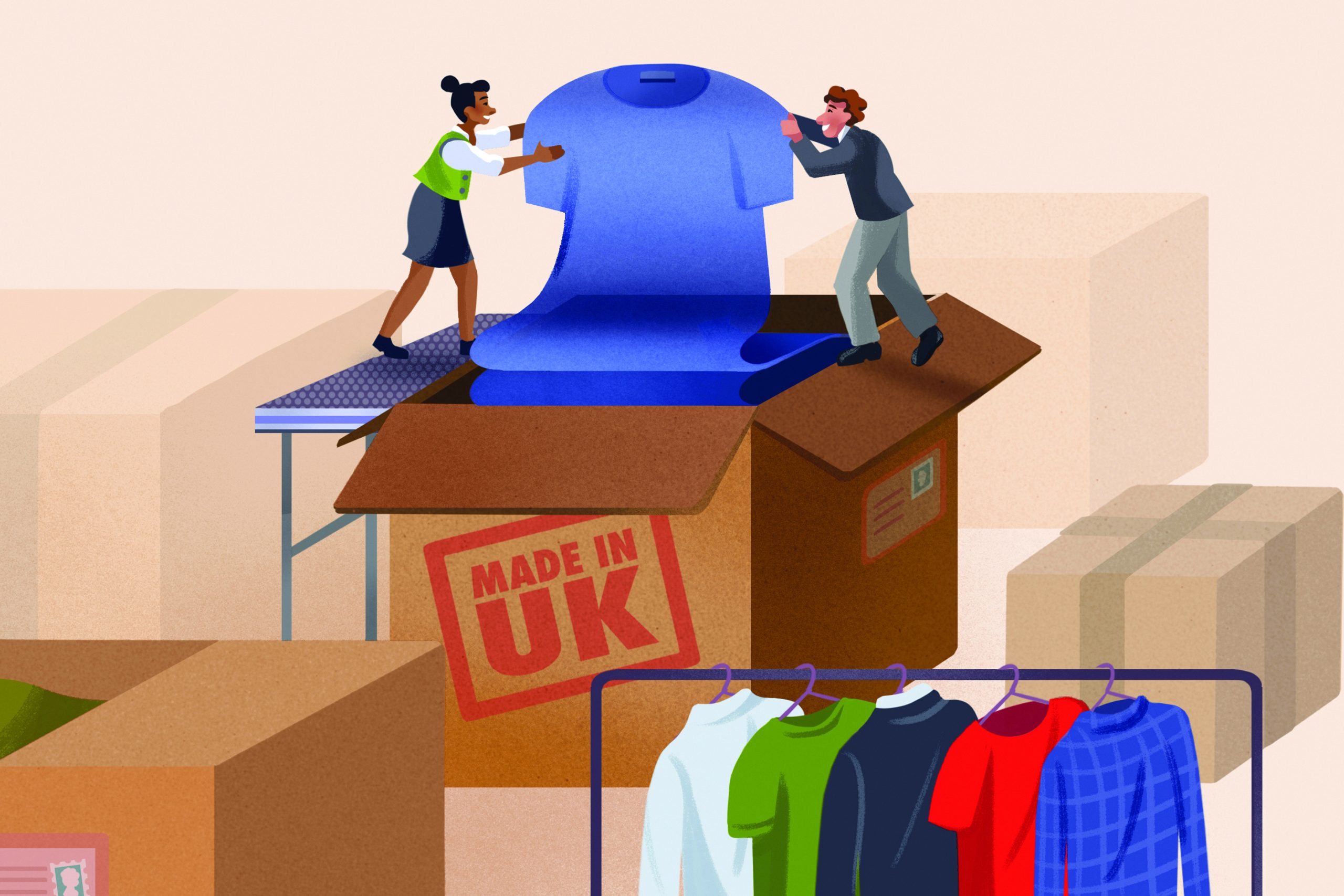
For millennials, it is hard to imagine the UK as a mass producer of clothing and textiles – a prosperous industry with factories across the regions employing about a million workers and pumping vast amounts into the economy, as it was in the 1970s. Today, we only have to look at the labels on our garments to see our clothes are produced further afield – labels reading “made in Bangladesh” and “made in China” are now the norm.
Back then, UK manufacturing was thriving, and powerful companies such as Viyella, Daks Simpson and Bairdwear were producing everything from jeans to shirts. It was a period of time when British fashion retailers were using British companies to create garments, and manufacturers were spread out across the country, tapping into local skills.
Professor Christopher Moore, director of the British School of Fashion and assistant vice-principal at Glasgow Caledonian University, explains: “The world was smaller then in terms of the origins of the competition and, as a result, manufacturing was locally based, too. The independent fashion sector also still existed, and that presented an opportunity for smaller British fashion manufacturers to reach consumers in a clear and direct way.”
Offshore exodus
By the early 1980s, UK manufacturing had slowly started to disappear, as offshoring became the buzzword, and retailers and brands spread their bases further afield to emerging markets in a bid to cut costs and increase their margins.
Globalisation wasn’t going away and we couldn’t stand on the shore like King Canute
Marks & Spencer spokeswoman in 2002
The bulk of manufacturing drifted off to China, which effectively became a factory in itself, churning out goods for markets across the globe. By the mid-1990s, UK production was well and truly grinding to a halt. In the early 2000s, the clothing and textiles sector reached its lowest number of employees, totalling only about 90,000 workers.
“By the time we hit 1995, we had offshored 70% of our production to the Far East,” says fashion consultant Daliah Simble-Hearn, looking back at her time when she was production manager at Monsoon.
She believes offshoring shaped today’s retail model: “If we hadn’t done that, the high street we know today wouldn’t have existed. Through being able to find those cheap items, retailers were able to invest in bricks-and-mortar, and expand.
“That’s the positive side of the globalisation of the supply chain. So many business models were built on volume, and retailers saw an opportunity to produce more product. Even at the height of UK manufacturing, there was still a cap on how many pieces they could make.’
As offshoring continued, there were significant changes in business models. Companies were bought by bigger, private companies, whose shareholders demanded more bang for their buck – and, if that meant sourcing overseas, then so be it.
So many business models were built on volume, and retailers saw an opportunity to produce more product
Daliah Simble-Hearn, fashion consultant
Marks & Spencer was reportedly one of the last British companies to jump ship.
“Globalisation wasn’t going away and we couldn’t stand on the shore like King Canute,” an M&S spokeswoman told the BBC in 2002. “Our competitors were offering customers better prices than we could hope or imagine, so we bit the bullet.”
As expected, with a big fall in demand, factories across the UK closed down, although some firms specialising in tailoring, outerwear and premium knitwear clung on to British soil. But then, in about 2007, a strange thing started to happen.
Coming home
Zara swooped on to the market, creating a fast fashion model that others envied. Some retailers and brands started to bring manufacturing – albeit a small amount – back to the UK. At the same time, retailers were aware that margins were better from sourcing overseas, but were won over by consumer demand for newness.
The resurgence was also fuelled by a newly found interest in Made in UK products. The emerging BRIC economies (Brazil, Russia, India and China) created a new wave of consumers with new spending power, and they desired British-made goods. Brands such as Mulberry and Aquascutum prospered as a result.
However, the resurgence was not solely driven by high-end fashion. In the mid-market, it was helped by brands such as Jaeger bringing some of its production back to the UK, and John Lewis and Debenhams offering Made in UK collections.
Source: Jack Hudson
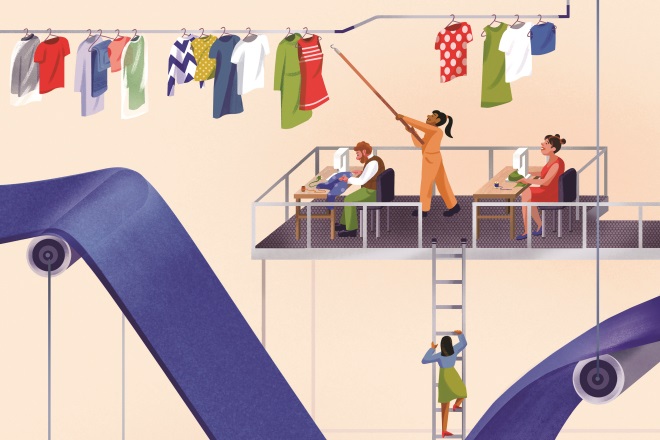
More recently, we have witnessed increased investment in British clothing from brands at the other end of the spectrum – fast fashion players such as Boohoo and Missguided are ordering from factories in the UK so they can react more quickly to trends.
Figures confirm that manufacturing in Britain has been enjoying something of a revival. A report from the UK Fashion and Textile Association (UKFT), which collated data from sources including the Office for National Statistics (ONS), and Revenue and Customs on imports and exports, found that there were 7.6% more companies producing textiles and clothing in the UK in 2015 than in the previous year, bringing the number to 7,880.
The biggest increase came from a rise in the number of garment manufacturers, up by 10.7% to 3,830 companies, while the number of textile producers had increased by 4.9% year on year to 4,030.
British manufacturing is still very much concentrated at the luxury end of the market
James Eden, Private White VC
The growth was attributed to the rising cost of overseas production, increasing need for supply control and flexibility, and growing demand for UK-produced clothing. The same report found that the number of people employed in textile and clothing manufacturing (including the self-employed) was at its highest level since 2006, at about 132,000. The healthier state of the UK manufacturing scene was also demonstrated by ONS figures that show 945 textile and clothing manufacturing companies were created in 2014, up from 710 in 2009.
The UK’s decision to leave the European Union has also encouraged retailers to look closer to home. The weakness of sterling since the Brexit vote – and the attendant effect on exchange rates – resulted in higher import costs, and makes buying in pounds from within the UK a more attractive prospect than it has been for some time.
This summer, footwear giant Clarks started up the machines at a new factory in Somerset. Domestic manufacturing has also given brands more control over the quality of what comes off their production lines. With factories on their doorstep (comparatively), rather than thousands of miles away, it is easier for sourcing managers to visit sites and check garments.
Limited to luxury
However, while some talk of a resurgence, others take a different view.
“For brands like ours, there has been an uptake, but British manufacturing is still very much concentrated at the luxury end of the market, with a plethora of brands shouting ‘Made in the UK’ but producing only a fraction of their range here,” says James Eden, who has run premium menswear label Private White VC since 2011. “Until labelling is properly controlled by the UK government, those who do produce their garments here will always be under threat.” Eden launched the label after taking over his great-grandfather Private Jack White’s former raincoat factory in Manchester.
As a manufacturer committed to remaining in the UK, our costs have only gone up during this time frame
Ian Maclean, John Smedley
One brand to have retained production here while others looked abroad is John Smedley, which was founded in 1784 and claims to be the oldest manufacturing factory in the world. The knitwear brand’s clothes are all manufactured in Derbyshire and South Yorkshire. The company also manufactures for a range of brands – including Margaret Howell, Holly Fulton and Comme des Garçons.
Yet, although business is going well, it’s been a tough slog, says chief executive Ian Maclean: “As a manufacturer committed to remaining in the UK, our costs have only gone up during this time frame. That has meant our prices have gone up as well, and our volumes have gone down.
“In volume terms, our business peaked in 1997 at around 600,000 garments manufactured each year. Last year, we made 350,000 garments. The main loss of business has been original-equipment manufacturer (OEM) business, mainly for the big department store chains, which took most of that business to the Far East about 20 years ago.
“What remains for us is the John Smedley brand, which has been the backbone of our business since the 1930s, and sells well today through department stores, indies and our own retail channels.”
Mind the skills gap
One of the key challenges for UK manufacturing is still the skills gap. In a survey of textiles employers for a report published by the Alliance Project in 2015, on the potential for rejuvenated UK textile manufacturing, 37% of the firms interviewed said that skills shortages were a barrier to growth. Almost half (49%) reported hard-to-fill vacancies, and half said that their recruitment problems in the past two years had related to small numbers of applicants with the experience and qualifications required.
In April 2017’s ONS Labour Force survey found that the UK’s textiles workforce stood at 127,500 across all skill levels, from packing and Warehouse staff to board directors.
Clothing manufacturing could and should play a critical role in our future economic and industrial prospects
Professor Christopher Moore, director of the British School of Fashion and assistant vice-principal at Glasgow Caledonian University
The age profile of the workforce is another limitation.
“A lot of the manufacturing workforce are on the wrong side of 40,” says Adam Mansell, chief executive of the UKFT. “So it’s about how we can make manufacturing more appealing to young people. We have 5,000 students on fashion degree courses in the UK, but not all are going to become fashion designers or buyers, so we have to go to schools and talk about why manufacturing is a good place to have a career.”
Eden also voices his concern: “Attracting new talent is currently our biggest hurdle. Waves of textiles graduates clamour to become designers in their own right, without understanding that a swathe of roles – apprentices, pattern-cutters, sample machinists, garment technologists and so on – are all very much in demand, and essential to support the industry.
“We risk losing the skills of yesteryear at the moment, because there aren’t enough young people looking to enter manufacturing.”
Brexit threat
Another factor is how Brexit will affect UK manufacturing. For some, it is already causing growing pains. One of the concerns raised is the number of employees in the UK fashion industry who are European Union nationals. The UKFT says it is working with the British Fashion Council to lobby government to make a firm commitment about their work status.
The prospect of Brexit makes any predictions about how UK manufacturing will pan out even harder. But most industry insiders remain quietly optimistic.
“The days of there being a mill on every corner in the north of England are over, but there are brand specialists producing within the UK and doing very well,” says Eden. He adds that his company is expanding its production facilities by 50% this year, and opening a new factory floor to keep up with demand.
Certainly, the industry needs to rally together to help to keep up the momentum.
As Moore says: “We should support and be optimistic about the sector, not just because it is part of our industrial heritage but, rather because it could and should play a critical role in our future economic and industrial prospects.”