

Meghan Owen,Work & Money Correspondent, BBC Londonand
Lauren Stanley,BBC London

 BBC
BBCOnce the powerhouse of UK manufacturing, London has seen a major shift in recent years by moving away from large-scale industrial manufacturing to smaller, artisan production. But how is its industrial identity evolving and what are the challenges it faces?
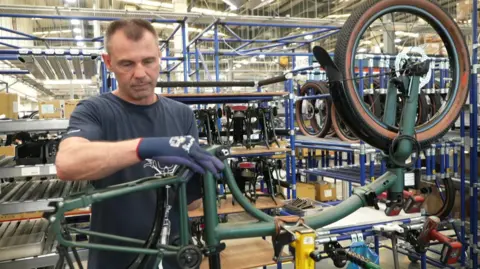
At the Brompton Bikes factory in Greenford, west London, employees are hard at work, painstakingly handcrafting each bike.
It’s been fifty years since the business set up in London, in the company of many other engineering workshops.
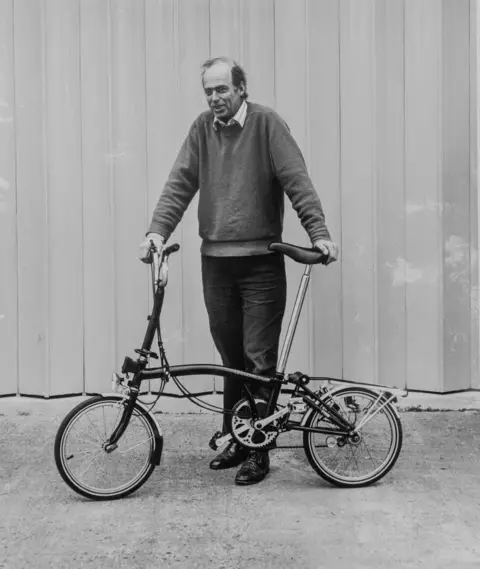
In that time, small machine shops that used to service big enterprises have, according to its founder Andrew Ritchie, been converted into residential units, a move which has left him sad.
The statistics support his sentiment: during the late 18th century to the mid-20th century, London was seen as a leading centre of UK manufacturing. It now accounts for just 2% of London’s overall income.
But according to City Hall, there is still hope for the sector: production of food and beverages, textiles and clothing have all seen their contribution to London’s income grow since the early 2000s.
Academics say although traditional manufacturing has declined, an “artisanal approach” has started to replace the industry of the past.
“London should not be written off too quickly as a city that makes,” say Cities of Making, a research project funded by JIP Europe.
 Brompton
Mr Ritchie said London was “not a natural place to be doing business” as “rates are higher, rents are higher, and cost of labour is that much higher”.
“But I was embedded in London. Once it grew, I had staff who lived nearby – I wouldn’t want to uproot them – and London was the place it was at. In some funny way, there were a lot of benefits.”
He added: “There was a case to up sticks and go elsewhere but that is a terrifying prospect – what do we do with our suppliers who are nearby?”
 Getty Images
Mr Ritchie says there’s been a “huge change in the face of London.”
“When I started there were many more manufacturing industries here. The aerospace had quite a big presence. Ford motor company. Lots of engineering.
“Much of the machine shops, that used to service these big enterprises, have now gone and now been converted into residential units.
“As a man who loves a workshop, and a bit of dirt under the fingernails, it’s a bit sad.”
‘Cultural symbolism’
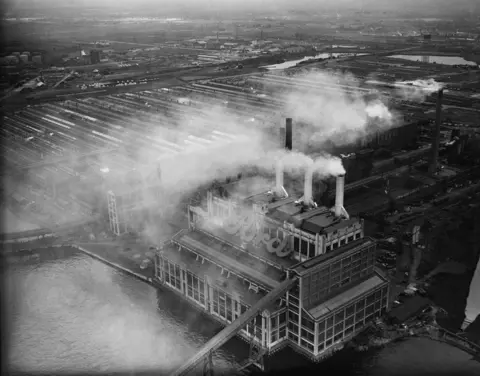
Dr Richard Courtney, head of department of Business Entrepreneurship & Finance at the University of East London, said: “What we’ve seen in the past is large, big dirty manufacturing, like the gas works in Beckton.
“They’re on the way outside of London because it’s easier logistically, it’s also cheaper to operate there. And actually, it’s going back to a more artisanal type of production that we saw in pre-industrial times.
“What people want from Britain is global great design; that cultural symbolism of British manufacturing.”
He says part of that change is down to sustainability: “People don’t want garments with a massive carbon footprint. They want to know they’ve been made on their doorstep.”
He adds a number of companies are using innovative ideas and technological advancements, including this London firm making seaweed underwear.
Christoffer Sellin, chief commercial officer at Brompton, echoes the idea, saying: “It’s one of our key drivers that we are manufactured in the UK and in London.
“Our customers, especially in the Far East, really value the fact that it is handcrafted in London.”
Brompton has recently had plans approved to open a new factory in Ashford, Kent, but Mr Sellin says they have “no immediate plans” to move from London.
‘Makers’ Mile’
London is home to some well-established manufacturing industries, such as furniture, textiles, construction materials – cement production – metal fabrication and food and beverages, according to a Cities of Making report.
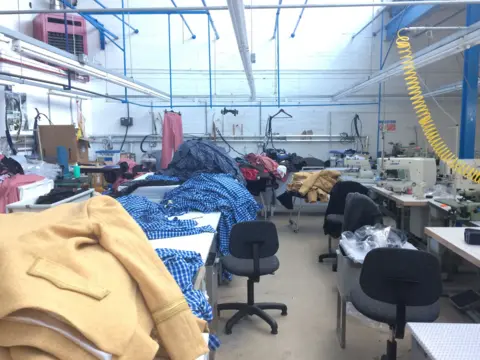
The report suggests Haringey, Park Royal and Old Oak and the “Makers’ Mile” – between Tower Hamlets and Hackney – are renowned manufacturing areas of London.
Haringey’s manufacturing industry is centred around clothing, furniture and food production, while in Park Royal and Old Oak, building-associated manufacturing takes place, along with carpentry, furniture, electronics and printing.
The “Makers’ Mile” is known for hardware start-ups, artist and design studios, clothing manufacturers, and food production.
 Dr Teresa Domenech, UCL. Cities of Making Project
While handcrafted products are flourishing and there is optimism in the sector, external affairs could be threatening jobs.
According to a new economic forecast report from City Hall, more than 143,000 manufacturing-related jobs in London could be directly and indirectly affected through disrupted supply chains due to Donald Trump’s upheaval of the world’s trading system.
It also warns that employment in manufacturing shows notable uncertainty, with expected flat growth in 2025, a strong rebound in 2026, before a slight contraction in 2027.
In a bid to reshape the UK’s economic landscape, the government has recently published its Industrial Strategy a plan designed to drive growth and investment across London and every region of the country.
As part of its broader Plan for Change, the strategy outlines “ambitious plans to ensure our country continues to be the best place to invest and do business”.
It also announced support for the Thames Freeport, a designated area in London and Essex designed to attract investment, trade, and jobs by offering tax and customs benefits, stressing “our plan for advanced manufacturing will help manufacturers adopt new and emerging technologies and help London’s industries to thrive.”
Although London’s skyline no longer billows with industrial smoke – the days of engineering giants have long passed – the city now faces new challenges: global divisions, climate change, and advancing technologies. Yet smaller businesses continue to produce products that are recognised and admired around the world.
For now, at least, their legacy endures