
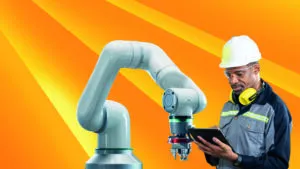
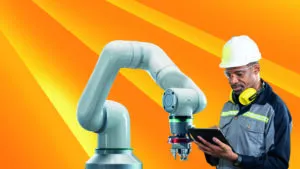
 IoT, artificial intelligence (AI), big data, cloud computing, robotics and automation are just some of the technologies helping to drive Industry 4.0, with intelligent manufacturing at its core.
Flexible factories use the latest technologies to automate and streamline production. This promises increased efficiency, enhanced productivity, flexibility and customisation, real-time data analytics, and greater sustainability. While the benefits are clear, there are plenty of challenges when it comes to adapting factories to meet shifting and growing market demands.
According to Global Industry Analytics, the smart manufacturing market is expected to reach $210.2bn in 2024, growing to $348.2bn by the end of the decade. The growth of smart manufacturing is driven by multiple factors, not least an increasing demand for operational efficiency and productivity as manufacturers seek to remain competitive.
Flexible factories
One of the core challenges in traditional manufacturing is an inability to switch quickly and efficiently between production processes.
Today, one of the key ways intelligent manufacturing increases flexibility is by introducing software-controlled production. This enables operations to be adjusted at the touch of a button without the need for extensive hardware modifications to repurpose machines and production lines with minimal downtime. Reconfigurable sensors and measurement systems enable manufacturers to switch between different types of monitoring, such as voltage or temperature, without replacing physical equipment.
Software-configurable hardware
At the heart of software-configurable hardware, analogue front-end electronics can be programmed to measure different signals without needing new components. In a factory setting, this means a single device can switch between measuring voltage, current or temperature depending on the production needs. Input and output configurations can be adjusted on the fly, making factory equipment more adaptable. Companies save costs by eliminating unnecessary hardware upgrades and reducing production downtime.
In factory automation and process control systems, the main controller uses embedded or remote I/O modules to receive sensor inputs and provide outputs to actuators. Previously, manufacturers had to swap entire I/O boards to measure a new parameter. Software-configurable systems mean settings can be configured digitally to accommodate new requirements.
Integrating an analogue I/O channel with two universal input channels on a single chip helps to reduce costs and simplifies the overall design for programmable logic controllers, process control, I/O modules and data logging applications across modern factories.
The evolution of production lines
The introduction of intelligent manufacturing technologies is already reshaping how production lines are configured. Instead of requiring dedicated machinery for each task, future factories will have more general-purpose machines that can be configured dynamically.
This enables greater efficiency, with manufacturers able to transition between product types faster and respond to market demands. It can also reduce capital expenditure, with factories able to handle more tasks using fewer machines. Perhaps most importantly, there is the potential to scale production up or down depending on demand, helping companies to adapt to changing and variable market conditions.
While electrical and software-driven systems can be easily reconfigured, mechanical components within the production line still require physical changes when switching between drastically different products.
The future of intelligent manufacturing
Process control industries stand to gain more than most. These rely heavily on continuous monitoring of parameters such as temperature, pressure and fluid levels, which software-configurable sensors can easily adapt to.
For with more rigid physical production lines, such as automotive or heavy machinery, the transition may be slower but is underway.
Retrofitting factories with software-configurable systems will require upfront investment. Updates need to be considered on a case-by-case basis, but when creating factories from the ground up, introducing intelligent and flexible technologies will initially see intelligent manufacturing driving Industry 4.0 and laying the foundations for the future of manufacturing.
About The Author
Alec M Makdessian is director, marketing and applications and Fabrizio Librizzi is senior marketing manager, both at NXP