
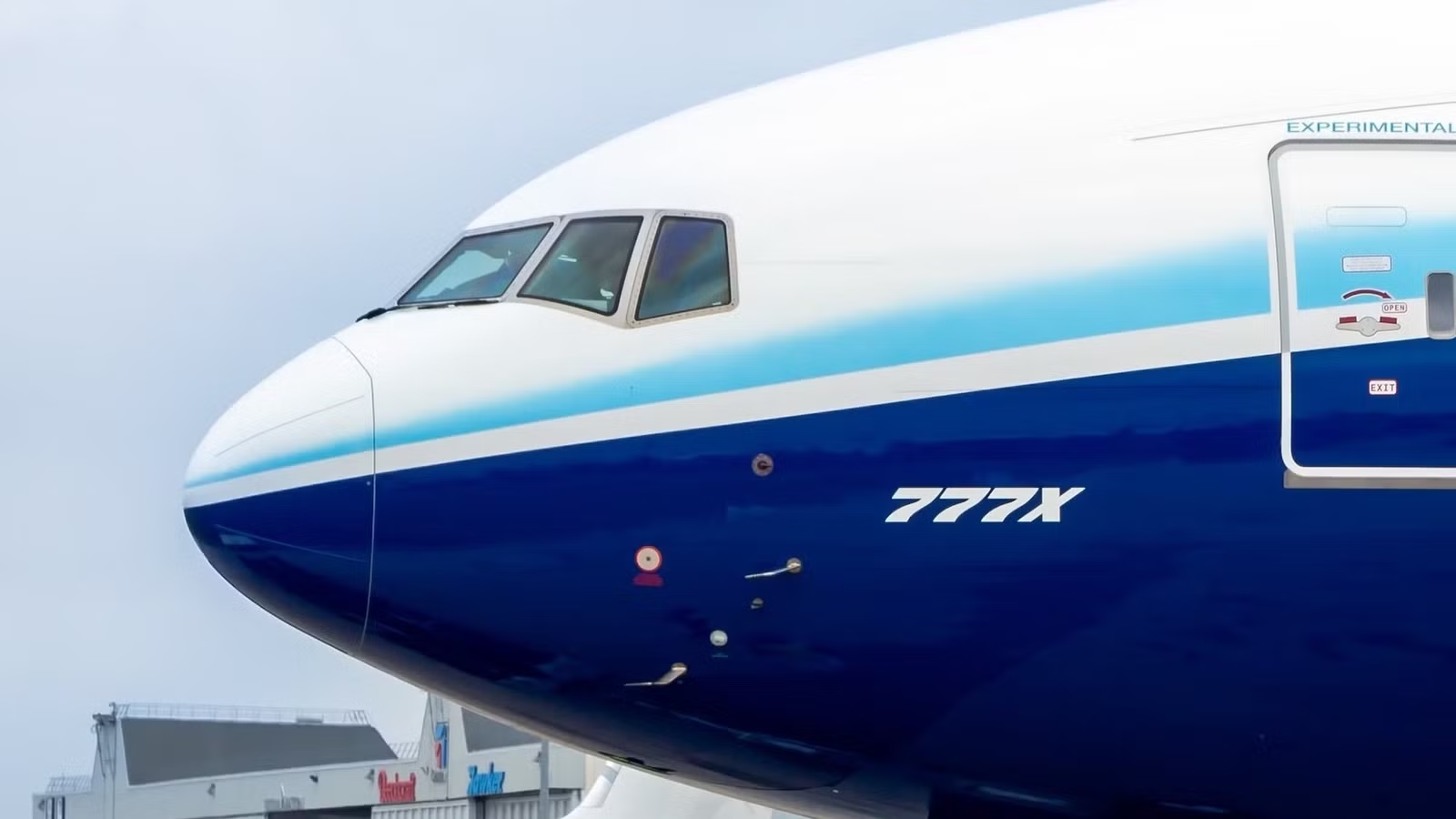
 Boeing has begun wing assembly on the company’s hallmark Boeing 777-8F Freighter, the world’s most capable twin-engine cargo aircraft. This marked a tangible build milestone for the dynamic Boeing 777X freighter program. The company’s first wing spars, each of which was over 100 feet, have now been put together alongside the corresponding skin panels at Boeing’s Composite Wing Center in Everett, Washington. Major assemblies are also progressing at the Japanese program partner, Mitsubishi Heavy Industries.
Japanese manufacturers Kawasaki and Subaru are also involved in the assembly process for the aircraft. This step follows earlier news that Boeing pushed the Boeing 777-8F’s entry into service as far back as 2028, with plans to end Boeing 767 freighter production in 2027, ultimately reshaping the overall near-term widebody cargo landscape.
What Are The Latest Developments

Overall wing assembly is well underway. Boeing has drilled and fabricated the first Boeing 777-8F wing spars at Everett, ultimately kicking off full-scale production of critical composite structures. Boeing’s most recent update, posted via LinkedIn, has indicated that 100-foot spars and concurrent fabrication of wing skins and stringers are well underway. This includes the advancement of other major sections, something consistent with a ramp-up to first deliveries that starts as soon as 2028.
Independent overall trade coverage confirms the overall achievement of this milestone, with reports of shop-floor work and robotic drilling on the initial spar being confirmed. Boeing previously delayed the service entry and production of the Boeing 777-8F to 2028. The manufacturer is also planning to cease Boeing 767F production starting in 2027, ultimately tightening the industry’s replacement pipeline as aging widebody freighters slowly begin to retire. These schedule moves, which are combined with the Boeing 777X’s certification pacing, frame overall risk and urgency around Boeing’s freighter industrial plan.
What Does All Of This Mean For Boeing?

Hitting wing-assembly gates ultimately signals manufacturing maturation on a strategically vital platform. The Boeing 777-8F leverages the composite wings and advanced capabilities of the Boeing 777X family, alongside its advanced GE9X propulsion systems, in order to make steady progress that will help amortize Boeing 777X development across both passenger and cargo variants. This also preserves Boeing’s longstanding leadership in the widebody freighter market, with the Boeing 747-400F, the Boeing 747-8F, and the original Boeing 777F all having a major impact on the industry.
From a commercial perspective, the 2028 entry into service delay compresses the bridge from the Boeing 767F and the Boeing 777F to tomorrow’s Boeing 777-8F, exposing Boeing to near-term risk if airlines and freight integrators begin to pivot towards the more capable Airbus A350F. Across the board, this latest development highlights visible factory milestones that will boost customer confidence and hopefully flow through to more orders.
From a financial standpoint, execution is still a major hurdle. The Boeing 777X’s certification headwinds and any further overall slips could potentially inflate costs. Meeting these production checkpoints, however, could prove rather expensive. The broader cargo market worries about future overall capacity, and it positions Boeing to capture the next upcycle with a high-payload, long-range, and lower-emission flagship freighter aircraft.
What Does All Of This Mean For Passengers?

In an indirect capacity, the freighter process affects passenger travel via the Boeing 777X’s overall ecosystem. The aircraft is definitely not a passenger aircraft, but smooth overall Boeing 777-8F production supports a shared industrial base for the aircraft, with composite wing fabrication, dynamic supply chain, and quality systems used on the passenger version of the Boeing 777X all being shared.
The biggest issue facing Boeing right now is the extensive set of certification delays facing the manufacturer’s latest aircraft families. In the near term, cargo belly space on passenger widebodies will remain a major revenue lever for airlines.
The eventual service introduction of the Boeing 777-8F will improve airlines’ ability to deploy cargo. This ultimately will allow them to generate more revenue from non-passenger operations, giving them more leverage to reduce prices across their passenger lineups.