
ISLAMABAD:
The growth in goods production by big industries slowed down to 4.1% in the first quarter of the current fiscal year as an internal government diagnosis suggests that some of the sectors are facing cost disadvantages up to two-thirds and cannot compete until a just platform is provided to them.
According to the Pakistan Bureau of Statistics (PBS), the pace of output growth in major industries slowed to 4.1% in the July-September quarter. The growth rate was 4.5% during the first two months. Although the output crossed 4% in Q1, still the index could not match the almost three-year-old level of 132.5. In September, the index stood at 114.7, according to PBS.
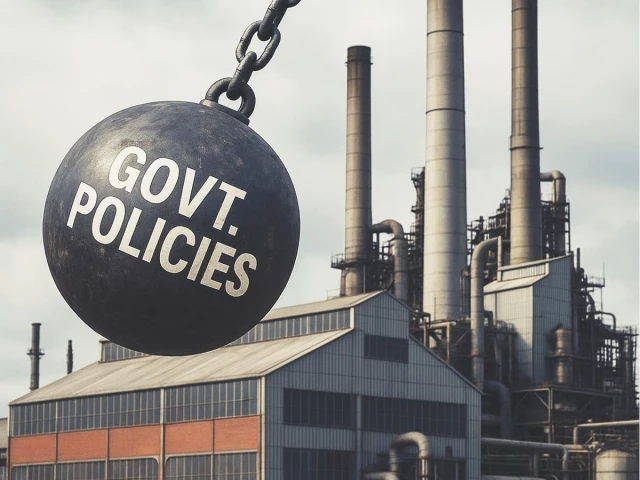
Industries are facing tough conditions, which are not just limited to economic slowdown, political instability and uncertain security conditions. They are facing more challenges because of skewed economic policies than from the political and security environment.
Sources said that the Ministry of Industries had recently conducted an internal analysis of the situation as part of the under-consideration industrial policy. According to the diagnosis, various sectors were facing cost disadvantages in the range of 22% to 67%.
Ceramic tiles and glass production sectors were facing the highest cost disadvantage of more than two-thirds. The cost disadvantage in the steel sector was one-third followed by one-fourth disadvantage in the paper and board sector, according to the Ministry of Industries’ assessment. Because of lopsided policies, the share of large-scale manufacturing in the overall economy has shrunk from 26% to 18% over the past three decades.
Sources said that there were two camps with differing views within the government. The Ministry of Industries-led camp was seeking protection while the other camp was advocating more opening of the economy to enhance export-led growth. According to the Ministry of Industries’ study, while tariff liberalisation incentivises companies to become internationally competitive and opens global markets to them, it does not fix the “structural high costs” faced by them because of government policy and regulation. It has sought major adjustments in taxes, energy policy, regulatory costs and exchange rate.
Prime Minister Shehbaz Sharif has been briefed in recent meetings that if the exchange rate was not allowed to move according to market forces, tariff reduction will erode foreign exchange reserves and prevent exporters from gaining competitive cost advantages.
The Ministry of Industries has proposed the abolition of super tax and a reduction in corporate income tax gradually from 29% to 26% with 1% reduction per year as and when fiscal space is created via enhancing the tax base through better compliance.
The ministry has also proposed an increase in utilisation of the export facilitation scheme, making it binding for banks to justify loan request refusals, and a reduction in interest rate by 5%.
It has recommended reducing the capital adequacy risk weight for medium-sized firms from 75% to 50% and restoring 10% corporate income tax reduction for marginal lending above 20%. However, there are also strong voices within the government that advocate letting uncompetitive industries die down instead of pampering them with fiscal incentives. They argue that overprotection has made it unattractive to focus on enhancing exports.
PBS reported that large-scale manufacturing industries registered only a 2.7% growth in September compared to a year ago. Main contributors to the overall growth of 4.1% were food, tobacco, textile, paper & board sectors.
The Ministry of Finance is of the view that Pakistan’s economy has remained on a recovery path despite flood-related disruptions. Industrial activity remains resilient, supported by a rebound in large-scale manufacturing, particularly in cement, automobile and allied sectors, while exports and remittances are showing steady improvement, it added.
But owing to anti-export biases, skewed taxation, exchange rate and energy policies, exports are struggling again to pick up momentum. According to PBS, exports during July-October dropped 4.04% year-on-year to reach $10.5 billion. However, imports increased 15.13% year-on-year to $23 billion and as a consequence, trade deficit widened 38% to reach $12.6 billion. The increase in trade deficit was driven by a 30.2% decline in food group exports while imports rose 20% on a yearly basis along with a 107% spike in transport group imports.