
When Dr. Jens Eichler started investigating hydrogen economy opportunities for 3M four years ago, many observers were keen about hydrogen’s use in household heating applications. Today, at least 38 different studies say that’s a bad idea for this new industry, but Eichler’s team had a strategic lens that had already moved it to more fertile ground.
While competitors may often chase obvious applications, 3M’s approach to new ventures reveals a more nuanced playbook: architect entire industries by understanding when and where markets will actually materialize, not just which technologies might enable them. This involves deeply understanding customers and markets.
The distinction matters more than most companies realize. As I explored in my book Capturing New Markets, firms repeatedly stumble by pushing technology into markets rather than solving well-defined customer problems. Eichler, who transitioned from 3M’s corporate lab to lead its Hydrogen Economy work within the company’s new growth ventures, embodies this shift in orientation. “I found it more insightful to try to understand where the challenges are and then help with 3M technologies to solve those challenges,” he explains.
The When-and-Where Framework
3M’s entry into hydrogen economy ventures began with two deceptively simple questions: when and where. This framing avoids the fatal attraction of defining markets by current product categories. It’s sometimes called the bowling alley trap. Just as bowling equipment makers once defined their competition narrowly and missed the broader leisure activities market, companies entering nascent industries often define opportunities around existing technologies rather than latent needs.

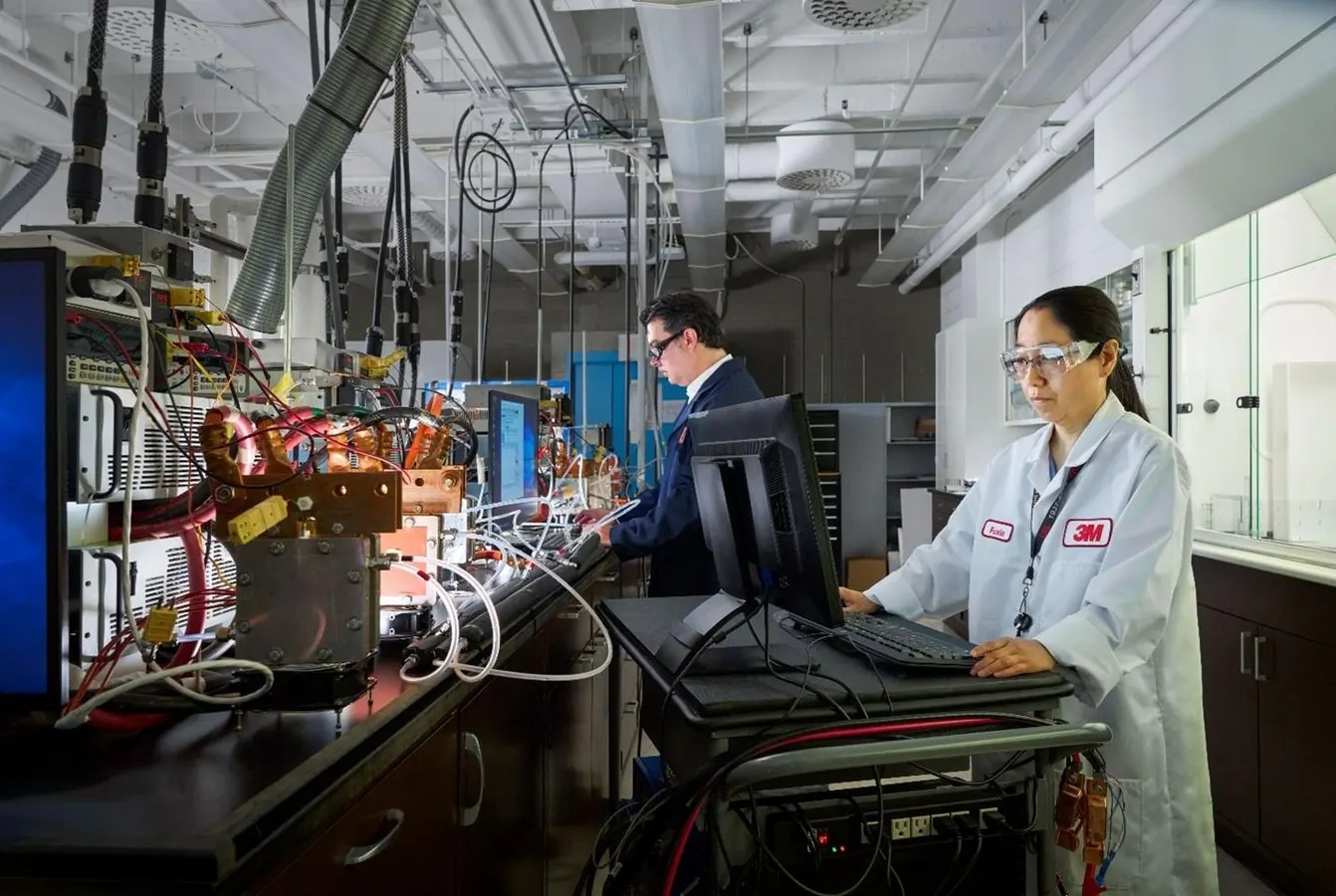
A 3M hydrogen technology lab
3M
Consider 3M’s work on iridium catalysts for proton exchange membrane electrolyzers. The constraint isn’t just technical; it’s geological. Iridium remains so rare that scaling Proton Exchange Membrane electrolyzer production to projected levels would exhaust the world’s available supply. 3M’s response wasn’t to abandon the technology but to architect a solution that addresses the boundary condition itself. It developed catalyst forms that achieve equivalent performance with dramatically less material. This exemplifies the sequencing of risks — tackling the most fundamental constraints first rather than optimizing around assumptions that may prove unsustainable.
The “where” question led Eichler’s team to another insight about manufacturing automation. Drawing on automotive industry experience, he recognized that moving from manual to robotic assembly would cascade through the entire electrolyzer value chain. It would change designs, processes, and material requirements. Rather than wait for this transition, 3M is developing adhesives and sealants specifically engineered for automated assembly. The company is helping to shape how this new market will actually function.
The 15% Culture Advantage
This kind of anticipatory architecture also demands an organizational culture that enables pattern recognition across disciplinary boundaries. 3M’s famous 15% culture, which allows technical staff to pursue passion projects with up to 15% of their time, serves a function that many observers miss. It’s not primarily about generating breakthrough inventions. It’s about building the connective tissue that enables an organization to spot opportunities at the intersections of technologies and market needs.
“Just having 15% culture is not enough,” Eichler notes. “You need our Tech Forum, for example.” This internal community of scientists and engineers creates what sociologists call “weak ties” — the loose connections between people in different specialties that often prove more valuable for innovation than close working relationships. The multilayer optical films that now enhance screen brightness across billions of LCD devices originated when two colleagues happened to have adjacent posters at a Tech Forum event. They weren’t assigned to collaborate. The infrastructure simply made serendipitous connections more likely.
Critically, 15% culture operates on self-empowerment rather than permission. When colleagues from other divisions approach Eichler about hydrogen economy opportunities, he doesn’t need to route requests through bureaucratic approval processes. If someone is passionate about a topic and it serves 3M’s interests, they can contribute their 15% time. This removes the friction that typically prevents large organizations from moving quickly on emerging opportunities.
The culture also addresses a frequent problem: specialists becoming so focused on their domains that they miss market-shaping developments. By encouraging exploration beyond core assignments, 3M prevents the tunnel vision that leaves companies vulnerable to disruption. Manufacturing engineers explore new process improvements. IT professionals tackle problems outside their job descriptions. The boundaries remain permeable.
Avoiding the Valley of Death
Perhaps the most telling aspect of 3M’s approach emerges in how Eichler thinks about failure. When ventures don’t succeed, he doesn’t primarily attribute problems to execution issues or market timing. Instead, he looks for patterns: “There’s things I should have taken a closer look at. I had this feeling in the back of my head.” Now in hydrogen ventures, he’s applying lessons from past programs, examining supply chain vulnerabilities much earlier, for instance, because he knows from experience how quickly such issues can derail commercialization.
This reflects what I call the “country road” approach to new markets, proceeding through territory without well-marked paths by staying alert to emerging opportunities and obstacles rather than following a predetermined route. Unlike established markets where companies can rely on historical data and proven playbooks, nascent industries require constant adjustment based on weak signals.
Consider Eichler’s example of thermocouple protection sheaths his team once developed. They created a superior product — more durable, longer-lasting ceramic materials. But they discovered that plant managers, who rotated positions every few years, had little incentive to invest in longevity beyond their tenure. The market existed, the technology worked, yet the business case did not fully materialize because they underestimated the actual decision-making dynamics.
These are the insights that only emerge through deep customer engagement, not just laboratory work.
The Class Six Challenge
Eichler describes hydrogen economy ventures as “class six” programs — not just new products for new markets, but new products for markets still finding themselves. This adds profound complexity because there’s no stable reference point. The industry itself doesn’t yet know its own structure, economics, or key players. Recent regulatory shifts from the EU demonstrate how even definitions of “green” hydrogen remain contested, making long-term planning treacherous.
Yet this ambiguity also creates opportunity for those who architect rather than merely participate. By focusing first on lowering the cost of hydrogen generation, 3M positions itself at a leverage point rather than spreading resources across the entire value chain. As costs decline and applications emerge (like Infineon’s recent electrolyzer deployment for chip production), 3M’s early positioning in critical constraint areas like catalyst efficiency and automated assembly pays compound returns.
The lesson extends beyond 3M or hydrogen. When entering nascent industries, the temptation is to hedge across multiple applications or technologies. What’s best is to identify which constraints will genuinely shape how the industry unfolds, then architect solutions that address those constraints in ways that become increasingly valuable as the market matures. That requires patience, deep customer engagement, and an organizational culture that connects specialists across boundaries.
It’s good to have breakthrough technologies. It’s even better to have the organizational infrastructure to architect new industries by recognizing which technologies matter and when.