
Welcome to Energy Source, coming to you from New York.
Donald Trump arrived in Tokyo on Monday and praised the “great friendship” between the US and Japan before his talks with the country’s prime minister. But all eyes will be on the US president’s summit with Chinese leader Xi Jinping later this week as he is expected to discuss China’s export controls on rare earths that western companies have warned could lead to broken supply chains and higher prices for chips, cars and weapons.
Access to critical minerals has been a chief concern of the US. Trump on Sunday struck trade and mineral agreements with Malaysia and Cambodia.
Europe is also focusing on securing critical minerals as it aims to reduce its reliance on China for materials needed for defence and clean technology. My colleagues Alice Hancock and Camilla Hodgson reported that Brussels will launch a consultation on stockpiling minerals by the end of the year in order to diversify Europe’s supply chain away from foreign sources.
In today’s Energy Source we have an exclusive report on Honeywell, which is unveiling new technology to help decarbonise heavy industries like maritime shipping. In our second item, Camilla takes us beneath the earth’s surface to a zinc mine in Sweden, where a group of daring runners recently took part in the “world’s deepest marathon”.
Thanks for reading — Alexandra
Honeywell tech could boost maritime decarbonisation drive
Honeywell is launching a new technology that can convert forest and agricultural waste to a lower carbon fuel that could directly replace the carbon-intensive fuel oil used by large ships, helping the maritime and other heavy industries decarbonise.
The US industrial group told Energy Source that the “biocrude upgrading technology” can use biomass, which includes agricultural waste, to create a range of renewable fuels including, sustainable aviation fuel, gasoline, diesel and marine fuel.
Honeywell’s new technology could be a game-changer for the maritime industry. It can produce a direct replacement to heavy fuel oil since it has a high enough energy density to power ships on long voyages around the world.
Ken West, president and chief executive of Honeywell Energy and Sustainability Solutions, told Energy Source that the fuel is compatible with existing engines and can utilise a wide range of biomass feedstocks.
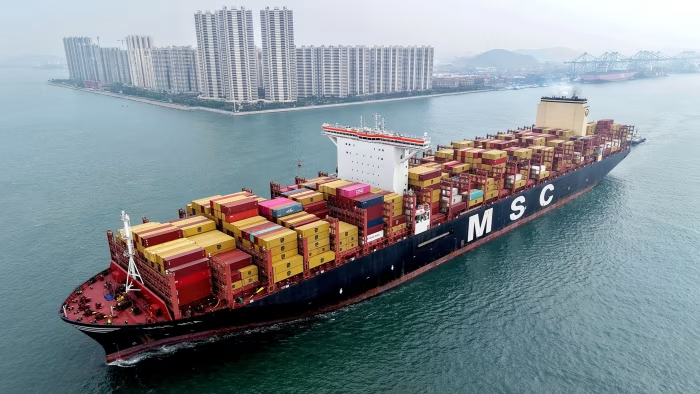
The announcement comes as the shipping industry faces growing pressure to decarbonise. According to the Rocky Mountain Institute, shipping is responsible for 3 per cent of global greenhouse gas emissions and is reliant on one of the dirtiest fuels: heavy fuel oil.
The industry is working towards decarbonisation and the International Maritime Organization has said it aims to achieve net zero greenhouse gas emissions by or around 2050.
Danish shipping company Maersk, which operates in almost 130 countries, hopes to reach net zero greenhouse gas emissions by 2040. CMA CGM, a French shipping company, plans to reduce its greenhouse gas emissions by 30 per cent by 2030 and 80 per cent by 2040.
Honeywell Energy’s West added that the fuel can help ship owners meet guidelines for reducing carbon emissions because it does not require them to commit to major capital upgrades in order to decarbonise.
Shipping is a global business and fleets typically refuel at ports across the world, making acquiring sustainable fuels at ports in a variety of countries crucial.
“Biomass can be found in many different areas and we can use this technology particularly in countries that may not have access to fossil fuels or may not have access to other forms of renewable power,” West said. “I think we’re going to have customers that are truly going to be global.”
Still, cost remains a barrier for the maritime sector’s transition to renewable fuel. Pure biofuel is about $1,100 to $1,300 a ton, which is roughly 2 to 2.5 times the cost of fuel oil, according to Aparajit Pandey, a principal in the Rocky Mountain Institute’s climate-aligned industries group. He added that as biofuel becomes more popular, the jump in demand could also raise prices.
“Any fuel for maritime is going to be expensive. This is a fuel that is going to be pretty expensive to start off with and will get more expensive over time,” he said.
Biomass is also not abundantly available and some experts have warned that unsustainable management of this resource could lead to deforestation and biodiversity loss.
Still, West at Honeywell Energy said that renewable fuel would not necessarily replace other energy sources but would be simply an addition.
“We’re going to require biomass . . . and we’re going to require transition technologies like liquefied natural gas,” he said. “We know the world needs more energy tomorrow than it needs today. And that’s going to take a number of different technologies to get there.” (Alexandra White)
Zinc mine hosts the ‘world’s deepest marathon’
Dozens of runners from around the world descended 1,120 meters below sea level at the weekend to run what is expected to be confirmed as the world’s deepest marathon.
The race, held in Swedish mining group Boliden’s Garpenberg zinc mine, saw 55 people don high-vis T-shirts, helmets and head torches and run for hours around a 4km circuit in near darkness in the hope of raising more than $1mn for charity.
The runners — including Boliden chief executive Mikael Staffas, Rohitesh Dhawan, the chief executive of the International Council on Mining and Metals, and Jonathan Price, the boss of Canadian miner Teck Resources — endured subterranean temperatures in the mid 20s Celsius and high humidity.

“Without the head torch, you wouldn’t have seen anything,” said Staffas, who successfully completed the race alongside the other 54 runners.
The circuit was located in the lower part of the zinc mine, in an “exploration drift”, a tunnel built for underground drilling teams to explore the earth and rock further below them.
Getting there required taking a lift down 1km — an ear-popping two-minute journey — and then a 10-minute underground minibus to the race’s starting line.
The slowest runner completed the race in under eight hours, with regular marathon runners saying the challenging conditions added about an hour to their normal times.
“I’ve run 15 marathons and this was by far the hardest,” said Dhawan. “You go through every emotion. You go to a pretty dark place because you’re alone with your thoughts in a dark tunnel.” But he added that it had been a “once in a lifetime” experience.
About $570,000 has been raised so far for the BecomingX Foundation, an educational charity, and Wild at Heart Foundation, which aims to reduce the world’s stray dog population. (Camilla Hodgson)
Power Points
-
NextEra has agreed to reopen a nuclear power station in Iowa that will primarily provide power to Google as the tech giant races to secure clean energy to drive its AI data centres.
-
TotalEnergies is ready to restart a $20bn liquefied natural gas plant in Mozambique, after it was forced to pause the project after a terrorist attack in 2021.
-
Nigerian billionaire Aliko Dangote plans to expand capacity at his refinery in Lagos that could rival Reliance Industries’ refinery in India as the biggest in the world.
Energy Source is written and edited by Jamie Smyth, Martha Muir, Alexandra White, Kristina Shevory, Tom Wilson, Rachel Millard and Malcolm Moore, with support from the FT’s global team of reporters. Reach us at energy.source@ft.com and follow us on X at @FTEnergy. Catch up on past editions of the newsletter here.
Recommended newsletters for you
Moral Money — Our unmissable newsletter on socially responsible business, sustainable finance and more. Sign up here
The Climate Graphic: Explained — Understanding the most important climate data of the week. Sign up here