
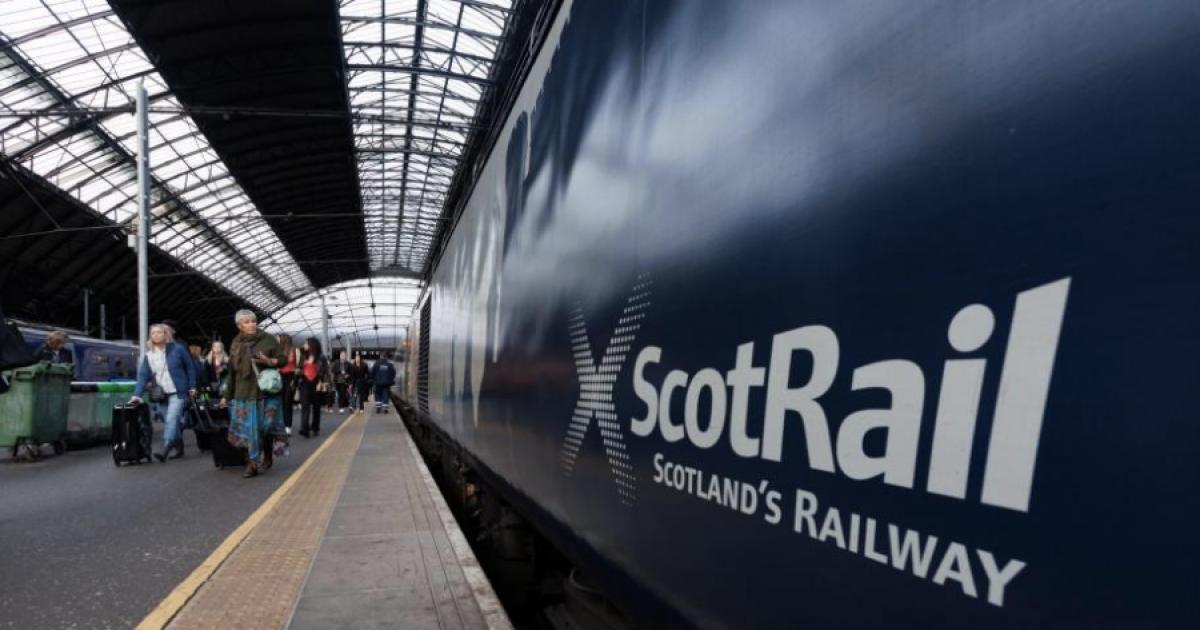
Gerry and Debbie Hilferty, who established Brodie in 1996, praised the support they have received from Porterbrook since it acquired a 49% stake in the company in early 2024. Since then, headcount at Brodie, which operates from two sites on either side of the Kilmarnock railway line, has nearly doubled to 150 from 80, and it has been able to access new streams of work through its association with Porterbrook.
Brodie specialises in maintaining, refurbishing and overhauling passenger and freight trains for the likes of ScotRail and Northern Rail.
Read more:
Mr Helferty, a rail industry veteran who began his career with British Rail nearly 40 years ago, declared the Porterbrook deal has been an “absolute game-changer” for his company, noting that it has been “definitely instrumental in the growth” Brodie is now experiencing.
“That has given us a springboard,” he told The Herald. “It is not all of our work, Porterbrook do work for other train operating companies, light rail, freight, so we have a diverse order book.
“Porterbrook are able to provide a very stable base layer of work, which gives us a lot of confidence, which is really good for recruitment and retention [of employees] as well.
“It is an absolute game-changer and it is so important for security and confidence.”
But life at Brodie is not without its challenges. Ms Hilferty stated that recruitment is the “biggest issue” facing the company.
“We struggle for certain trades to get college positions for the apprentices,” Ms Hilferty said, highlighting measures taken by Brodie to establish its own courses on site. “The one we are doing just now for painting is ground-breaking, because we just couldn’t find anywhere that could do the one-day a week training, based at work. They come to us and assess [apprentices] on site because we just could not get it anywhere. Not for all the apprentices, just for certain ones. We struggled for welding.”
I continued to follow events at M Squared Lasers in November and broke the news that its intellectual property and certain other assets had been sold to a new company that includes a co-founder and boss of the failed Glasgow technology business.
Alistair McAlinden and Geoff Jacobs of Interpath, who were appointed joint administrators of M Squared Lasers on August 27, have completed the sale of the assets to Novacene Photonics Limited for an undisclosed sum. It came around two and a half months after M Squared collapsed into administration with a total creditor deficiency of £64 million.
Documents at Companies House show that Graeme Malcolm, co-founder and former chief executive of M Squared Lasers, was appointed a director of Glasgow-based Novacene Photonics on November 4. The business is described on the Companies House website as being involved in the manufacture of optical precision instruments.
Novacene Photonics was incorporated at Companies House on September 4, with Nils Hempler, a former chief operating officer of M Squared Lasers, registered as its first director. It was one of three new companies set up by Mr Hempler on that date, alongside Novacene Technologies and Novacene Quantum, as previously reported by The Herald. Mr Malcolm is not listed as a director of Novacene Technologies or Novacene Quantum.
Mr Jacobs said: “Following a wide-ranging post-appointment marketing exercise, we are pleased to have secured a sale of M Squared’s intellectual property and certain other assets to Novacene Photonics Limited. The company’s intellectual property assets in particular attracted interest from a variety of parties.
“We wish Novacene well for the future and hope to see the business develop and potentially provide future opportunities for the former customers and suppliers of M Squared.”
On a lighter note, I used one of my Business Voices columns in November to reflect on Scotland’s astonishing qualification for the World Cup next year and the potential impact it could have on hard-pressed businesses.
The piece stated: “When captain Andy Robertson & co make the trip across the Atlantic next summer, I would wager that the World Cup will not have seen anything like it. Who knows, Molson Coors and Budweiser might even be ripping up the sales forecasts and ramping up production cycles; it’s going to be boomtime for the brewing business.
“Yet, it is not only fans of the Scotland team, which last qualified for a World Cup in 1998, and company executives across the Pond who will be licking their lips in anticipation of next year’s jamboree. The successful qualification of Steve Clarke’s men for the greatest sports show on earth has given a timely boost to the morale of a nation fatigued by years of political rowing and a crushing cost of living crisis. And businesses which have seen morale sapped by surging costs, flawed policy-making, the coronavirus pandemic and flatlining consumer confidence can begin to look forward to capitalising on an event that so many will be eagerly anticipating. The timing could scarcely be better.”