
For all the talk of a hyperconnected world, the industries shaping how societies communicate rarely occupy the same space. Media, entertainment, gaming, technology, and fast-growing digital platforms are advancing at a pace unthinkable a decade ago. Yet their growth has created a paradox: a world overflowing with content but increasingly short on coherence.
More platforms mean more choice, but less orientation, and audiences feel this first. A political speech appears as a live broadcast, a meme, a short video, and an AI-generated summary. A song goes viral in a game long before reaching traditional channels. Recommendation engines shape what millions see. Innovation is plentiful, but increasingly layered with noise.
For the industries behind this ecosystem, fragmentation is even more pronounced. Declining trust in news, unstable streaming models, social media volatility, and algorithm-driven churn have pushed each sector to respond in isolation. In India—one of the world’s largest and most diverse media markets—these pressures are sharply visible, from newsroom battles with disinformation to debates over platform governance.
So, in a world full of walls, the United Arab Emirates chooses to build a bridge—one designed for ideas, industries, and the future of the global content economy.
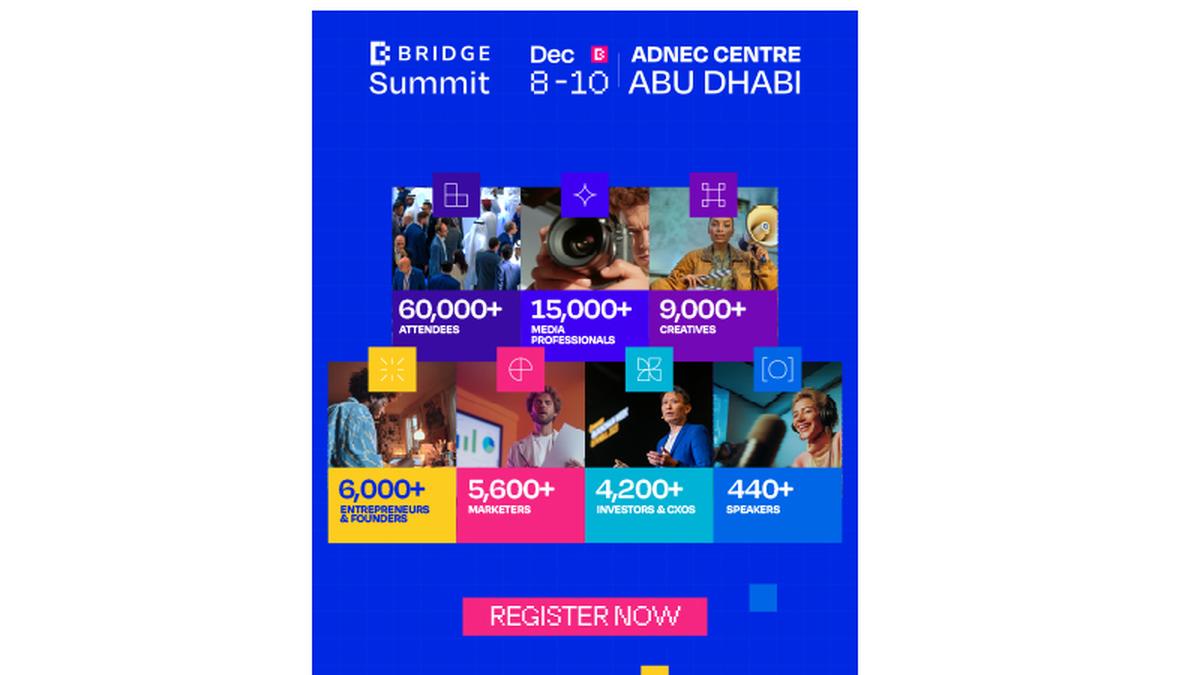
It is into this fragmented environment that BRIDGE Summit 2025 is being introduced. Abu Dhabi’s brainchild and described as the ‘largest debut media gathering in the world’, the Summit attempts to bring together fields that rarely sit at the same table despite shaping global culture in overlapping ways. From 8–10 December at ADNEC, the gathering will welcome 60,000 participants from 132 countries, including 1,200 CEOs, 260 advertising agencies, and nearly 5,000 media professionals across more than 300 sessions.
Its proposition is simple: if the future of influence emerges where industries intersect, those intersections need a platform.
A global media landscape in transition
For more than a century, media sectors evolved separately—journalism, cinema, music, gaming, advertising, academia. That architecture no longer holds. Information now flows across categories with unprecedented fluidity. This convergence brings opportunity but also exposes profound disparities, particularly in the Global South, where innovation outpaces regulation and digital access remains uneven.
BRIDGE positions itself as a space to examine these shifts collectively; not as a festival or trade fair, but as a long-term architecture for collaboration.
Also, trust in news is declining. Streaming models face uncertainty. Social networks and short-form video have transformed attention. Artificial intelligence is reshaping authorship, verification, and intellectual property. These pressures vary across markets, and India, despite its vast digital audience, continues to grapple with affordability, governance, and representation.
BRIDGE does not claim to solve these challenges. It offers something increasingly rare: a venue for policymakers, technologists, creators, investors, and cultural institutions to examine them together.
An ecosystem, not an event
BRIDGE operates as a multi-layered ecosystem, offering co-production labs, regulatory exchanges, research partnerships, and accelerators for frontier innovation, and the Summit is the most visible expression of this architecture. With more than 150 companies selected amongst 1,000 applicants, and over 100 startups working across AI, immersive media, cultural tech, and next-generation storytelling, it provides a working model of what a converging content economy might look like in practice.
Seven tracks for a more connected media future and a shared content economy
Organized into seven tracks—Media, Music, Picture, Gaming, Technology, Marketing, and the Creator Economy—the Summit encourages sector-crossing conversations. AI researchers study impacts on filmmaking and fact-checking. Musicians explore platform logic and discovery. Gaming studios examine narrative behaviour. Marketers explore trust in an algorithmic era.
Across these intersections the one truth that emerges is this: content is no longer the product of separate industries but the connective tissue of the global digital economy. And, BRIDGE Summit’s design reflects this philosophy.
News labs sit adjacent to AI studios. Creator hubs share space with gaming environments. Policy dialogues unfold alongside workshops on machine learning, immersive narratives, and audience intelligence.
An early step, not a definitive answer
While no single platform can resolve global media fragmentation, BRIDGE offers a reference point: a vocabulary, a structure, and an environment where shared thinking can begin.
As ideas move faster than regulation and audiences shift across platforms in real time, coherence will not come from any one institution. It will emerge at intersections—where industries choose to meet rather than drift apart.
BRIDGE Summit 2025 is one of those intersections. A bridge may not be the destination, but it reshapes what becomes reachable—and who can reach it together.
Further details are available at worldmediabridge.com.

“This article is part of the sponsored content programme.”
Published – December 01, 2025 02:35 pm IST