
Drones reportedly struck the Novokuibyshevsk Oil Refinery in Russia’s Samara region, as well as the Luch Thermal Power Plant in Belgorod, also causing temporary airfield closures and restricted flight operations at airports across the country’s southwest.
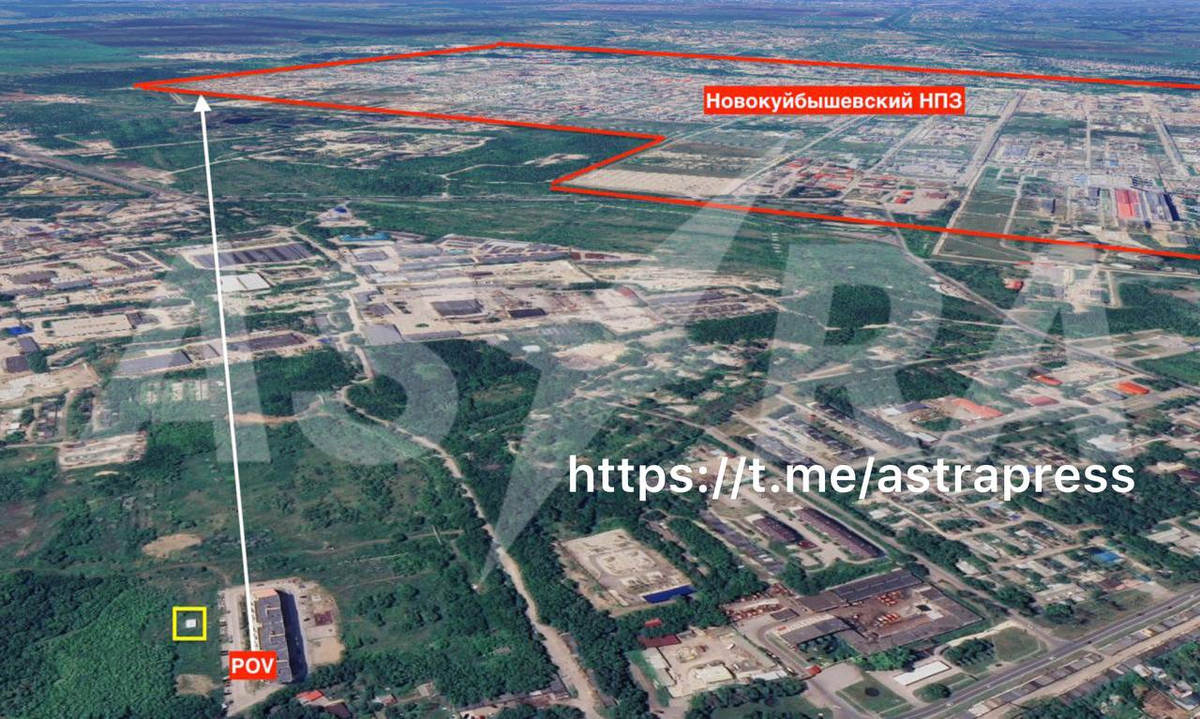
According to the Russian Telegram channel Astra, analysis of eyewitness videos shows that several flashes seen early on Nov. 27 occurred directly above the Novokuibyshevsk refinery.
JOIN US ON TELEGRAM
Follow our coverage of the war on the @Kyivpost_official.
Footage filmed from Michurin Street captures at least three explosions: one at an altitude of roughly 1.5 kilometers, another likely caused by air defense south of the refinery, and a final bright flash on the refinery grounds themselves.
The blast site was more than 3.5 kilometers from the filming location.
Local authorities have not commented on the incident.
Following the latest strike, Rosaviatsiya temporarily closed the airports in Samara, Penza, and Saratov, while airports in Krasnodar and Sochi imposed restrictions on takeoffs and landings.
Astra also reported, citing the Pepel Telegram channel, that the Luch Thermal Power Plant in Belgorod was damaged in a missile strike, leaving 20 apartment buildings without heat.
There has been no official confirmation, though Belgorod Governor Vyacheslav Gladkov noted that “energy facilities” were hit and that the extent of the damage is still being assessed.
Russia’s Defense Ministry claimed its air defense systems intercepted and destroyed 118 Ukrainian fixed-wing drones between 11 p.m. (20:00 UTC) on Nov. 26 and 8.30 p.m. (17:30 UTC) on Nov. 27, including 52 over Belgorod and 18 over Samara.
Other Topics of Interest
US Negotiator to Europeans: Russia Amassing Missiles Faster Than It Fires Them
Driscoll warned European diplomats that Russia is stockpiling long-range missiles, a growing threat Washington says adds urgency to reaching a settlement.
Another 18 drones were reportedly downed between 8.30 a.m. (05:30 UTC) and noon (09:00 UTC) on Nov. 27.
Ukraine has not confirmed responsibility for the attacks.
The Novokuibyshevsk refinery, part of the Rosneft Oil Company, has been repeatedly targeted by Ukrainian drones. The refinery had already been attacked on Nov. 16 and Oct. 19.
Ukraine’s General Staff reported that in the early hours of Oct. 19 the plant, which produces more than 20 types of commercial products and has an annual processing capacity of 4.9 million tons, experienced explosions and a fire.
Preliminary assessments suggest damage to its primary oil processing units (ELOU-AVT).
“The facility is involved in supplying the Russian military,” the General Staff said.
In September, this refinery briefly suspended operations due to infrastructure damage. In August, another strike damaged the atmospheric column of its AVT-11 unit, halting production.
Since early November, Ukrainian drones have disrupted at least three other Russian refineries, along with the Sheskharis oil-loading terminal in Novorossiysk, which resumed operations a few days after the attack.
Rosneft’s Saratov refinery shut down completely on Nov. 11 and is unlikely to restart before December. Lukoil’s Volgograd refinery was damaged on Nov. 6, and Rosneft’s Tuapse plant stopped processing on Nov. 3.
Ukraine has intensified strikes on Russian oil and gas infrastructure since August, forcing about 38% of Russia’s refineries offline by early October.
The resulting disruptions have triggered fuel shortages across the country, pushing Moscow to restrict gasoline and diesel sales and import supplies from Belarus, China, and other Asian states.
According to Rosstat, fuel prices rose 2.6% in September – the sharpest monthly increase since 2018 – while annual inflation hit 12.7%, the highest in 14 years.