
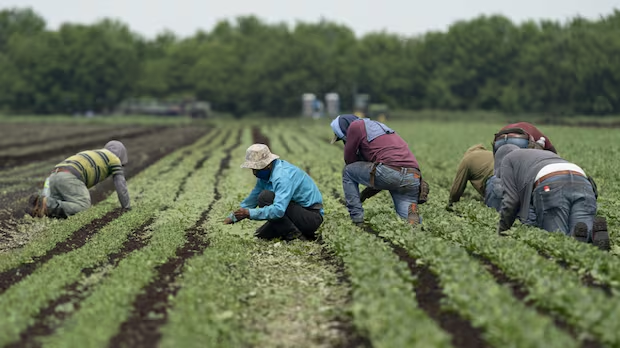
For years, the faces behind Prince Edward Island’s food industries have increasingly come from far beyond the Island’s shores.
Many are temporary foreign workers: people who come to Canada for a set period of time, often to fill jobs in sectors facing labour shortages.
On P.E.I., up to 20 per cent of the province’s agriculture workforce is made up of people from other countries, said Donald Killorn, executive director of the P.E.I. Federation of Agriculture. These workers help operate farms, manage production and harvest crops.
“Without that labour… it wouldn’t be possible for Prince Edward Island farmers to do the things they need to do to farm the land,” Killorn told CBC News.

The federal Temporary Foreign Worker Program, which began half a century ago, was originally designed to address short-term labour shortages in agriculture — but economists say it has expanded well beyond its original scope.
Prime Minister Mark Carney’s first budget, which passed earlier this month, includes plans to scale the program back, with significant reductions to the number of temporary foreign workers admitted to Canada over the next three years.
Still, experts say the program’s expansion has already impacted Canada’s labour market, raising questions about whether the reliance on foreign workers benefits the broader economy, especially as unemployment rates rise.
“I think we’re becoming reliant on temporary migration in general to fill these jobs,” said Christopher Worswick, an economics professor at Carleton University who has researched the program.
“I can’t say that it’s causing the high youth unemployment we’re experiencing in Canada but, coincidentally, we have very high youth unemployment.”
Local labour alone can’t fill the gaps, industries say
On P.E.I., Killorn said local hiring remains a priority, but the scale of the province’s food production far exceeds the available labour pool.
“We produce so much food on Prince Edward Island, it’s difficult to fathom how much,” he said.
“We’re always interested in strategies that grow the local workforce. It is a key part of building a resilient agriculture industry on Prince Edward Island…. But the fact is, with the amount of work that we’re doing in agriculture, we do require an alternate labour source from just Prince Edward Islanders.”
It’s not just farms.
P.E.I.’s seafood processing sector has also depended on temporary foreign workers for more than 15 years, according to the Prince Edward Island Seafood Processors Association.
Today, those workers account for 35 to 40 per cent of the industry’s labour force, which consists of more than 2,000 people on a seasonal basis, said executive director Bob Creed.
“Without our valued temporary foreign workers, there would be no seafood processing sector in P.E.I. in 2025,” he said.

Creed added that aging demographics, shrinking rural populations and shifting career preferences have made it difficult to attract local workers.
“Not everybody wants to do labour work. Not everybody goes to school to do labour work… and we respect that.”
From a policy perspective, we should be doing what’s best for the country, not what’s best for companies.– Christopher Worswick, Carleton University
Worswick said a case can be made for the agricultural stream of the program, as many of those jobs are in remote rural areas, seasonal and hard to fill. But the program’s expansion into other sectors has raised concerns.
He said the program broadened under the Stephen Harper government and continued after that, extending to other businesses struggling to find workers, like restaurants.
That trend is evident on P.E.I.
A decade ago, about 65 people held work permits under the TFW program for jobs in retail and food services, making up roughly 15 per cent of all permit holders on the Island at the time, according to Statistics Canada.
By the end of 2024, that number had climbed to around 535 workers, accounting for more than one-third of all TFW permit holders in the province. The biggest increases were in kitchen-related jobs like cooks, food counter attendants and kitchen helpers.
Wage impacts
Worswick said this growing reliance on temporary workers can have long-term consequences, including wage suppression.
He pointed to a hypothetical employer struggling to fill positions at a posted wage. Normally, they would face three options: advertise the job at higher wages, invest in technology to reduce their need for labour, or even shut down entirely.

The TFW program adds a fourth option: hire workers from lower-wage countries who are willing to work for the posted rate.
“It might actually lower wages over time if employers realize that the failed [local] search means that they can hire temporary foreign workers instead,” Worswick said.
“I think there’s reasons to think that firms are pursuing their own for-profit motive, which I have no problem with. I’m an economist. I’m not against profit motives. But from a policy perspective, we should be doing what’s best for the country, not what’s best for companies.”
Worswick added that because temporary foreign workers are typically tied to a single employer through closed work permits, they are often less likely to complain about working conditions or leave their jobs for fear of being sent home or jeopardizing future opportunities for permanent residency.
Island Morning8:32Advocate wants to see more protection for temporary foreign workers
The province is set to implement better protections for temporary foreign workers on April 1, but advocates like Joe Byrne say the new act should have been proclaimed long ago. Byrne shares what he’s learned through working with the Cooper Institute.
But both Creed and Killorn noted many migrant workers return to P.E.I. year after year and maintain strong relationships with their employers. Many have gained permanent residency, while others are working toward it with employer support.
“There’s been very few instances on Prince Edward Island where we’ve seen any abuses of the system at all. And those instances… have been identified and investigated and charges have been brought against those that abuse the system,” Killorn said.
‘The people just aren’t there’
Worswick said some research suggests that when low-wage labour is readily available, companies may invest less in technology — even if those investments could lead to higher productivity, stronger economic growth and better-paid, higher-skilled jobs for workers.
But industry leaders on P.E.I. say that’s not what’s happening here.
Creed said seafood processors have made major investments in technology and automation, from machines used in mussel harvesting to modern lobster processing equipment.
“We are processing more volumes than we ever have in the past, most years with less people,” he said.
“We’re doing that because of the investments that have been made into our processing facilities.”

Still, he said, the need for labour remains.
“The people just aren’t there.”
He said wages continue to rise as much as businesses can afford, while federal supports like the Atlantic Fisheries Fund have helped companies innovate. He hopes to see more such initiatives implemented in the future.
Killorn said the agricultural sector also needs continued investment and access to funds to modernize and remain competitive.
“We want our farmers to have access to capital, and we advocate with our government, provincial and federally, to make capital available to our farmers so that they can invest in their businesses,” he said.
A different path forward?
Worswick believes the whole TFW program should be replaced with smaller, targeted programs focused on specialized and genuinely hard-to-fill jobs.
He said there’s currently a stream of the program where companies can bring in highly skilled, high-wage global talent. He said this can be a standalone program.
He added there should also be a separate agricultural program to continue addressing the labour needs in that sector.

Canada’s seafood-processing sector is still dealing with China’s new tariffs. And as CBC’s Sheehan Desjardins reports, the impact is trickling down to temporary foreign workers on P.E.I.
Killorn agrees.
“We want to see governments take real steps to separate agriculture from the larger pool, and there may be other industries that need the same treatment,” he said.
Creed said seafood processors are ready to work with Ottawa to improve the system, but getting rid of the program is not an option.
“It’s an industry that’s the very fabric of P.E.I.,” he said. “People don’t come to P.E.I. to see buildings. They come to P.E.I. to see the vistas of the farmers’ fields, the fishing boats in the harbour, the people working in these sectors, the mussel [and] the oyster operations, fishers….
“Without a program, quite frankly, there is no industry to operate.”