
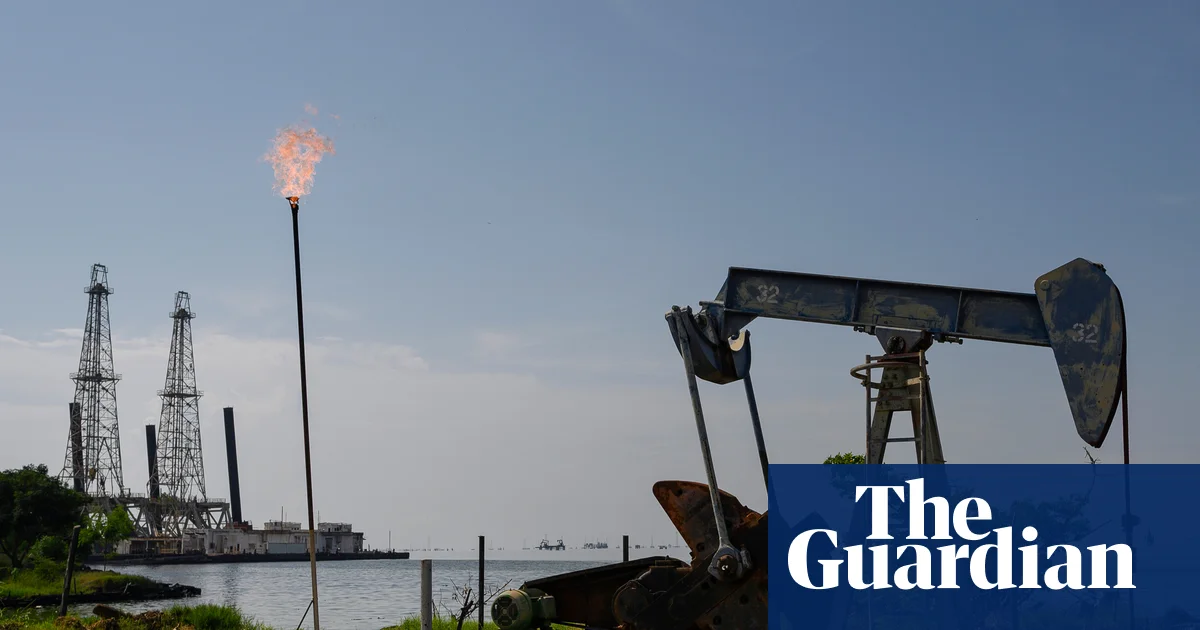
Clustered along the US Gulf coast are some of the largest and most complex heavy-oil refineries in the world. These sprawling industrial hubs, owned by major US oil companies, stand ready to emerge as some of the major victors of Donald Trump’s swoop on Venezuela.
In some ways, these refineries are a relic of another time; built to process the heavy, unctuous crude imported from Latin America before the boom in lighter US shale oil emerged earlier this century.
Venezuelan oil is particularly dense and sticky. The high-sulphur crude more closely resembles a semi-solid tar than the far clearer liquids produced in US shale heartlands, making it more difficult to extract and process into gasoline, diesel, jet fuel and feedstock for the chemicals industry. But it is exactly what many refineries in the US were built to treat.
As a result, the US remains a major importer of crude to feed its refineries, despite being one of the biggest oil exporters in the world. Access to Venezuelan crude at an attractive price could play an important role in sating Trump’s appetite for cheap energy to fuel the “reindustrialisation” of the US economy.
“Most of Venezuela’s crude supply is heavy, sour oil, which if you’re a US refiner is one of the most ideal grades of crude you could ask for,” said Janiv Shah, a vice-president at Rystad Energy, a global consultancy.
“At the moment, US refineries import heavy crude into the Gulf states via pipeline from Canada and there are also heavy crude options from Colombia and Mexico. But securing Venezuelan crude would be in addition to these, and the geographic proximity of Venezuela helps too.”
It could help to safeguard the US oil industry, which has struggled despite support from the White House against the steepest decline in global oil prices since before the 2020 pandemic, made worse by the economic impact of Trump’s trade war.
US refineries support about 3m jobs despite employing only about 80,000 people at their sites. The industry has the highest job “multiplier” of any industry in the US – meaning that for every direct job in the sector more than 45 further roles are supported, according to a study by Oxford Economics. This reflects the industry’s “exceptionally high labour productivity and large economic footprint”, which is often rooted geographically in states loyal to Trump.
But during Nicolás Maduro’s presidency, imports of Venezuelan crude to the US refineries fell as the South American nation’s industry suffered from neglect and corruption, and US sanctions against the regime took effect.
In the late 1990s US imports of Venezuelan crude reached almost 2m barrels of oil a day, more than half of the South American country’s output. At the end of last year US imports from Venezuela were just 135,000 barrels a day.
This suggests that US refineries could readily receive an extra 1m barrels a day from Venezuela, according to analysts at Energy Aspects, helping the US to reduce its reliance on more expensive imports of heavy crude from Canada.
This could divert Venezuela’s cheaper heavy oil exports away from China, which has absorbed most of the country’s crude since the US imposed sanctions on its exports as repayment on the billions in financial support extended to the Venezuelan government over recent years.
These imports represent a small fraction of China’s oil consumption, which could be easily replaced from other sources. However, the US intervention will force its global rival to pay a higher price for energy at a time both major economies are chasing the cheapest energy possible to fuel economic growth.
“This is part of Trump’s view that almost any issue can be solved by making the cost of energy cheaper so that prices for consumers across the economy fall too,” Shah said. “It is also Trump flexing the US’s muscles on the global stage against one of its greatest global rivals. China could source crude from elsewhere, but this move is politically symbolic.”
The gamble is a long game, with no guarantee of success. Returning Venezuela’s crude production to 3m barrels of oil a day would require 16 years of work and investment totalling $185bn (£137bn), according to figures from Rystad Energy, a global consultancy.
At least $30-35bn of international capital would need to be committed in the next two to three years to make this scenario plausible, Rystad said. “This could only be financed by international oil companies, which will consider investments in Venezuela only if they have full confidence in the stability of the country’s systems and its investment climate for international oil and gas players,” it added.
The global oil market responded to Trump’s plan to extract a “tremendous amount of wealth” from Venezuela’s oil industry with significantly less drama than the events of recent days.
Less than 48 hours after Trump called for America’s biggest oil companies to reignite Venezuela’s struggling oil industry, the global oil market barely budged. The international benchmark rose slightly to just over $60.50 a barrel on Monday morning, after briefly falling below $60 a barrel late last year, although shares in the US oil majors Chevron and Exxon Mobil rose by more than 3% and 6% respectively.
“A rapid recovery in Venezuelan oil production in the short term is highly unlikely,” said Jorge León, the head of geopolitical analysis at Rystad. “Years of chronic underinvestment have severely eroded oil infrastructure, much of the skilled workforce has left the country, and ongoing political instability continues to undermine operational confidence.
“Even under a more constructive political scenario, rebuilding output would require significant time, capital, and institutional stability, making it difficult for international companies to justify new investments in Venezuela at present.”