
South Africa’s small industrial towns are grappling with the long-term effects of deindustrialisation, a process that has seen manufacturing activity decline sharply over the past four decades.
Once vital hubs of the economy, towns such as Lichtenburg and Komati have experienced significant job losses, infrastructural decay and social vulnerability as key industries shut down.
According to Frontline Africa Advisory, the closure of Clover’s cheese factory in Lichtenburg in 2021 and Komati’s coal power station have triggered rising unemployment, collapsing municipal revenues and declining community resilience.
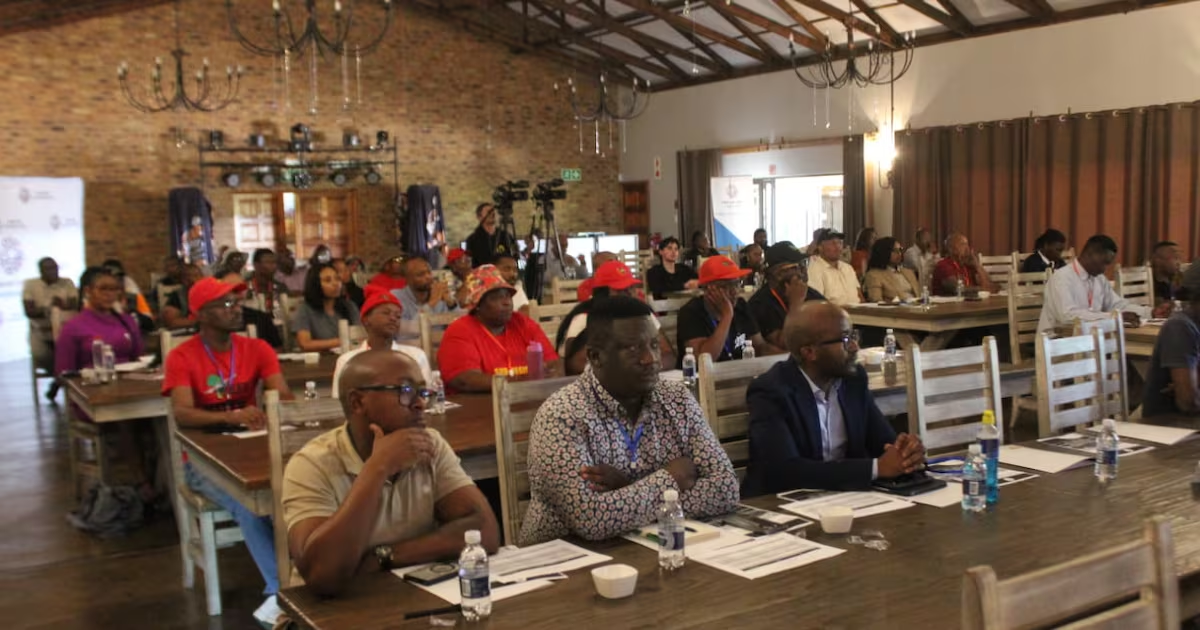
Frontline Africa Advisory, in partnership with the South African Chamber of Commerce and Industry (Sacci) and the Lesedi Black Business Forum, recently convened a symposium on the socio-economic impact of de-industrialisation on small towns.
The event explored how the withdrawal or collapse of anchor industries has reshaped, and in many cases, devastated local economies and communities in smaller municipalities.
The symposium examined several case studies, including the closure of Eskom’s Komati power station in Mpumalanga and the relocation of Clover SA from Lichtenburg in the North West to KwaZulu-Natal in 2021.
The gathering aimed to assess the effects of industrial decline, generate practical policy recommendations and propose strategies for economic revitalisation in towns facing collapse due to the loss of major employers.
Frontline Africa Advisory and its partners said the timing of the symposium was critical, as the economic viability of Heidelberg and other small towns remains under threat.
It’s a crisis. The government doesn’t create jobs, the private sector does. But when industries are forced to shut down or relocate, jobs disappear and that collapse filters through the entire local economy
— Zamokwakhe Somhlaba from Frontline Africa Advisory
Zamokwakhe Somhlaba from Frontline Africa Advisory said the symposium generated meaningful dialogue and a rare consensus among government, business and labour.
Somhlaba said discussions focused on public-private partnerships, targeted incentives and the alignment of industrial master plans with municipal realities.
“There was broad agreement that policy momentum is needed to create flexible fiscal transfers and to ensure development plans reflect what’s happening on the ground,” he said.
He highlighted unemployment as one of the most visible consequences of deindustrialisation, noting that the country’s jobless rate rose to 33.2% in the second quarter, from 32.9% earlier this year and that the expanded definition of unemployment now hovers about 50%.
“It’s a crisis. The government doesn’t create jobs, the private sector does. But when industries are forced to shut down or relocate, jobs disappear and that collapse filters through the entire local economy,” Somhlaba said.
Somhlaba emphasised the importance of re-skilling displaced workers to prepare them for a changing economy and said Technical and Vocational Education and Training (TVET) colleges require renewed attention.
“When coal mines close or factories repurpose towards renewables, we must ensure those workers are retrained to adapt. Otherwise, they’ll be left behind and the cycle of unemployment will continue,” he said.
Lesedi mayor Mluleki Nkosi said Lesedi has historically benefited from its strategic location along the N3, N17, N12 and R42, R23, R549, R51, R108 corridors, and its proximity to Johannesburg and Ekurhuleni.
He said Heidelberg, Devon and Ratanda grew as centres for manufacturing, agriculture, transport and light industry.
“However, over the past two decades, we have seen a steady decline of industrial activity. Some manufacturing plants have downsized or closed, rail-related jobs that once supported our local economy have diminished and agricultural processing facilities have either relocated or reduced their footprint,” he said.
Nkosi said key drivers of deindustrialisation in Lesedi Local Municipality are attributed to relocation of industries, technological changes, shifting trade and investment patterns, the decline of rail and transport services and skills and infrastructure gaps.
“Many firms moved closer to major logistics hubs in Gauteng metros or to lower-cost regions. Automation in manufacturing reduced the demand for local labour. Global competition and imports affected local textile and agro-processing operations. Reduced railway operations weakened Heidelberg’s historical role as a transport node. Some sectors cited shortages of skilled workers and ageing infrastructure as barriers to staying in the area,” Nkosi said.
He said the impact of deindustrialisation has been far-reaching, resulting in significant job losses that have pushed unemployment, particularly among young people and women, to alarming levels.
As formal employment opportunities have dwindled, he said informal trading has surged and has become a survival mechanism for many.
Nkosi added that local businesses, from small retail shops to transport operators, have suffered as household incomes and spending power continue to shrink.
“The municipal revenue base has been under pressure, limiting resources for infrastructure renewal and services. We face growing social challenges, including poverty-related crime and migration of skilled residents,” Nkosi said.
Beyond job losses, Somhlaba said deindustrialisation has crippled municipal finances, especially in smaller towns that once relied on big employers for rates and taxes.
“One mayor told us that their municipality used to receive R80m annually from a major tobacco company, now it’s just R2m. That loss in revenue directly affects service delivery, from water and electricity to road maintenance,” he said.
Somhlaba said that the decline of major industries also hits small businesses that rely on them, from transport providers to caterers and informal traders.
“When a plant shuts down, the taxi operator who ferried workers loses his livelihood and the local vendor who sold food outside the factory also shuts down. The effects are cascading and deeply personal,” he said.
He said reviving South Africa’s deindustrialised towns requires collaboration, skills investment and policy alignment to build labour-intensive industries that can restore local economies and dignity to communities.