
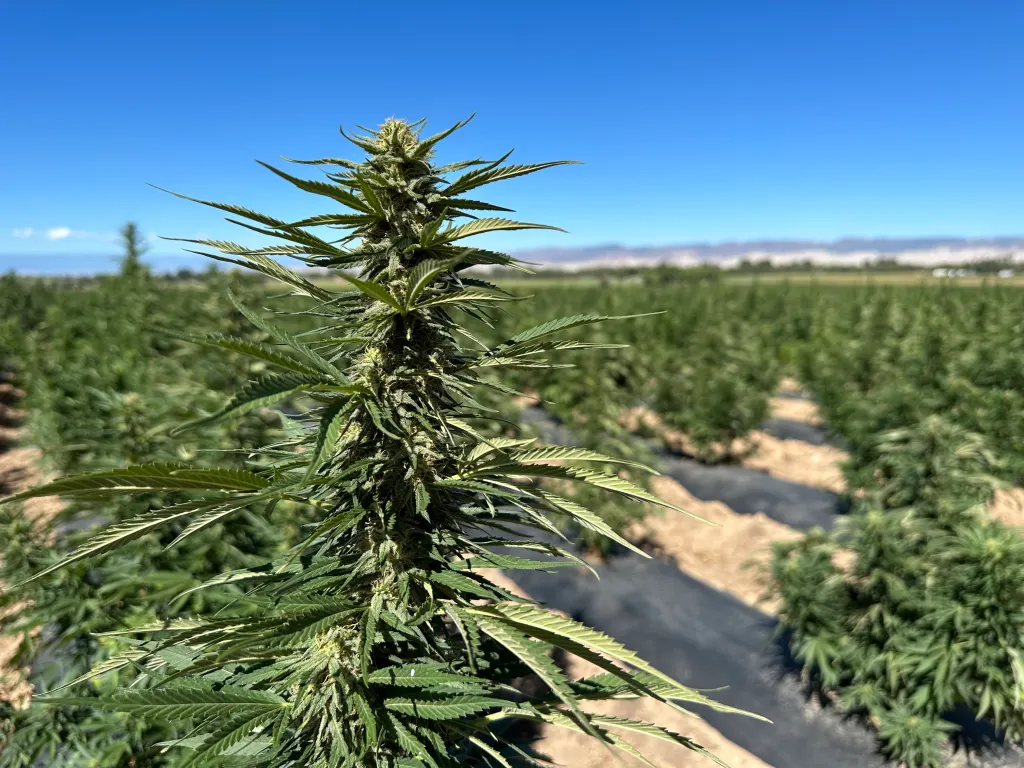
The U.S. government began reopening this week after the longest federal shutdown in the country’s history, but a cohort of Coloradans aren’t happy with the bill that made it happen, saying it could have devastating effects on the hemp industry and businesses that rely on the sale of cannabidiol, or CBD, as well as some consumers.
On Wednesday, the U.S. House of Representatives passed a budget bill that funds government operations through Jan. 30. President Donald Trump signed it following the vote. Among the myriad of things it addresses, the bill bans most hemp-derived consumable products by limiting the amount of tetrahydrocannabinol, or THC, to .4 milligrams per package.
Proponents of the change, which is expected to take effect in one year, say it aligns federal law with the intention of the 2018 Farm Bill, which legalized hemp for commercial production, by closing a loophole that has allowed for the proliferation of intoxicating THC edibles, beverages and vapes, primarily in states where marijuana remains illegal. Henny Lasley, executive director of Denver-based advocacy organization One Chance to Grow Up, for instance, said in a statement that closing the loophole is “a critical victory for protecting kids from the harms presented by THC.”
And while hemp-derived products are not widely available in Colorado due to regulation, the ban’s impact will still be felt here, opponents say. Business for the state’s hemp farmers, for one, will be negatively affected, and the ban will largely decimate the country’s CBD market, a concern for both local manufacturers and consumer advocates.
“They’re taking a sledgehammer to the whole industry basically,” said Ryan Eakes, chief operating officer of Typhoon Farma, a hemp cultivation in Montrose. “It’s going to take out the good with the bad.”
Eakes’ largest clients are extraction companies that purchase plants and process them for oil. Last year, those clients contracted to buy 300 acres of hemp in advance — a rarity, Eakes said — enabling Typhoon Farma to double its production. Due to future uncertainty, those companies have not committed to purchasing any crops in 2026.
The Farm Bill previously only put stipulations on THC content for hemp plants — not products — and established the legal limit at 0.3% of the cannabinoid, which causes a high. Even though hemp is low in THC, it can be extracted and concentrated into doses that cause intoxication. Manufacturers can also create synthetic versions, like Delta-8, from the hemp plant that achieve a high.
Limiting packaged products to .4 milligrams of THC means that most tinctures, gummies and topicals that include other naturally occurring cannabinoids – known as “full spectrum” products – would become illegal. That threshold is simply too low for an entire container, said Jared Stanley, co-founder of Charlotte’s Web, the country’s pioneering CBD company.
“Charlotte’s Web offers around .4 to 1 milligrams of THC per serving,” he said. The company would have to sell individually wrapped gummies “and even cut gummies in half,” to meet the new standard.
Even though products made with CBD isolate – meaning no THC or other cannabinoids – would remain legal, those account for a small fraction of Charlotte’s Web’s inventory. The ban puts about 80% of the company’s sales at risk, said CEO Bill Morachnick. Full-spectrum products are believed to be more efficacious because cannabinoids are more effective when working together, a concept known as the entourage effect. Veterinarians even suggest them for dogs despite canines being more sensitive to THC than humans.
“This isn’t a widget that, if regulated improperly, has no victims. There are real people that suffer real consequences,” Morachnick said. “You know this is a really bad call when you see panic buying. Our sales have gone up exponentially since this announcement because people are fearful.”
Paige Figi, executive director of consumer advocacy organization Coalition for Access Now, called the ban “absolutely unethical” when considering the people who rely on CBD to treat ailments, from chronic pain to seizures. Figi, a Colorado resident, helped elevate CBD to a household name more than a decade ago when it proved to be the only remedy that quelled her daughter Charlotte’s seizures. Coalition for Access Now works to educate the public and lawmakers about the health benefits of CBD.
Charlotte’s story is, in large part, what inspired federal regulators to legalize the commercial production of hemp. (The namesake of Charlotte’s Web, Charlotte Figi, died in 2020 at age 13.) Paige Figi worries that American families like hers will suffer without access to affordable products.
“Where are they gonna go? There’s no CBD black market,” she said.
The ban comes at a time when the hemp industry had just begun to stabilize, Eakes said. The passage of the 2018 Farm Bill caused a “green rush” into hemp cultivation, and Typhoon Farma opened in 2019 alongside numerous other operators hoping to capitalize on the demand for CBD.
The payoff, however, wasn’t there, and many farmers pulled out of the industry. In 2021, Colorado producers planted more than 10,000 acres of hemp, according to the U.S. Department of Agriculture. By 2022, production had plummeted to 1,600 acres. Hemp plantings hit a low of 1,350 acres in 2023 before increasing slightly to 2,300 in 2024, per the USDA’s latest National Hemp Report.
Eakes needs to solidify his plans for the 2026 growing season by the end of November, including determining the amount of labor and infrastructure he will need. The hemp ban has made that extremely difficult.
“As a producer, we’re trying to do things above board, so we want all these bad players out of the market. We think there should be sensible regulation. It’s just the regulation they put in this bill is not sensible at all, so it’s going to hurt a lot of people,” Eakes said. “All we can do is cross our fingers and hope the legislators hear us.”
Get more Colorado news by signing up for our daily Your Morning Dozen email newsletter.