

Industries seek plots, technological support
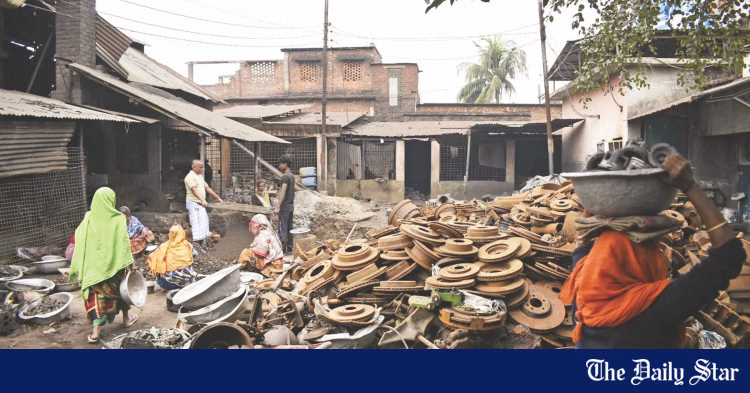
Foundry and light engineering industrial units in Bogura manufacture agricultural machinery and spare parts for vehicles, meeting 90 per cent of the national demand. Photo: Mostafa Shabuj
“>
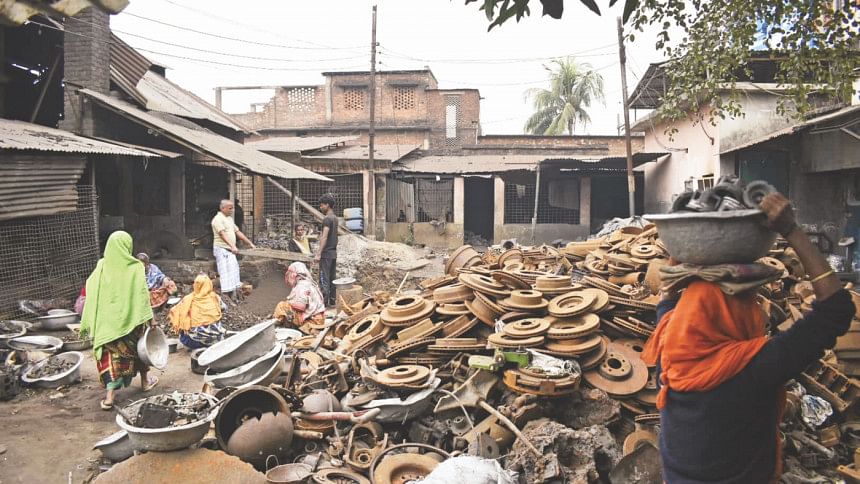
Foundry and light engineering industrial units in Bogura manufacture agricultural machinery and spare parts for vehicles, meeting 90 per cent of the national demand. Photo: Mostafa Shabuj
The foundry and light engineering industries in Bogura are thriving amid various challenges but they now need more land, easy loans and technological support to position themselves for the next phase of growth and fight off cheap imports, entrepreneurs say.
More than 80 per cent of the foundry industries of the country are located in the northern district.
 For all latest news, follow The Daily Star’s Google News channel.
 They manufacture at least 85 per cent of agricultural equipment, including centrifugal pump, spare parts used in agricultural machinery, tube-well, lathe machine, saw mill, flower mill, machinery of textile mills and jute mills and grinding machine.
Photo: Mostafa Shabuj
“>
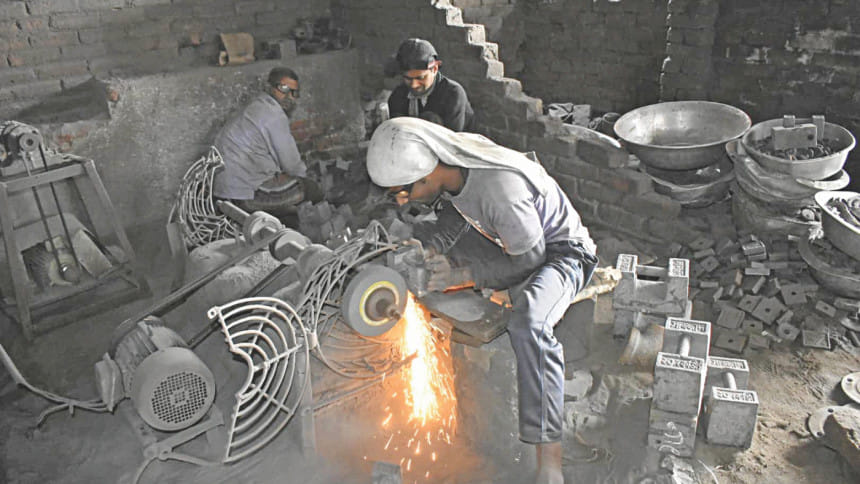
Photo: Mostafa Shabuj
This has made Bogura the hub of the country’s foundry and light engineering workshops. The owners of the industries have generated jobs, provide a handsome amount to the national coffer and export products.
“In Bogura, we are manufacturing agricultural machinery and spare parts for vehicles and agricultural machinery, which meet 90 per cent of the total national demand,” said Mahfuzul Islam Raj, senior vice-president of the Bogura Chamber of Commerce and Industry.
The old estate of the Bangladesh Small and Cottage Industries Corporation (BSCIC) was established on 14.50 acres of land at the Fulbari mouza of the town in 1968. The BSCIC (extension) was built on 18.67 acres in 1983 in the same area.
There are 42 foundry industries, 800 agricultural machinery manufacturing industries and 745 agricultural equipment spare parts manufacturing workshops in Bogura district, according to the BSCIC.
Some 3,755 people, including 700 women, are working in the BSCIC industries, the BSCIC said in its annual report. Owners of the industries invested a combined Tk 3,600 crore.
Photo: Mostafa Shabuj
“>
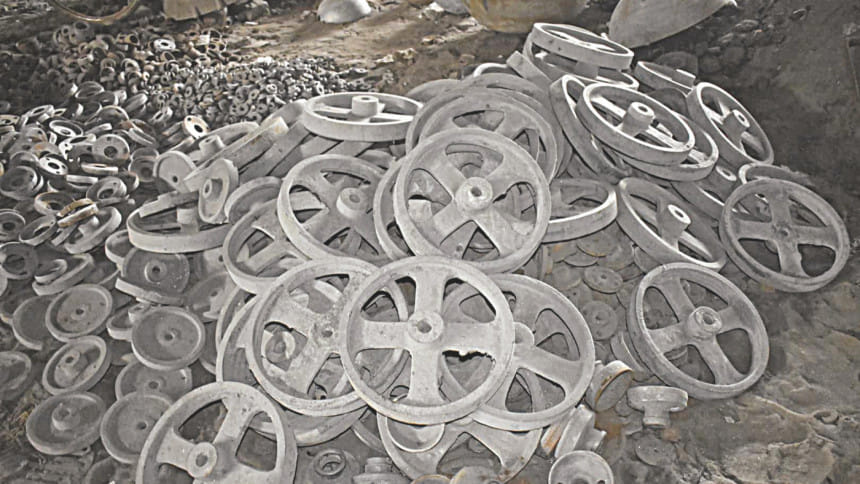
Photo: Mostafa Shabuj
The industries import raw materials such as pig iron, talcum powder, silicon steel, manganese, carbon block graphite power, fire bricks, waste and scraps cast iron, aluminium iron and hard coke coal.
They bought raw materials amounting to Tk 317 crore from the local market and Tk 476 crore from abroad in the last fiscal year.
They manufactured centrifugal pump, liner-piston, various spare parts of power tillers and agricultural machinery and jute mills, tube well, lathe machine, 350 types of motor engine-based filters, food items and potteries worth Tk 1,324 crore in fiscal 2018-19.
Photo: Mostafa Shabuj
“>
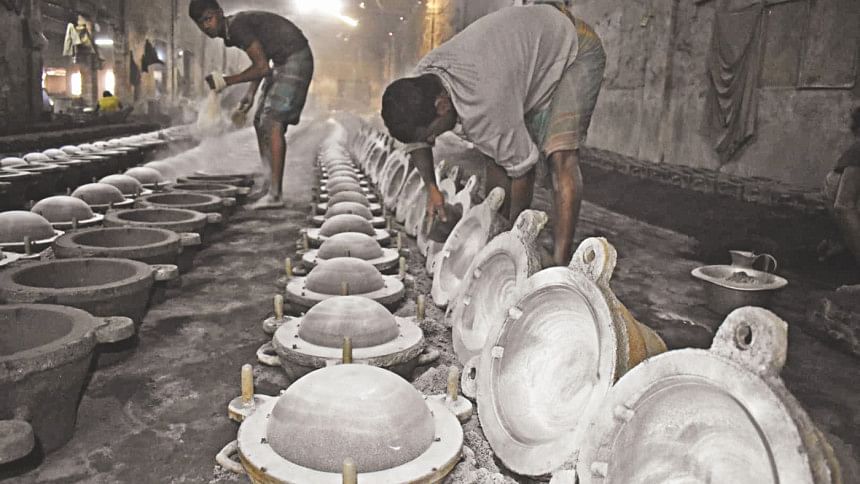
Photo: Mostafa Shabuj
Outside of the BSCIC estate, there are 45 foundry industries and more than 1,000 light engineering industries in Bogura, according to Razedur Rahman Raju, secretary of the Bogura unit of the Bangladesh Agricultural Machines Merchant Association.
They manufacture 2,000-3,000 types of finished products worth of more than Tk 500 crore a year.
At this stage, the industries are facing various challenges.
One of them is labour shortage. Industries normally pay a production labourer Tk 2,000 to Tk 5,000 a week but if they run auto-rickshaws or CNG-run auto rickshaws they can earn more than that.
Photo: Mostafa Shabuj
“>

Photo: Mostafa Shabuj
“Therefore, we can’t retain trained and skilled workers. If we give them more money, our production cost goes up,” Raju said.
Besides, importers who bring in agricultural equipment from China make more profits as they bring in the products at cheaper prices compared to those produced in Bogura.
The cash credit loan, a short-term source of financing, the industries receive from commercial banks to invest in local industries carries 14-15 per cent interest rate.
Photo: Mostafa Shabuj
“>
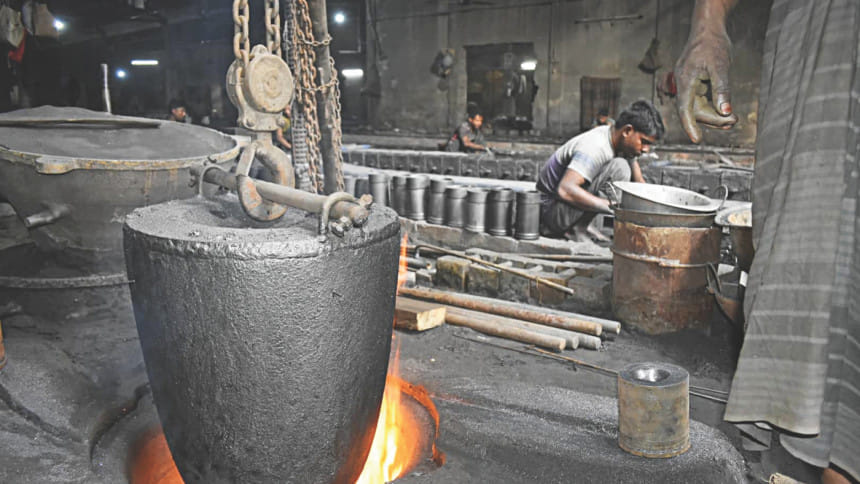
Photo: Mostafa Shabuj
“As a result, many entrepreneurs can’t make large investment in the sector,” Raju said.
The industries are lagging behind when it comes to adopting modern technologies. “We would have exported more machinery if we had had a testing machine for our products. We even don’t know the quality of our products,” Raju said.
Small engineering workshops and foundry industries are closing and big companies are taking their positions.
“We are losing our markets as Chinese products are well-finished and are cheaper than ours. But if we compare qualities, the local equipment are far better than the Chinese products,” said Abdul Malek Akanda, owner of Al-Madina Metal Works and president of the BSCIC Industries Owner’s Association.
In the BSCIC area, there are nine foundries, which manufacture more than 2,000 types of agricultural equipment.
The government has raised the service charge three folds in the BSCIC estate. Last year, Akanda paid Tk 45,000 for the 10,669 square-feet Al-Madina Metal Works, but he has to pay Tk 110,873 this year.
The district’s light engineering workshops are using old lathe machines but their competitors in China are using modern ones.
“Therefore, we can’t compete with them. If we have to keep alive the foundries, we must have to adopt modern technologies. For the sake of the growing foundries, the government should help us by providing technological support,” Malek said.
BSCIC-based industries used to manufacture 90 per cent of the country’s shallow machine’s liner-piston, but it has lost majority of the market share to imported Chinese products.
Malek pointed out that the drainage and road network in the BSCIC area is the worst. During rainy seasons, the whole area gets flooded and the labourers cannot come to the factories.
A project to construct new roads, culvert, bridge and drainage systems in eight BSCIC estates has been planned. “We hope the project will be approved soon,” said AKM Mahfuzur Rahman, estate officer of the Bogura BSCIC Industrial Area.
“We need large area for the growing industries,” Raj said.
Many factory owners have applied for plots but are not getting any as there are no place available in the existing area, Rahman added.
A proposal to set up the second Bogura BSCIC Industrial Park on 300 acres of land has been sent to the head office for approval.
Fourteen foundry industries, light engineering workshops, yarn factories and other companies from Bogura exported products worth $72 million to India in 2019, according to the Bogura Chamber of Commerce and Industry.
BSCIC–based industries paid Tk 163 crore in various taxes and duties to the government treasury in fiscal 2018-19, up from Tk 161 crore a year earlier, the chamber said in its annual report.
“The foundry industry of Bogura can create jobs for hundreds and thousands of unemployed people, earn a lot of foreign currency and generate big amount of revenue for the government,” Rahman added.