
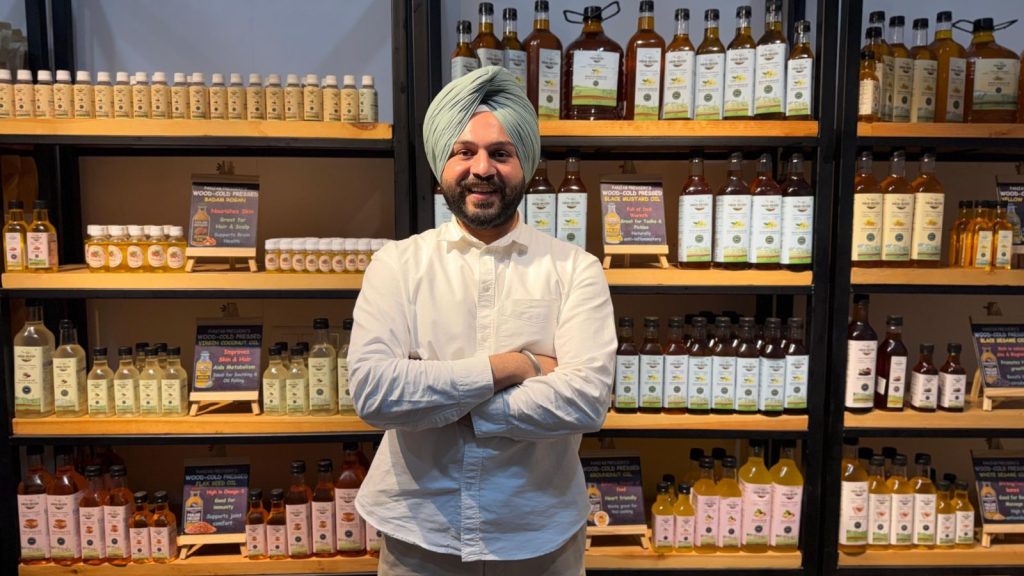
How diversification can transform small-scale farming — setting an example, a 30-year-old farmer from Batala in Gurdaspur district has in just three years built a full-fledged food processing enterprise with an annual turnover exceeding Rs 2.5 crore. Starting with traditional wood-pressed oil extraction using mustard grown on his modest four-acre landholding, Manmeet Singh steadily expanded into value-added products, turning a small farming setup into a multi-crore venture driven by quality, innovation, and direct market connect.
Operating under the motto “Purity needs no curtain”, Manmeet has set up a live wood-pressed oil extraction unit, where customers can directly see the production process. “Why should we hide anything when our focus is on quality?” he says.

A BTech graduate in Food Technology, Manmeet has revived the traditional method of wood-pressed oil extraction to provide pure and full of natural properties oil for good health.
Coming from a modest background in Batala, with farmland in Harchowal village, Manmeet’s journey was not without challenges.
At the age of 15, while studying in Class X in 2010, he moved to Italy with his parents, where his father had a work visa. “After spending more than a year, we realised that hard work is the key to success everywhere. We felt if we put even half the effort in Punjab, we could achieve more at home.”
Upon returning to Punjab, he completed his Class XII and pursued a BTech. However, tragedy struck when he lost his father in 2015 at the age of 19.
His grandfather, Bhagwan Singh, a retired District Food and Civil Supplies Officer, and his mother, Maninder Kaur, a schoolteacher, supported the family, while Manmeet kept his focus on building a future rooted in agriculture and food processing.
Story continues below this ad
After completing his degree in 2019, he underwent training in food and dairy processing and later received technical training in oil extraction from the Khadi and Village Industries Commission (KVIC) in Nashik.
After extensive research in oil extraction, Manmeet first reclaimed his family’s four acres of land, which had been given on lease, and began cultivating mustard. Alongside this, he started his venture in 2023 with a single wood-pressed oil machine installed in a small 1.5 marla space.
He also secured a loan of Rs 9.35 lakh for three years under the Pradhan Mantri Formalisation of Micro Food Processing Enterprises (PMFME) scheme. However, the manufacturer supplied faulty machines, creating initial setbacks.
“I then pooled in Rs 3 lakh from my family and purchased a new machine. Initially, I used mustard grown on my fields to extract oil. As the demand grew, I expanded rapidly, adding two more machines within a year,” he says.
Today, his unit operates three wood-press machines made from health-beneficial wood, each capable of crushing about 25 kg of seeds per hour, producing around 125-150 litres of oil daily. Annually, he sells 45-50 tonnes of oil of various types, priced between Rs 300 and Rs 6,500 per litre, with a profit margin of around 15 per cent.
Story continues below this ad
The unit primarily produces black and yellow mustard oil and coconut oil, which account for the bulk of daily sales. Other oils, such as groundnut, almond, neem, moringa, castor, flaxseed and black and white sesame, contribute around 5-10 per cent of the total output. During winters, sesame oil demand rises significantly, touching nearly 30 per cent.
Unlike refined oils, Manmeet’s wood-pressed oils are extracted slowly at low temperatures to preserve nutrients, taste, and density. “If seeds are exposed to high temperatures, the quality deteriorates and impacts health. Our focus is on maintaining natural properties,” he explains.
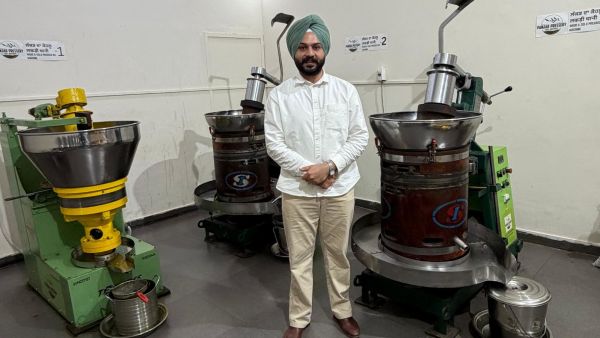 Unlike refined oils, Manmeet’s wood-pressed oils are extracted slowly at low temperatures to preserve nutrients, taste, and density. (Express)
All products are FSSAI-certified and lab-tested. Despite premium pricing, mustard oil (black and yellow) at Rs 300-Rs 360 per litre, coconut oil around Rs 1,000, castor oil Rs 1,200, neem oil Rs 2,000, and speciality oils like almond and moringa reaching Rs 3,200 to Rs 6,500 per litre, the demand continues to grow. “Oil is dense, so consumption is less. In the long run, it becomes economical. People today understand the value of purity, as oil is a necessary part of cooking,” he adds.
Several restaurants, hotels, food joints, and regular customers purchase directly from him, and demand is steadily increasing.
Story continues below this ad
With an initial investment of just Rs 3 lakh, Manmeet has invested around Rs 25 lakh over three years. Today, his enterprise records an annual turnover of over Rs 2.5 crore.
Operating under the brand name ‘Panjab Pressery’, Manmeet has designed his store uniquely, with one section displaying products and another separated by glass, allowing customers to observe the oil extraction process live. His enterprise is highly clean, well-organised and professionally displayed —matching the standards of a modern, high-end setup.
During his time in Italy, he learned the importance of hygiene and presentation. “Every small shop there was neat and clean, and hygienic. I follow the same here. We do not compromise on cleanliness — whether it’s storage, processing or packaging,” he says.
The unit employs four persons — two full-time and two part-time —and is supported by his entire family, including his grandfather, mother, wife Ramneet Kaur (an IT professional), and sister Navpreet Kaur, who is settled in Canada.
Story continues below this ad
His customer base cuts across economic classes. “From a bicycle owner to a Mercedes owner—anyone who values quality comes to us,” he adds.
He emphasises that he keeps profit margins reasonable to ensure access to pure products. “We source the best seeds from farmers across India and focus on freshness rather than storage,” he says. At his store, he has also displayed the properties and health benefits of each oil to educate customers.
Despite his growing business, Manmeet continues farming on his land, cultivating mustard and traditional wheat varieties. In the Kharif season, he is diversifying into pulses, turmeric, and premium old Pakistani basmati rice.
Natural farming practices
Manmeet is also moving towards natural farming practices, avoiding chemical fertilisers as much as possible. He now plans to expand further by adding more machines, as he is unable to meet the growing demand with the current setup.
Story continues below this ad
Expanding beyond oils, he has introduced stone-ground flour using a traditional chakki. He processes both regular hybrid wheat and indigenous varieties like ‘Sona Moti’, known for low gluten content.
Although Sona Moti yields about 10 quintals per acre, almost half of the hybrid varieties, it fetches a premium price of around Rs 130 per kg due to its superior nutritional value. This rabi season, he has grown the Sona Moti wheat variety on his fields.
He also processes millets such as ragi and bajra & bajri sourced from Rajasthan and sells specialitygrocery items like GI-tagged rajmah, black chickpeas, and other traditional foods. He is also planning to add a peanut butter manufacturing unit, given the growing demand.
“My aim is simple, focus on quality and keep diversifying,” he says, adding that the support of three women of his family, his grandfather’s guidance and his hard work have been key to his success.