
TOKYO, Apr 13 (News On Japan) –
Japan’s cram school industry is seeing a growing divide, with major operators expanding their market share while smaller firms struggle to survive amid declining birthrates and shifting education trends, according to expert analysis.
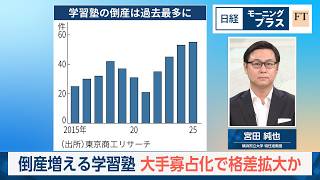
The number of cram schools nationwide stands at around 33,000, but bankruptcies reached 55 cases last year, marking a third consecutive year of record highs, according to Tokyo Shoko Research. Total liabilities amounted to approximately 4.1 billion yen, with more than 90% of failed firms employing fewer than five people, highlighting the vulnerability of small operators. Over the past decade, 381 cram schools have gone bankrupt.
Miyata, an associate professor at Yokohama Shiritsu University who is well-versed in education trends, pointed to multiple factors behind the surge in failures. “The most significant factor is the declining birthrate,” Miyata said, adding that rising prices have made it harder to attract students and secure instructors, while tuition hikes remain difficult to implement. As households become more cost-conscious, demand for value in education spending has intensified, further tightening competition.
The need for digital transformation (DX) investment has also widened the gap between large and small operators. While larger firms can invest in technology, smaller cram schools often struggle to keep up, leading to increasing disparities across the industry.
The challenges facing smaller operators were underscored by the collapse of Nihon Gakuryoku Shinkokai, a long-established university preparatory school operator with more than 40 years of history, which abruptly closed its classrooms in January last year during the exam season. The company carried liabilities of 170 million yen and received a bankruptcy ruling from the Tokyo District Court, affecting 349 creditors, most of whom were students and employees.
Miyata noted that changes in university entrance systems have also played a role. “Admissions are no longer limited to traditional academic exams, and schools must adapt to more diverse selection methods,” Miyata said. Institutions that relied heavily on rote learning methods have struggled to respond to these changes, further compounding their difficulties amid rising DX costs.
Despite these challenges, overall industry revenue has shown modest growth. A survey of 396 major cram school operators found that total sales reached approximately 540 billion yen in 2023, slightly up from the previous year. However, the market has become increasingly concentrated, with major firms accounting for about 66% of total revenue following a wave of mergers and acquisitions. Meanwhile, around 30% of cram schools are operating at a loss.
Miyata attributed this widening gap to differences in financial strength. Larger firms have leveraged their capital to respond to increasingly diverse parental needs through acquisitions and brand expansion, accelerating market consolidation.
Several successful M&A cases illustrate this trend. The Z-Kai Group strengthened its offerings by acquiring Eikoh Seminar, enabling it to provide integrated education from early childhood through university entrance exams. Waseda Academy has expanded overseas by acquiring cram schools in the United States, targeting returnee students and opening new markets beyond Japan. Meanwhile, Benesse Holdings has broadened its scope by acquiring Digital Hollywood University, moving beyond its traditional focus on children’s education to include reskilling programs for working adults and the development of digital talent.
As consolidation accelerates, the cram school industry appears to be entering a transformative phase, with smaller operators facing increasing pressure to adapt or exit the market.
Source: テレ東BIZ