
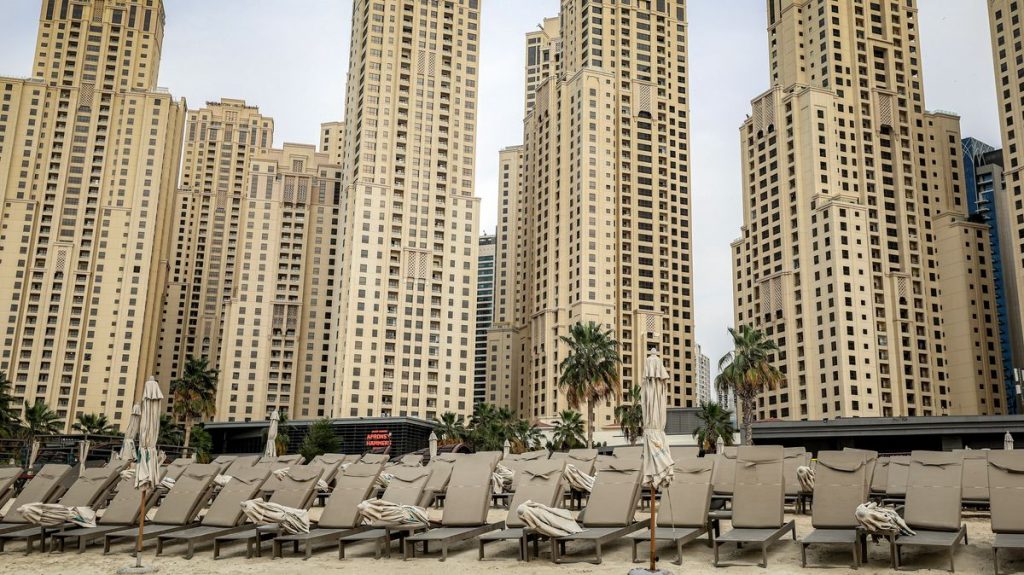
Dubai’s luxury image is under strain as empty hotels, falling tourism and regional tensions raise doubts about its future as visitors increasingly turn back to Europe

Empty sunbeds have become the norm in Dubai as tensions become hard to ignore
For years, Dubai has sold itself as the five-star destination for year-round sunshine and tax-free living. But behind the polished social media facade, cracks are beginning to show.
Flocks of influencers and Brits have been moving to the United Arab Emirates city in recent years, posting themselves sunbathing underneath skyscrapers and shopping in luxury malls. But landmarks like the Burj Al Arab now tell a very different story.
The sail-shaped icon, long associated with eye-watering opulence, was hit after Iran launched retaliatory strikes. Footage showed the iconic hotel on fire, now seemingly quiet while it repairs the damage. Across Dubai, the signs are becoming harder to ignore.
READ MORE: Katie Price explains break from Dubai saying ‘I’ve done my bit’ visiting LeeREAD MORE: ‘I lost £3m on gambling addiction by blowing £30K a night on football matches’
Hotels that once bustled with international visitors now feel eerily quiet. Staff outnumber guests in some five-star resorts, while shops in vast malls sit almost empty.
Taxi drivers report dramatic drops in business, with some claiming demand has fallen sharply. In the property sector, estate agents are quietly slashing prices, with luxury apartments once snapped up by foreign investors now lingering on the market.
Much of the unease stems from instability in the wider region. Dubai, part of the United Arab Emirates, has long relied on its reputation as a safe haven in an often volatile part of the world.
But recent geopolitical tensions have shaken that perception. Reports of drone strikes, heightened security and disruption have led many visitors to rethink travel plans.
Flights have been cancelled, bookings paused and some expatriates have chosen to leave altogether – at least temporarily. Even those who remain are feeling the pressure.
Schools and businesses have adapted to disruption, with remote working returning in some sectors and a sense of uncertainty lingering over daily life.
Tourism has been one of Dubai’s biggest success stories, drawing nearly 20 million international visitors in recent years. But that momentum now appears under threat.
Hotel prices – once among the highest in the world – have dropped significantly, with luxury stays now available for a fraction of their usual cost. While that might sound appealing, it reflects a deeper issue that fewer people are returning.
Restaurants, too, are struggling. Some operators have reported revenues plunging, forcing tough decisions including salary cuts and staff reductions. In extreme cases, businesses have placed workers on unpaid leave as they try to weather the downturn.
Dubai’s global appeal has always relied on more than just sunshine and skyscrapers. Its promise of safety, stability and opportunity has drawn millions of expatriates – including a significant British population.
But beneath the surface, there are growing concerns about how the system operates. Strict laws governing speech and behaviour mean residents must tread carefully, particularly during times of crisis.
Legal experts warn that even private messages or social media activity can carry serious consequences if deemed harmful to the country’s image.
At the same time, critics point to deeper contradictions – from questions around human rights to the stark divide between the ultra-wealthy lifestyle on display and the reality for many low-paid migrant workers who keep the city running.
Scroll through Instagram, and you might see little sign of trouble. Dubai’s army of influencers continues to promote the city as glamorous and carefree, sharing poolside snapshots and luxury experiences.
But the reality on the ground appears more complicated. While some content creators have left, others remain – often painting a picture of normality that contrasts with reports of quieter streets, reduced business activity and heightened tensions.
A new visa scheme that was brought in back in 2019 might be one of the reasons that some influencers and content creators are remaining tight-lipped about the ongoing war. Those that haven’t – including a 60-year-old UK tourist, and up to 70 other Brits, are facing dire consequences, for sharing videos and photos of the war damage, which has included debris from intercepted missiles rocking buildings in central Dubai and the airport. The authorities have confirmed that 109 people had been detained for sharing imagery of the damage brought on by the conflict – but the Guardian reports that the figure is “feared” to be much higher than this in reality.
The Golden Visa scheme is aimed at investors, “specialised talents” and entrepreneurs, offering them a home in the city – and authorities have established a scheme for content creators too, particularly those with large followings.
Richard Osman explained on a podcast, The Rest is Entertainment, how the scheme has massively incentivised people with big followings to take the plunge and build a new life in Dubai – with the visas offering a lot of perks alongside residency.
Describing the set-up, he said: “They give you a physical creators HQ hub, which has podcast studios, offices, all those things, they will give you business and legal support, they essentially set you up as a business.”
His co-host pointed out, however, that there is a “dark side” to the programme, which means that influencers and creators alike can “never rock the boat”.
Marina Hyde warned: “You can be detained for making defamatory comments. You do sometimes have to do state work – although it’s never discussed, people don’t say whether they’ve been paid or whether it’s just, you know, ‘You’re on the team now you take one for it and it’s just the cost of doing business’ and they never rock the boat.”
In March it was revealed that a British man, 60, has been charged under cyber-crime laws in Dubai after allegedly filming Iranian missiles over the city.
The CEO of Detained in Dubai, Radha Stirling, said by her “estimates” between 50-70 British people have been charged, with police finding a video of an Iranian missile strike in Dubai on the British man’s phone. She told the BBC the formal charges were “very vague”, adding that the UAE was cracking down on people filming the terrifying scenes in order to “maintain the facade that it is safe for tourists”.
“We’re talking approaching 50 to 70 was my estimate and possibly even more. I think by the end of this we’ll see a lot more, possibly 100, maybe 150,” she said to Sky News at the end of March.
The Mirror spoke to a source who spent a short spell in a Dubai jail in 2016, and they paint a brutal picture about life behind bars there.
Speaking anonymously, they said: “I think my worst experience was a night when I heard someone get raped in his cell. Usually there’s obviously gangs and stuff, but when you know someone actually pays the guards or whatever to be out of his cell block, then it’s quite sad. Even after he left, I think the worst part was being able to hear him sob all night. It was crazy.”
The source we spoke to claimed that while there were “definitely” a lot of people locked up for “minor crimes,” those who are incarcerated for “white collar crimes” had a very different experience to everyone else. They said that “those from a high tax bracket lived a very different life in prison… usually it’s about six people in a cell but they had their own cells to themselves.”
For decades, Dubai has thrived by attracting the world’s wealthy – offering a lifestyle few other cities could match. But as uncertainty grows, some are beginning to look elsewhere.
European destinations are increasingly back in favour, with cities like Milan and Madrid emerging as alternatives for those seeking stability alongside lifestyle perks.
That shift could prove significant. Dubai’s success has always depended on its ability to draw people in – tourists, investors and expatriates alike. If that flow slows, the impact could be long-lasting.
Behind the gleaming skyscrapers and luxury branding, there’s a sense that the emirate is entering a more uncertain chapter – one where its carefully curated image is being tested like never before.
READ MORE: Dubai: Buildings damaged as debris falls from sky after drones intercepted