
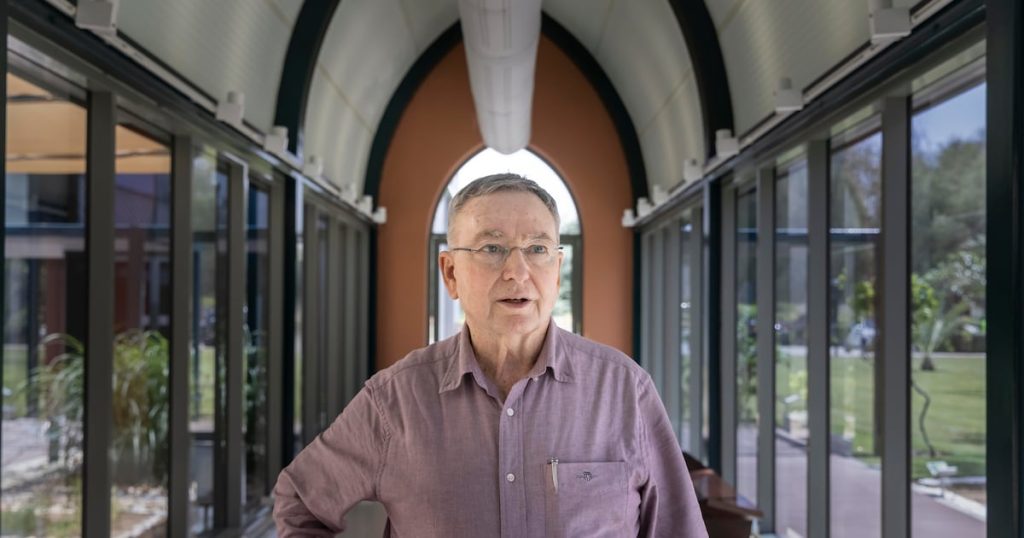
Peter Jackson arrived in Dubai when wind towers still lined the Creek and skyscrapers, such as Burj Khalifa, were hard to comprehend.
More than five decades later, he leaves the UAE having documented a lost world and helped shape parts of the UAE’s architectural identity.
Over the past 20 years, he has worked as architect adviser at the Ruler of Sharjah’s office – where he helped to manage and deliver key projects – and has now been reflecting on a long association with the UAE as he prepares to retire to Germany.
The Dubai of 1972 he arrived into was small and centred around the Creek, where traditional merchant homes and wind towers dominated the landscape.
“Nobody knew where it was in those days,” Mr Jackson told The National at Sharjah’s Islamic Botanical Garden – one of the buildings he designed. “It was quite unknown in London.
“But it was a really charming place. There was a real buzz about it and also a real sense of community.”
The UK-born architect was then still in college and his first visit lasted only a few weeks, during which he worked for the John R Harris Architects firm on banks, private homes and religious buildings across the city.
Mr Harris, a British architect who helped shape modern Dubai, offered him a job, leading to his return the same year.
During this time he became deeply immersed in the architecture of old Dubai, particularly the wind tower houses along the creek and the people who lived in them. This led to a project of huge significance.
In 1975, alongside Anne Coles, he produced a short work, titled A Windtower House in Dubai, documenting the Bukhash family home in Al Bastakiya. The study captured both the architectural detail and the lifestyle associated with these traditional homes.
“The little alleyways were very narrow, so women could walk around in shade and privacy and it was easily protected. It really had that sense of being enclosed and being a town within a town,” Mr Jackson said.
Two members of the family became architects with one, Rashad Bukhash, going on to run Dubai Municipality’s historic buildings section, which was responsible for the restoration of the area. Renamed Al Fahidi in 2012, it remains historically significant.
The 1975 study later inspired Windtower, first published in 2007 and expanded in subsequent editions, including in Arabic. It remains an important record of a way of life that has largely disappeared.
But the winds of change were blowing also for him. Keen to design his own buildings, Mr Jackson moved to Africa and spent more than two decades in Zambia and Zimbabwe, working on projects ranging from office buildings to a bus station in the Zambian capital Lusaka to Harare, where he served as a historic buildings adviser in that country’s capital. His time in Zimbabwe began with optimism following its independence under Robert Mugabe, but conditions worsened.
“I never thought I’d see the UAE again. But the economic and political situation became unfriendly. And I didn’t see a future for my family.”
He returned to the UAE in 2002 to a changed country. Dubai was on the verge of a major development boom and the sense of community he remembered had faded. About half of the wider Al Fahidi area was demolished in the 1980s, but parts have since been restored.
“It was unlike the city of the 1970s and no longer had that sense of the small community where everybody knew each other.”
Despite the transformation, his connection to historic districts remained strong. In 2007, he guided the then Prince Charles and Camilla around Al Fahidi with Rashad Bukhash – the future UK monarch had a keen interest in the preservation of the area and had visited before.
“Then people lived there,” he says. “Now it’s commercialised and for tourism but if that’s what it takes to have to preserve old buildings so be it. But the community are still immensely proud of the houses that are left.”
On the same day as the royal visit, he was invited to join the office of the Sharjah Ruler, Sheikh Dr Sultan bin Muhammad Al Qasimi, as an architectural adviser. Over the next two decades, he helped to manage and guide major cultural and environmental projects across the emirate.
These included the Heart of Sharjah, Al Hefaiyah Conservation Centre (the second of two he was architect on), Khor Kalba Mangrove Centre, Wasit Wetland Centre, Buhais Geology Park, Sharjah Safari, the Islamic Botanical Garden at Sharjah Desert Park, and the Sharjah Marine Science Research Centre in Khor Fakkan.
“Sharjah is a city with a very distinct character, which had been established by the Ruler,” said Mr Jackson.
“He’s very passionate about architecture. All the government buildings have a particular style, and he located them at key points, streets and roundabouts in the city. This gave Sharjah a distinct identity and uniformity. Although this architecture has different classical and Islamic styles, there’s a strong harmony to them.”
His role involved introducing new architectural ideas, while respecting the emirate’s established identity.
“My architecture had to complement this. It also wasn’t trying to copy Dubai or Abu Dhabi. They had to be appropriate and unique to their sites,” he said, talking about the projects he worked on.
One of the most significant initiatives he worked on was the Heart of Sharjah project, which restored the historic city centre with its souqs, traditional homes and narrow alleys. Once a hub of merchant trade, the area has been revived as a heritage and arts district.
“It went through many different iterations and there were ‘different views,” he said. “But this didn’t matter. It changed over time but we had a basis.
“For me the really important thing was to restore the souq,” which he had first walked through in the 1970s.
Another project he highlights is Sharjah Safari, which opened in 2022 after seven years of development. Designed to recreate African landscapes, it aimed to avoid becoming a conventional zoo.
“I remember going on site the first time and wondering, How are we gonna do this?” he recalls with a chuckle. “It was a barren gravel plain and overgrazed,” he said. “It was to be an African safari, not a zoo. I just spent 26 years in Africa and I was really concerned that it shouldn’t become a theme park. We were essentially making a savannah and Serengeti type landscapes in the middle of the Madam Plain.”
Reflecting on his time working with the Ruler, Mr Jackson described a leader who was both demanding and closely involved.
“He is an inspiring figure. He would come on site and really be looking. He didn’t just walk through ceremonially, Mr Jackson said. “My job I always thought was to make sure that the consultants, the architects and the engineers give us the job that we need, not what they might necessarily think we need. I had to make sure the Ruler got something that he would be happy with.”
He also raised concerns about urban expansion into the desert, warning of its environmental impact.
“You’re finishing up with this suburban sprawl going out and destroying one of our biggest assets, environmental assets, which is the desert.” On architectural trends, he stressed the importance of restraint. “Everything has to be iconic now,” he said. “But it should be fit for purpose, blend into the environment and not compete with it.”
Now returning to Germany, Mr Jackson reflects on a career spanning continents and decades of change. From documenting old Dubai to shaping Sharjah’s development, his work has left a lasting imprint
“It has been an enormous privilege to have been architect adviser at the Ruler’s office. And an enormous privilege to have worked with so many great architects, designers and contractors,” he said.
“I have been so lucky.”