
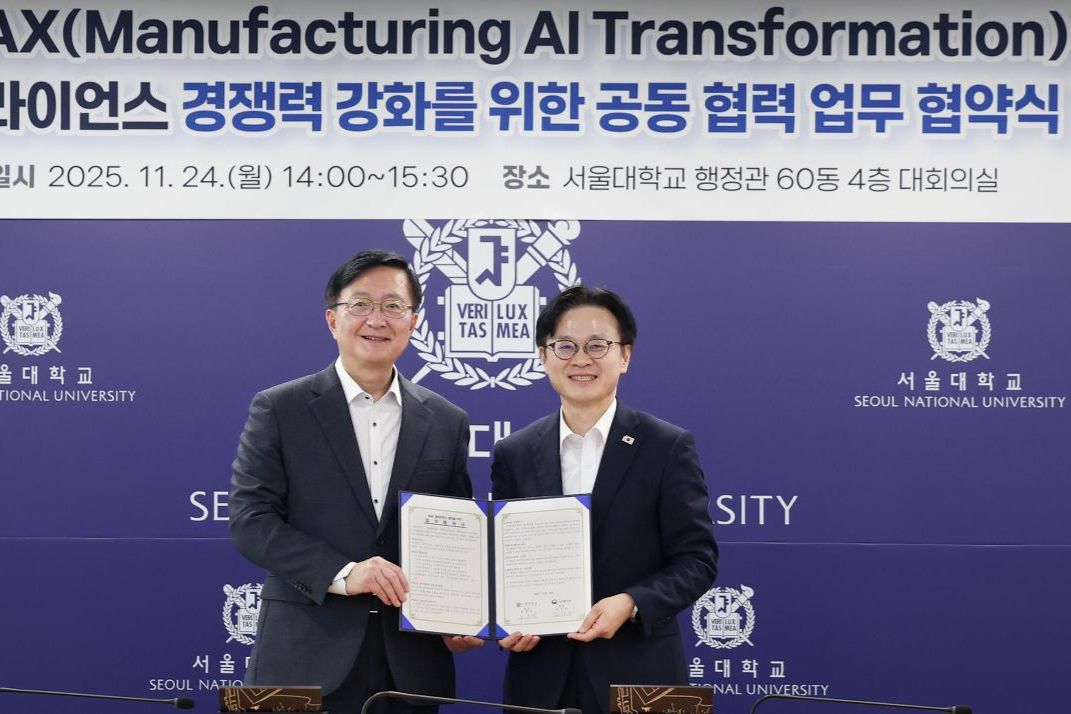
The Ministry of Trade, Industry and Resources and Seoul National University (SNU) signed a partnership agreement on Monday for the school to join the ministry’s M.AX Alliance project, cooperating to develop artificial intelligence (AI) models for humanoids, self-driving cars and AI factories.
The M.AX Alliance is a collaborative initiative jointly launched by the ministry and the Korea Chamber of Commerce and Industry in September, with more than 1,000 participants, including major companies such as Samsung Electronics, Hyundai Motor Group and Rainbow Robotics.
It brings together industry, academia and research institutions to accelerate the development and commercialization of advanced AI technologies across sectors ranging from manufacturing to biology by leveraging joint research and large-scale demonstration projects.
Through the alliance, the ministry aims to drive innovation in manufacturing processes and foster emerging sectors, including humanoid robotics, with a goal of generating over 100 trillion won ($67.7 billion) in added value by 2030 and establishing Korea as a global powerhouse in AI-driven manufacturing.
“When the world-class manufacturing capabilities of M.AX member companies meet the creative research prowess and talented workforce of Seoul National University, achieving Korea’s goal of becoming a global leader in advanced manufacturing won’t be a distant future,” Industry Minister Kim Jung-kwan said.
Under the agreement, the university will join key initiatives of the project, focusing on AI model development, the utilization of manufacturing data and the cultivation of specialized talent.
SNU will collaborate with manufacturing companies in the alliance to codevelop AI models for humanoid robots, autonomous vehicles and AI-driven factories.
To support these efforts, the ministry recently launched targeted research funding at the school for these three fields, totaling about 1.19 billion won through 2029.
Companies will provide the necessary data and platforms — such as robots, automotive systems and factory systems — while the university develops specialized AI models using this data. Once completed, the AI models will be integrated back into corporate products and factories.
By early next year, SNU and the alliance plan to establish a framework for sharing manufacturing datasets accumulated through research and development and AI factory projects.
They will preprocess, standardize and anonymize the shared data and apply it to AI model development and field testing.
The two parties will also strengthen cooperation in talent development through industry-academia collaboration projects and training programs.
The ministry plans to offer SNU students more opportunities to participate in the M.AX Alliance. It will select outstanding students through the school’s startup support program and connect them to R&D projects and internship programs within the alliance.
Through the partnership agreement, the two sides also plan to expand cooperation to include one-on-one partnerships between six specialized SNU research institutes and corresponding divisions within the M.AX Alliance.