
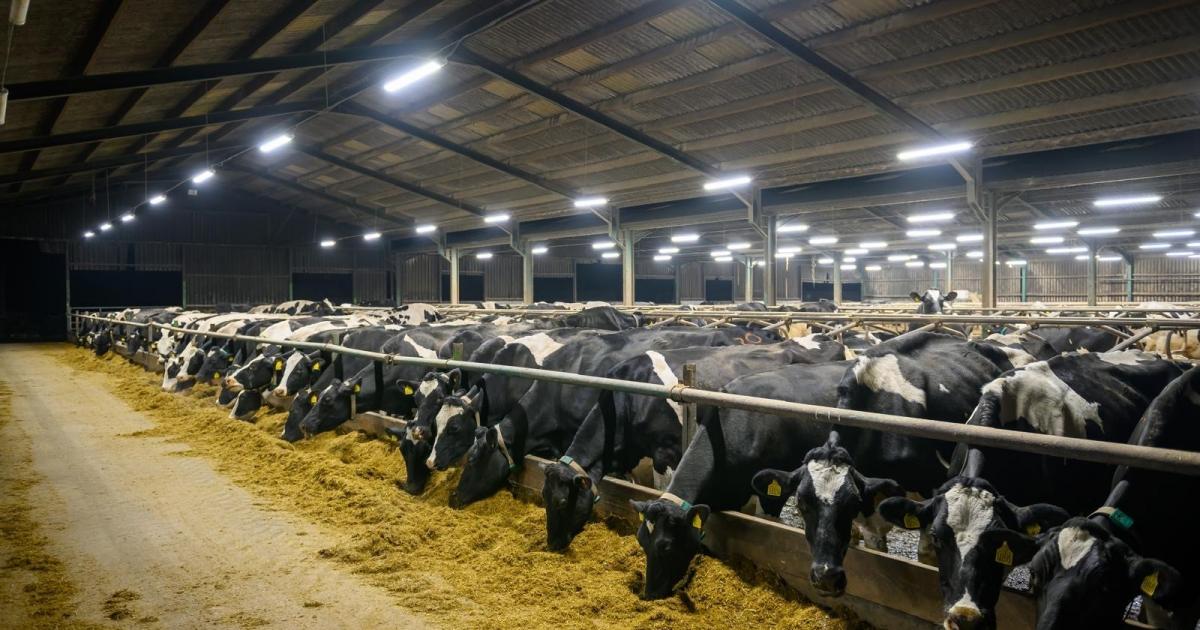
Director of DairyLight, Dr Torjus Baalack explains: “UK herds often experience a drop in milk yields throughout the autumn and winter as a result of reduced daylight.
“This can be avoided through the use of innovative lighting systems to extend the photoperiod during the lactation period and manipulate the levels of some key hormones that influence cow metabolism and productivity.”

Referencing the NFU Energy Dairy Lighting Technology Review, Baalack highlights the benefits of installing a Long Day Photoperiod (LDPP) system, which provides 16 hours of light and eight hours of darkness, or using red light during resting periods.
“The LDPP system works by consistently exposing dairy cattle to a specific level and spectrum of light throughout the year,” he says.
“Unlike industrial lighting, which is designed for human use, the DairyLight system uses blue-enriched white light to mimic daylight, followed by red light at night to ensure proper rest and recovery.”
Extending the photoperiod helps regulate hormones such as melatonin, insulin-like growth factor-1 (IGF-1), and prolactin, which affect cow activity, metabolism and milk production.
“During the hours of daylight, melatonin production is suppressed, optimising feed intake, rumination and feed efficiency. This is followed by a period of darkness, where melatonin production is stimulated, allowing cows to rest and recover,” explains Mr Baalack.
He adds: “By reducing the circulating levels of melatonin – a hormone that suppresses milk production because it lowers the production-enhancing hormones prolactin and IGF-1 – milk yield can be significantly improved.”

“An audit by Alltech E-CO2 found that farms installing DairyLight luminaires saw an average 9% increase in milk yield, equating to roughly £263 additional income per cow.
“Dairy cows are naturally influenced by day length and light intensity, which affects their biological rhythms and consequently their productivity, so altering this is an easy win for dairy farmers looking to naturally boost yields,” says Mr Baalack.
“Upgrading to LED lighting in itself reduces energy use and costs, but when you also use specific light spectrums and light intensity there’s benefits to cow productivity, and the return on investment becomes very quick.”
He adds: “While the lifetime of a light system will be 8-10 years, payback can be reduced to as little as six months with improved milk yield driven by the LDPP system.”