
Since becoming the prime minister of Nepal last month, Balendra Shah has been drawing extensive coverage in Indian media.
Earlier, during his term as the mayor of Kathmandu Metropolitan City, he had already attracted attention when he upped the “anti-Indian” rhetoric—most notably by displaying a map of Greater Nepal in his chamber. That move drew significant coverage in the Indian media. Later, in June 2023, Shah threatened to ban Bollywood movies in cinema halls within the metropolis unless the Indian film ‘Adipurush’ corrected a line that described Sita as the “daughter of India”.
Time and again, he raised boundary-related disputes with India through his social media posts, which also drew attention in the Indian media, though to a limited extent.
After last September’s Gen Z protest, several representatives of Indian print and electronic media were in Kathmandu to cover Nepal’s unfolding political course, when Shah emerged as a central figure in the national discourse.
In early January, when Shah decided to enter active politics by resigning as mayor and joining the Rastriya Swatantra Party as a senior leader, there was hardly any coverage in the Indian media.
However, once he was declared the RSP’s prime ministerial candidate, the party decided to kickstart its election campaign from Janakpur, which, according to Nepali observers, piqued the interest of Indian media due to the southern town’s religious significance.
Kundan Aryal, head of the Central Department of Journalism and Mass Communication at Tribhuvan University, said Shah’s Madhesh origin was one of the driving factors behind the surge in coverage.
“It is a known fact that India attaches great importance to the strategic importance of Nepal’s southern plains,” he said.
Shah launched his campaign from Janakpur after offering prayers at the highly revered Janaki Temple. Addressing a public gathering in Maithili, he spoke in the city celebrated in Hindu tradition as the place where Lord Ram married Sita.
His remarks and religious appeal transcended borders, and his pro-Hindu image after worshipping at the Janaki Temple in Janakpur became a subject of discourse in the Indian media and New Delhi’s strategic circles.
Unlike some Western media outlets that labelled him a “rapper,” Indian media ties his religious affinity as a new glue for Nepal-India relations, which have often experienced friction.
Anand Pradhan, who teaches at the Indian Institute of Mass Communication, Dhenkanal campus in Odisha state, said Shah’s election as prime minister is widely seen in Indian media as a generational shift in Nepali politics.
“It is being portrayed as the rise of a young, educated Gen Z leadership that is increasingly impatient with corruption and unprincipled governance. His emergence has been seen with admiration, symbolising both hope and a desire for meaningful change in the region,” he told the Post.
During his election campaigning and following the landslide victory, Indian diplomats also saw the development as an opportunity to reset relations between Nepal and India. Former Indian ambassadors Ranjit Rae, Rakesh Sood and Manjeev Singh Puri, along with members of India’s strategic community, have cautiously welcomed his entry into Nepali politics, seeing in him the potential to mend ties strained under the old parties.
In articles and interviews with Indian media, they have expressed hope that, as prime minister, Shah could “reset” relations with India and provide a new strategic direction to bilateral ties.
The Times of India described him as an “engineer, rapper, mayor, disruptor” and even discussed his potential as a transformative national leader.
The Indian Express framed him as a symbol of political change, rising from “a political nobody” to a central figure in Nepal’s shifting political landscape. Other coverage reflected a tone of curiosity and fascination, contrasting him with traditional political leaders from the Nepali Congress, CPN-UML and other communist parties.
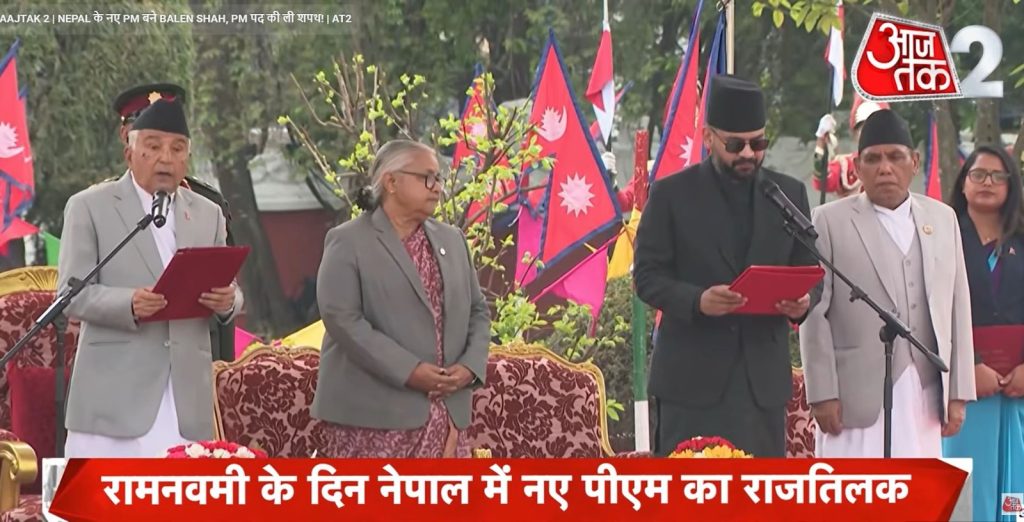
In an editorial, The Hindu, another influential Indian newspaper, stated that at 35, he is Nepal’s first Madhesi leader, and disrupts the old dominance of the Brahmin-Chettri Pahadi elite in the power structure. His swearing-in ceremony, conducted with Hindu rituals and Vedic chants at the President’s Office, was widely covered in Indian media.
After he took office, Indian television channel Aaj Tak gave a largely Hindu account of his oath-taking ceremony, calling it “Raj Tilak” (a ceremony of crowning a new king) in Nepal following the Gen Z movement.
“The swearing-in ceremony of Nepal’s new prime minister, Shah, was held on the day of Ram Navami, following Hindu Vedic traditions, which strengthens the cultural ties between Nepal and India,” the Aaj Tak report said.
“They also want to know whether Shah is anti-India or not,” Aryal said. “Given his Madheshi roots, they are keen to see what kind of relations he will pursue with India—his likely stance towards New Delhi, his political persona, and whether he follows or diverges from [former prime minister KP Sharma] Oli’s diplomatic approach.”
Oli rose in national politics on a nationalist plank, particularly after the Indian blockade of 2015-16 and the map row of 2019-2020.
Many Indian reports emphasise Shah’s strong youth support base, the role of the 2025 protests and anti-establishment sentiment.
“Some Indian media reports also raise suspicions about his links with Western powers,” Aryal said. “His rise as Nepal’s first Madhesh-origin prime minister, breaking the long tradition of hill elites in power, has come as both a surprise and a source of interest for Indian media. At the same time, there are concerns over some of his past positions, such as displaying the map of Greater Nepal [in office following India’s unilateral inclusion of Lipulekh and Kalapani in its map].”
Outlook India calls his rise a “Gen Z wave” against old political parties.
Its coverage frames him as a part of a broader political reset in Nepal driven by young voters.
Some other reports portray him as an anti-establishment, disruptive figure, a challenger to traditional elites, with a strong and sometimes controversial voice.
Indian Prime Minister Narendra Modi was among the first foreign leaders to congratulate RSP President Rabi Lamichanne and Shah for their election success. This also contributed to heightened media attention in India. Critics say Indian media narratives tend to tilt towards the establishment and toe its line on foreign policy.
Dhananjay Tripathi, associate professor at South Asian University, told the Post that two major elections in South Asia—those in Bangladesh and Nepal—witnessed contrasting media coverage in India.
“The Bangladesh election was more closely followed in Indian media for obvious reasons. By contrast, coverage surrounding Nepal elections focussed largely on evaluating the impact of Gen Z protests. While the unexpected mandate received some attention, the primary focus remained on the overall results and the decline of established political parties,” he said.
In some Hindi newspapers and Indian news television channels, Shah’s past remarks about India and nationalist stance are frequently mentioned.
Akanshya Shah, a Delhi-based Nepali scholar who works in different Indian think tanks, told the Post that there is a kind of curiosity in India at Shah’s personality, character and style.
She says that his age, in particular, is of interest, as it is unusual to see such a young person in a leadership role in the neighbourhood.
“I feel there is general excitement in India over the new prime minister. A frequent question asked by mediapersons here is whether Prime Minister Shah will engage openly with the media at home and abroad, or adopt a more controlled style, similar to PM [Narendra] Modi,” said analyst Shah.