
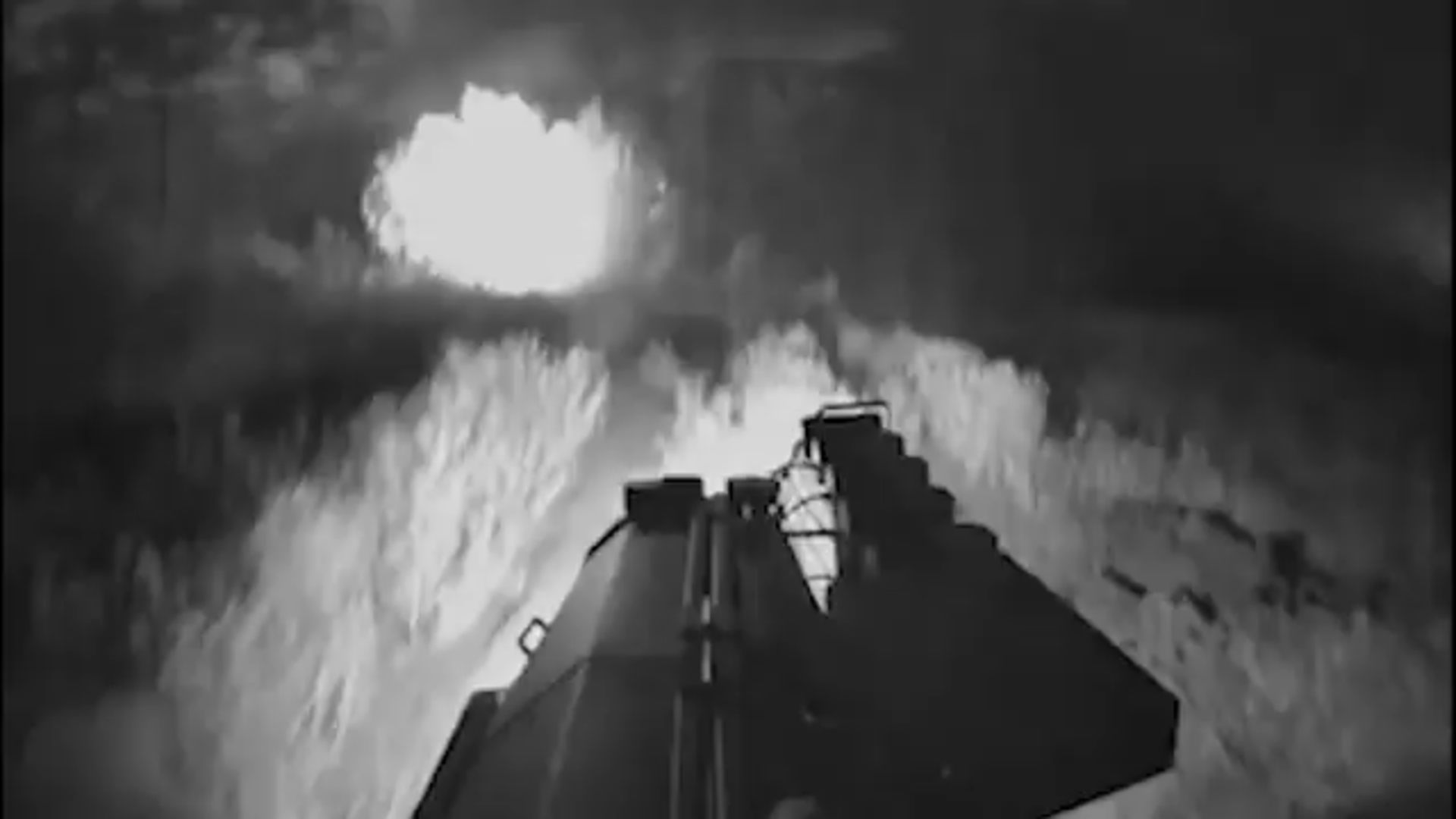
WATCH the nail-biting moment an armoured drone retrieves a wounded Ukrainian soldier who had been stuck in no-man’s land for 33 days.
The soldier had stepped on a landmine and kept himself alive with a tourniquet, as six previous attempts to rescue him had been unsuccessful.
On the seventh attempt, an unmanned vehicle set out on a painstaking five-hour-and-58-minute mission, crawling more than 40 miles along enemy lines.
Despite being “battered by blasts,” and even losing a wheel, the capsule continued its advance.
Once the vehicle arrives, the injured soldier climbs into the armoured capsule, sealing himself inside.
Moments later, an enemy drone drops an explosive but the armour holds firm, protecting its passenger.


“If the fighter didn’t give up, we had no right to give up,” said the medics of Ukraine’s First Separate Medical Battalion.
Grainy footage shows the remotely piloted vehicle inching across Russian-controlled territory as enemy drones hover overhead.
“The area is what we call a kill zone, with a very high density of enemy drones in the air, numerous mines and obstacles, and waiting drones -drones lying in ambush on the ground, waiting for movement,” explained Volodymyr Koval of the First Medical Battalion.
The rescue vehicle, known as the MAUL ground drone, was developed by the battalion specifically to evacuate wounded troops from otherwise unreachable positions.
Built on an ATV frame, encased in armour, and guided remotely through mined roads with the help of near-constant aerial surveillance, the UGV is designed to survive exactly the kind of mission it faced that day.
“The mine blast occurred en route to the wounded soldier.
“One of the wheels was damaged, but the drone remained operational and continued the mission,” said Koval.
“The UAV strike happened on the return leg – on the way back to the handover point where the medevac crew was waiting.
“The wounded soldier was unharmed [by the drone attack], as he was inside an armoured capsule.”
Once the drone reached Ukrainian lines, medics opened the capsule, lifted the soldier onto a stretcher, and removed his clothing and the tourniquet he had used for more than a month.
His limb has since been amputated, and he is now undergoing rehabilitation in Kyiv.
“The mission involved dozens of people – pilots, navigators, the planning group, drone operators providing overwatch, specialists from supporting units, and the medical evacuation team that was waiting to receive the wounded soldier,” Koval added.
According to the battalion, the MAUL is an armoured evacuation platform powered by an internal combustion engine and capable of speeds up to 43mph.
Its armoured capsule protects wounded personnel, while its airless metal wheels allow it to survive mines and rough terrain.
Production has since been taken over by DevDroid, a Ukrainian defence company, with each unit costing around £14,000.
Ukrainian President Volodymyr Zelensky praised the operation and vowed to expand the use of ground robots.
“We will scale up exactly this kind of technological backbone for our army – more ground robotic systems operating at the front, more drones of all types, and increased deliveries of modern solutions that help achieve results in combat, in providing supplies for our combat units, and in evacuating our wounded warriors,” Zelensky said.
Traditional medical evacuations are becoming increasingly difficult under constant fire.
Troops must first carry the wounded – or use ground drones – to reach a stabilisation point.


From there, patients often wait for conditions to become safe enough to move them by ambulance to larger hospitals.
Ground evacuation robots like the MAUL are now helping to bridge that deadly gap, reducing risk and saving lives.