
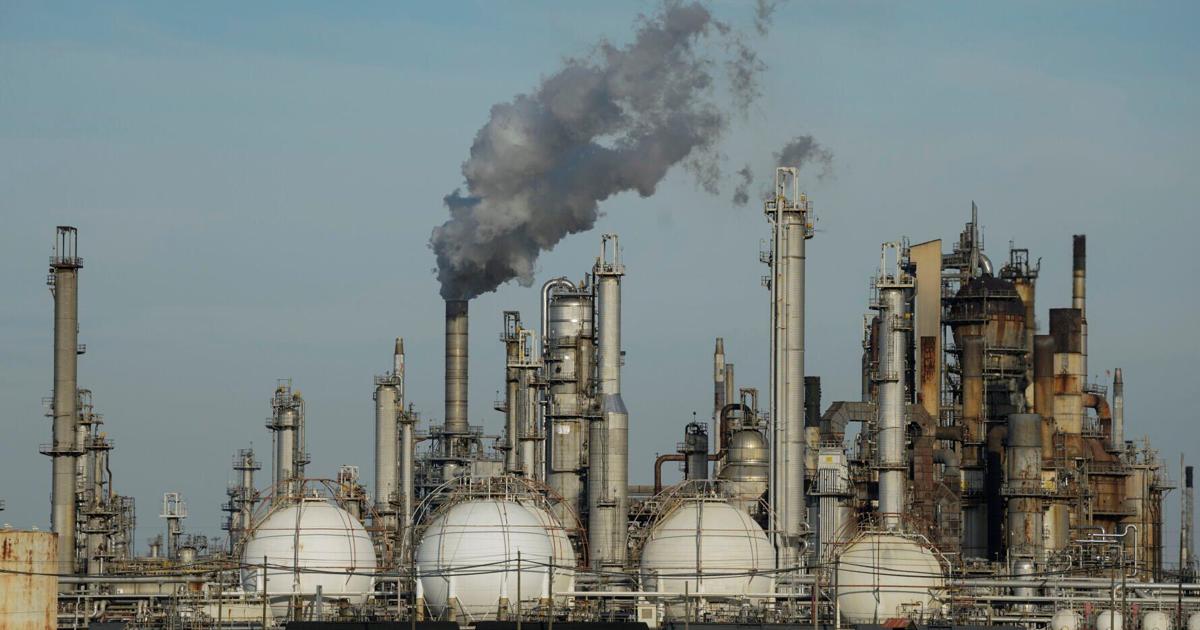
A central piece of a closed crude oil refinery in Convent recently came crashing down as Shell Oil shifts the nearly 60-year-old complex toward making renewable fuels, company officials confirmed.
The cat cracker and cat cracker reactor structure were demolished in a planned takedown this past weekend that was captured on video and posted on social media.
A Shell spokesperson and the St. James Parish president confirmed the demolition this week after being informed of the video.
“This was part of Shell’s planned demolition exercise, and they have been communicating with the parish for quite some time now,” Parish President Pete Dufresne said in a statement.
The video shows the familiar bulbous reactor vessel at the top of the cat cracker and another structure of entwined pipes coming down, with dust and audible cheers rising in the aftermath. The person who shot the video and posted it on social media could not be reached by Friday for permission to publish it. It has since been deleted.
A common piece of equipment in oil refineries, a cat cracker turns heavy crude oil into gasoline, which was one of the old oil refinery’s main products.
Even before the dramatic removal of the cat cracker, Shell had demolished other pieces of the oil refinery in a yearslong process to remake its operations in the parish and was continuing the work Friday morning with another expected “controlled demolition.”
“Some residents may notice loud noises during this time,” St. James Parish sheriff’s deputies said in a Facebook notice. “Shell has safety measures in place and will monitor the area during and after the demolition.”
Shell plans to locate a future renewable low-carbon fuels plant on 99 acres of the former refinery where demolition has been happening. About 200 more acres next to the refinery that has been in sugar cane production will be used for a rail spur and loading complex, state permit records say.
‘Replacing fossil fuel-based products’
The refinery was a major employer and taxpayer in the region before Shell idled it in late 2020. Built and opened by Texaco in 1967, the refinery later became part of joint ventures before Shell owned it fully in 2017.
In 2020, the oil major announced the shutdown after failing to find buyers for the 240,000-barrel-per-day oil complex. At the time, Shell said it was trying to reduce the number of its petroleum refineries and focus on integrated chemical and oil complexes and renewable fuels. Shell says it is striving to have net-zero greenhouse gas emissions by 2050 to help limit global temperature increases tied to those emissions.
Located near the Sunshine Bridge, the refashioned facility along the Mississippi River is expected to turn up to 6,000 tons per day of waste animal fats and vegetable oil into renewable diesel, sustainable aviation fuel, propane, butane and naphtha.
“Produced products will provide environmental benefits by replacing fossil fuel-based products in the marketplace,” Shell officials told regulators in an August 2022 permit application.
The shift at Convent is projected to mean sharp reductions in particulate pollution, sulfur and nitrogen oxides, carbon monoxide and greenhouse gases, but less so for toxic air pollutants, though some, like sulfuric acid and hydrogen cyanide, will be nearly or completely eliminated.
Even with the reductions, the complex expects to remain a major emitter of all those pollutants, permit documents say. Due to the large reductions, Shell was not required to model the cumulative impact of future air emissions, permit records show.
Toxic emissions are expected to total up to 673 tons per year. VOCs are expected to total nearly 1,854 tons per year. Shell told regulators that background air quality is expected to remain within federal and state limits.
Shell expects the facility to have about 85% less greenhouse gas emissions than the refinery did — about 252,100 tons per year — and produce a renewable diesel that has reduced tailpipe emissions on the road.