
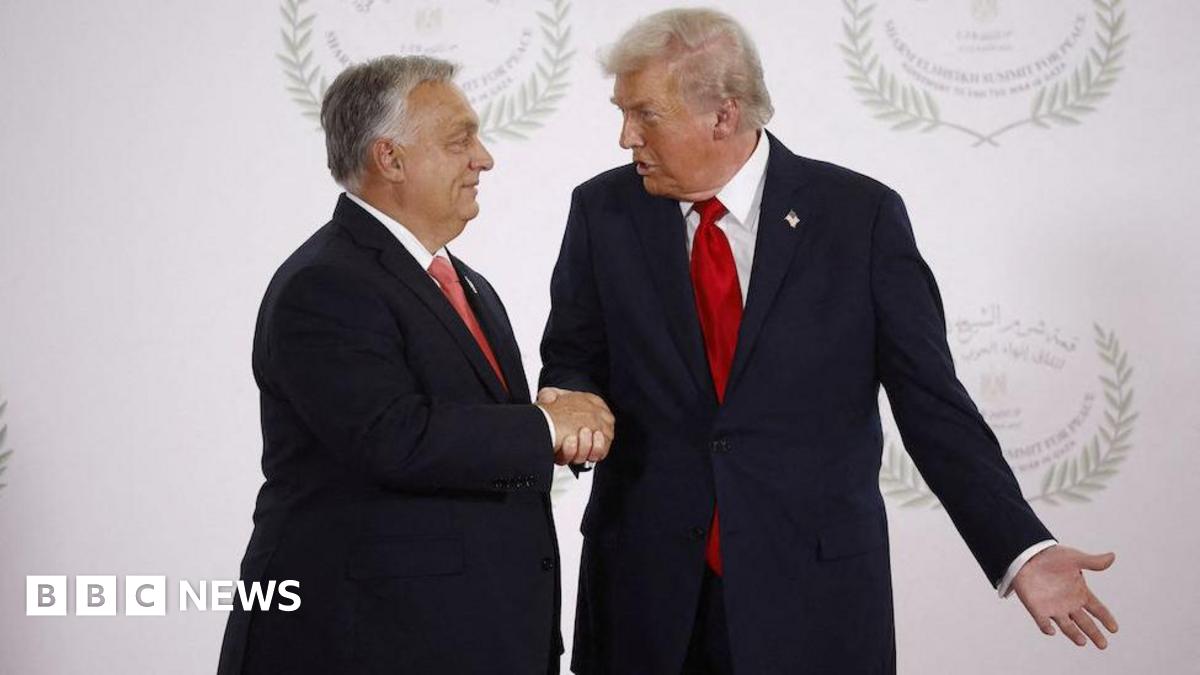
The biggest issue souring US-Hungary relations is oil.
In 2024, Hungary even increased the amount of oil it receives through the Druzhba (Friendship) pipeline from Russia. On 23 October, just as Orban was addressing a rally of his supporters in front of Parliament in Budapest, the US announced sanctions on the two giant Russian oil companies, Lukoil and Rosneft.
Hungary received 64% of its oil through the Friendship pipeline from Russia, via Belarus and Ukraine, in 2020. By 2024 that figure stood at 80%, or 5 million tonnes a year.
The Hungarian government argues that land-based pipelines are the cheapest way to receive oil, and that with no sea coast of its own, it has no alternative. Much smaller quantities are also imported from Kazakhstan, Croatia, Iraq, and Azerbaijan.
Another issue is that Russian Urals crude has a higher sulphur content than the Brent crude supplied from elsewhere. The major Hungarian refinery at Szazhalombatta, run by Hungarian oil giant MOL, and the Slovnaft refinery in Slovakia, also run by MOL, are both set up to process mostly Urals crude, not Brent.
Within the EU, Orban is now the longest standing leader. Far from leaving the bloc, he wants to remake it in his own image, as a union of sovereign nations. For this, he has also won praise from Putin.
But Hungary’s argument that it cannot change is undermined by the Czech example. That is a country with a similar population to Hungary, and also landlocked.
The Czech Republic traditionally relied heavily on Russian crude for the eight million tonnes of oil it needs a year.
Starting in early 2022, following the full-scale Russian invasion of Ukraine, the Czech government under Prime Minister Petr Fialla invested heavily in improving the existing Transalpine pipeline to the Italian port of Trieste.
At the same time, its refineries at Kralupy and Litvínov were adapted for Brent crude. In April 2025, the Czech authorities announced proudly that they were no longer receiving a drop of Russian oil.
Energy experts say that while MOL, the Hungarian oil giant, is quietly changing its technology, what is missing is a political decision from the government to shift to the Adria pipeline from the Croatian port of Omisalj.
There are also disputes between the Croatian company Janaf and MOL – over just how much oil the pipeline could support.