
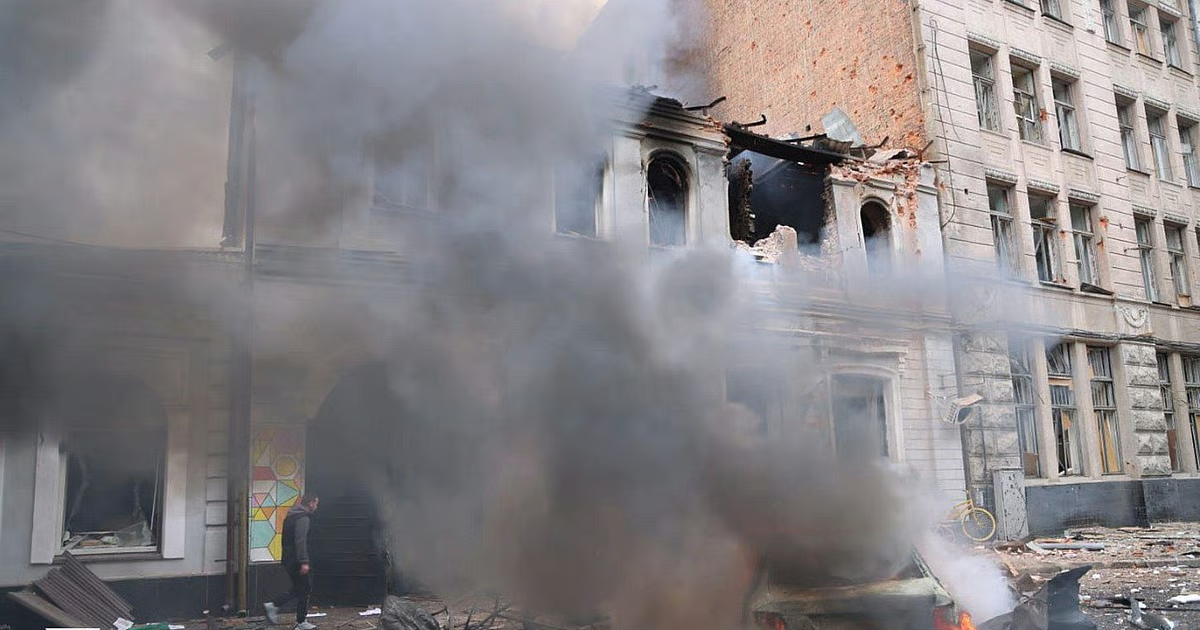
Russia’s defence ministry, meanwhile, claimed that 44 Ukrainian drones were intercepted overnight and into Wednesday morning, with eight shot down over the southern region of Dagestan. However, none were reported intercepted over Mordovia, suggesting Ukraine’s aerial strike had found its mark.
Artyom Zdunov, head of Mordovia, confirmed that the region had suffered a “large-scale drone attack”, acknowledging damage to a local enterprise — an unusual admission in a country where officials have often downplayed strikes on domestic targets.
Farther south, a second wave of Ukrainian drones struck the Makhachkala oil refinery in Dagestan, damaging a key processing unit. The refinery is known to supply fuel to Russian naval vessels of the Caspian Fleet, making it a strategically significant target in Ukraine’s campaign to erode Russia’s military logistics.
In a fleeting post on Telegram, Makhachkala Mayor Dzhambulat Salavov reported that the drone attack had damaged several commercial facilities and two vehicles in the city. His message vanished within 12 minutes — but not before users captured an accompanying photograph that appeared to show military vehicles among the wreckage, raising questions about what exactly the refinery complex was sheltering.
Ukraine’s military described the attacks as part of an effort to “reduce Russia’s military-economic potential”, signalling Kyiv’s growing confidence in conducting operations well beyond the frontlines.
The overnight assault followed Tuesday’s precision strike on the Bryansk Chemical Plant, carried out with UK-supplied Storm Shadow missiles. Ukrainian officials said the operation was jointly conducted by the Air Force in coordination with the Navy, Land Forces, and special units — underscoring the country’s increasingly sophisticated command structure and Western-aided strike capabilities.
Storm Shadows, prized for their low radar signature and long range, have previously been deployed against targets in Russia’s Bryansk and Kursk regions as well as Russian-occupied Crimea. Their latest use signals Ukraine’s intent to systematically dismantle the industrial backbone sustaining Moscow’s war effort.
These escalating strikes come as Kyiv and Washington engage in delicate talks over the potential supply of Tomahawk cruise missiles, a weapon system that could further extend Ukraine’s reach into Russian territory.
Speaking earlier this week, President Volodymyr Zelenskyy said that strengthening Ukraine’s long-range strike capacity could “increase pressure on Russia to seek a diplomatic path out of this full-scale war,” hinting at a strategy that blends battlefield precision with political calculation.
For now, the fires in Saransk and Makhachkala burn as stark reminders that the war, once confined largely to Ukrainian soil, is now casting its long, explosive shadow across Russia’s own industrial heartland.
With IANS inputs