
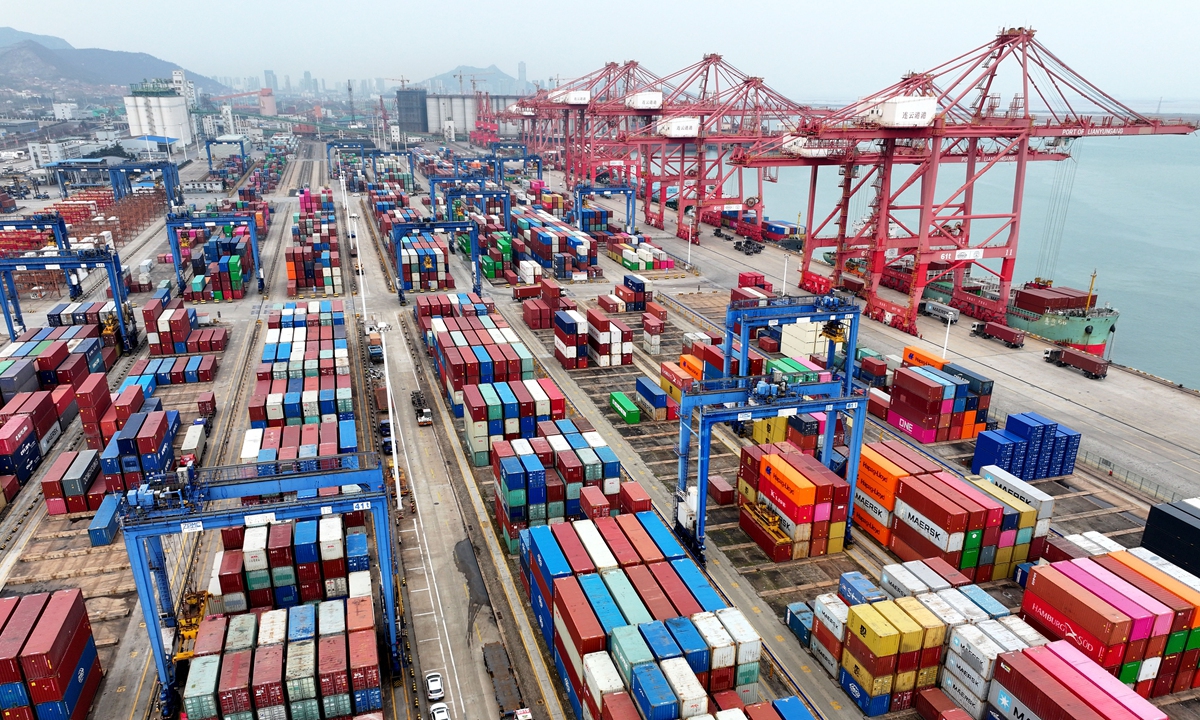
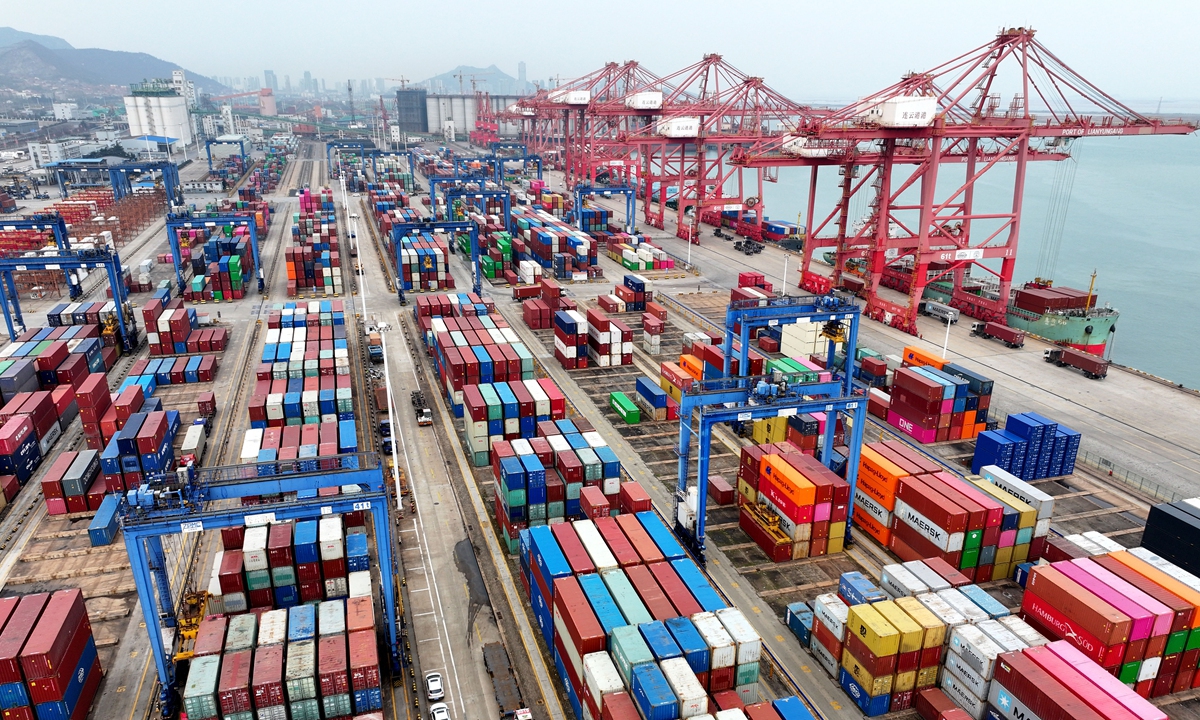
Containers at the Lianyungang Port in Lianyungang City, East China’s Jiangsu Province Photo: VCG
Against the backdrop of Washington’s threat to impose additional tariffs on Chinese goods, a report by the South China Morning Post on Sunday has drawn considerable attention. MyActuator, a Chinese manufacturer of intelligent drive modules for humanoid robots, has seen a sudden surge in orders in the past week alone as US humanoid robot producers and artificial intelligence (AI) companies, including industry leader OpenAI, rush to secure critical components amid Washington’s tariff threat, according to the report.
This scenario bears a striking resemblance to the panic buying by US companies during the last round of trade frictions. It not only underscores the inextricable ties between Chinese and US industrial chains but also highlights the deeply intertwined complementary structure they have formed within the global industrial ecosystem.
In recent years, the US has rolled out a series of policies to curb China’s advancement in high-end technologies, seeking to build “technological barriers” in areas such as semiconductors and AI. However, in the broader manufacturing and application fields, US companies face an unavoidable reality: China’s industrial chain has become an indispensable support for the commercialization and practical application of their technologies.
This is not a coincidence but the result of decades of accumulated advantages in China’s manufacturing industry. From large-scale precision-component production and a complete R&D-to-logistics industrial ecosystem to rigorous cost and efficiency controls, China has become indispensable in fields such as robotics and electronic components in the global manufacturing landscape.
While the US may hold a first-mover advantage in certain areas of high-tech R&D, the value of technology is never confined to theoretical breakthroughs in the lab. The development of high-end technologies ultimately needs to be transformed into manufactured products and services, which relies on a mature manufacturing system and huge consumption market. The US has long been plagued by the problem of manufacturing hollowing-out. It is precisely in these areas, such as hardware equipment and core components that China has established globally leading capabilities.
Take the robotics industry as an example. China has achieved large-scale application in industrial robots while also accelerating its presence in cutting-edge fields like humanoid robots, establishing a complete industrial chain from core components to finished product manufacturing.
Artificially severing this mutually beneficial industrial linkage would hinder the development of high-end US technologies. If the US pursues “decoupling” through tariff hikes and export or technology restrictions, it may affect certain Chinese firms in the short term; in the long run, however, American firms could face supply‑chain disruptions and sharply higher production costs, delaying commercialization of their own innovations.
The advancement of high‑end technologies is not isolated, and it depends on a virtuous cycle connecting application scenarios and manufacturing capacity. US strengths in basic AI research and China’s expertise in application development and market deployment could form an ideal complementary pattern.
As a spokesperson for the Chinese Commerce Ministry previously stated, “China and the US share extensive common interests and broad space for cooperation. Cooperation benefits both sides while confrontation harms both.” This statement is grounded in a clear recognition of the deeply integrated industrial chains between the two countries. From consumer electronics to new-energy vehicles, and from semiconductors to AI, cooperation across multiple industries has created a pattern of interdependence. And restrictive policies cannot change that without paying a heavy price.
The global industrial chain is undergoing profound restructuring, with technological revolution and geopolitical conflicts intertwined to create an uncertain international economic environment. Nevertheless, the industrial chain links formed based on comparative advantages and market laws are far more resilient than political games.
For the US, leveraging this complementarity may be more effective in maintaining its technological strengths than artificially trying to contain China. For China, continuously strengthening the core competitiveness of its manufacturing industry and deepening cooperation in the global industrial chain are key factors in addressing external challenges and achieving high-quality development.