
Ammonia-Based Hydrogen Fuel Cell-Powered Crude Oil Carrier
Receives Approval in Principle (AIP) from French Classification Society
“We Will Lead the Development of Hydrogen Mobility Technology”
Samsung Heavy Industries has taken its first step in developing next-generation eco-friendly ships. By obtaining international certification for a hydrogen fuel cell-powered vessel, the company has secured technological reliability and opened up possibilities for commercialization.
On September 24, Samsung Heavy Industries announced that it had received Approval in Principle (AIP) for the basic design of an “ammonia-based hydrogen fuel cell-powered crude oil carrier” from Bureau Veritas, the French classification society. The ammonia-based hydrogen fuel cell system separates ammonia into hydrogen and nitrogen through a “cracking” process, supplying the extracted hydrogen to the fuel cell to generate electricity. Since the ship is powered by the chemical reaction between hydrogen and oxygen, this technology is drawing attention as a next-generation eco-friendly propulsion method.

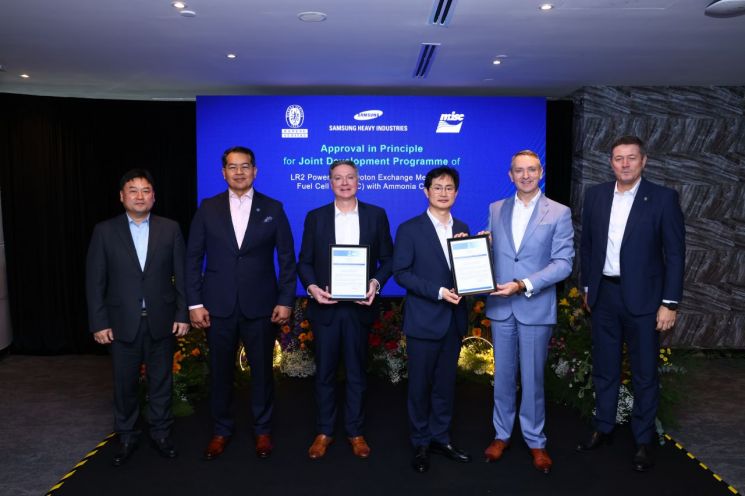
Drago Pinterich, Vice President of Bureau Veritas France BV (from right), Alex Greg Smitch, Senior Vice President of Bureau Veritas BV, Jang Haeki, Vice President of Technology Development Headquarters at Samsung Heavy Industries, Nick Porter, President of AET (a subsidiary of MISC), Zahid Osman, President of MISC, and Kim Dongju, Head of Technical Sales Team at Samsung Heavy Industries, recently signed an agreement to proceed with an international joint development program for the commercialization of an ammonia-based hydrogen fuel cell-powered crude oil carrier. Samsung Heavy Industries
The vessel that received certification this time is a 115,000-ton crude oil carrier. It is equipped with polymer electrolyte membrane fuel cells (PEMFC) that can start quickly at low temperatures and offer excellent durability. Samsung Heavy Industries explained that it has enhanced safety by distributing two 5 MW-class ammonia cracking units and six 2 MW-class fuel cells throughout the ship, while also minimizing noise and vibration.
In this process, Samsung Heavy Industries applied equipment from domestic companies. The cracking equipment was manufactured by Panasia, headquartered in Busan, and the fuel cells were developed by Vincen, based in Geoje, Gyeongnam. In addition, Malaysia’s state-owned shipping company MISC provided operational data for the vessel, and the French classification society was responsible for certification and evaluation, establishing a global collaborative system. Through this, Samsung Heavy Industries stated that it has secured technological reliability and expects to accelerate both economic feasibility assessments and commercialization in the future.
Jang Haegi, Vice President and Head of the Technology Development Headquarters at Samsung Heavy Industries, said, “Fuel cells are an important propulsion device for next-generation eco-friendly ships,” and added, “Samsung Heavy Industries will continue to lead hydrogen mobility technology through ongoing research and development.”
Earlier this month, at “Gastech 2025” held in Milan, Italy, Samsung Heavy Industries also received Approval in Principle for the basic designs of a “molten salt reactor (MSR)-powered liquefied natural gas (LNG) carrier” and an “80,000-cubic-meter liquefied hydrogen carrier,” further accelerating the development of eco-friendly ship technologies.
Hot Picks Today
© The Asia Business Daily(www.asiae.co.kr). All rights reserved.