
Jonathan Reid was building a steady career in digital marketing in 2019, when his partner sent him a message that upended his ambitions.
It was a photo of a chalkboard that read: “Scissor makers wanted.”
“She sent me the picture as a joke, I think,” Reid, 32, recalls. “She wasn’t expecting me to immediately go to [find] the workshop and ask if I could be a scissor maker.”
Reid found himself on the premises of Ernest Wright, the last remaining manufacturer of traditional handmade scissors in the historic steel city of Sheffield, South Yorkshire. Now working as a putter — short for putter-togetherer — he is fully employed in one of the UK’s 165 endangered heritage craft industries.
Leaving a job in the tech sector, long seen as a safe route to a promising career and a high salary, to learn an almost-extinct craft seemed like a risky move. But as artificial intelligence threatens once-secure jobs, the human touch of crafts looks, to some, like an unexpectedly enduring career choice. “For the time being” Reid says he feels “more secure in his job”. His industry’s survival by adaptation, he adds, offers potential lessons for today’s at-risk businesses.
“AI is a big threat to a large part of the creative industry,” says Daniel Carpenter, executive director of the charity Heritage Crafts, which compiles the list of endangered trades. “We think craft is probably quite resilient to that. So we’re looking to take advantage of this competitive edge to promote craft as skills for the future.”
He is not the only one feeling upbeat. The global handicrafts market, valued at $907bn last year, is forecast to more than double to $1.94tn by 2033, according to the analysts Research and Markets. A Crafts Council survey this year found that, of those with an opinion, more than 60 per cent were optimistic about the future of the sector. In a recent International Labour Organization assessment of professional vulnerability to AI, craft workers ranked among the least exposed.
Once core to the labour market, trades such as blacksmithing, willow weaving and letterpress printing dramatically declined in 20th-century Britain, as automation and offshoring incentivised a switch to mass-produced products.
Today, such work represents an employment niche. In 1891, the UK had about 14,000 professional basket makers, for example, but this fell to 5,500 by the mid-1930s. Recent numbers are thought to be closer to just 200.
Still, Staffordshire-based second-generation basket maker Eddie Glew has “never been more positive” about his industry. “Since I got into it, it’s only gone one way, it’s only gone upwards.”
While mass production has slashed demand for handcrafted essentials, bespoke, high-quality products still command a premium price. A focus on craftsmanship and physical wares means less vulnerability to AI than computer-based jobs.
Research by Etsy, the maker-focused ecommerce platform on which $10.9bn in goods were sold last year, found that 94 per cent of buyers on its site prioritised the quality of goods and 84 per cent saw mass-produced items as lower quality. “We’re seeing clear signs that buyers place a premium on work shaped by human hands,” Josh Silverman, Etsy chief executive says. “I believe handcrafted work will only grow more coveted and celebrated as AI and automation become more common.”
Glew says larger businesses are waking up to this: when he started working with interior designers “you’d be an invisible person . . . Whereas now they’re a lot more keen on telling my story.” He has forged a career in the high-end market, specialising in made-to-measure baskets for designers and sculpture weaving, including bespoke work on the Alton Towers’ Wicker Man rollercoaster.

Carpenter of Heritage Crafts points out that high end is not always about “expensive things, it’s not about bling or status or showing off” but “that sense of authenticity . . . and the human story behind the things”. Distributors have cottoned on to demand for such items: brands such as Fortnum & Mason and Liberty highlight the unique nature of crafted products, while Amazon sellers can register under a dedicated Handmade designation for artisan producers.
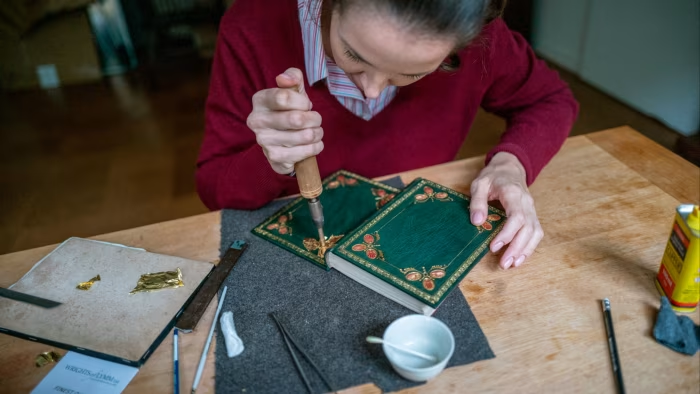
Maria Ruzaikina, a London-based bookbinder, has also sought career security with wealthier customers. Expert in tooling covers with intricate gold designs, she works mostly for private collectors seeking more than just function. “Many of my clients buy books as an alternative investment,” she says. “In terms of what I bring to the table, I help to increase the value of rare books.”
Many craftspeople are also adapting by acquiring such contemporary skills as social media marketing. Ernest Wright posts images from its scissor making workshop on Instagram, alongside black-and-white photos illustrating its 123-year history. TikTok’s BookTok trend has boosted interest in bookbinding. This storytelling is an increasingly important part of the business, says Carpenter. “Traditional craftspeople who are really succeeding at the moment are those who are opening up their workshops to the world.”
Another lucrative income stream is teaching workshops for hobbyists. A Craft Council survey in 2020 found more than a fifth of makers supplemented their earnings by teaching workshops or courses.
But even amid the optimism, there are deep challenges in the sector, from post-Brexit bureaucratic demands on small businesses exporting goods, to the relatively small customer base. “A hundred years ago I would have had several hundred colleagues, because their skills were used widely,” Ruzaikina says. Today, “no one needs hundreds of gold finishes [on book covers] . . . It’s a smaller market.”
Many craftspeople struggle to make a living. The Craft Council has estimated that the median income for people pursuing their craft full time is about £33,000 a year, but this represents just two-fifths of those surveyed, with many more reliant on an additional income.
The Heritage Crafts charity is running a hardship fund for makers. “We’ve had over 1,200 applications to that in the last year,” says Carpenter. “It just goes to show how much people are struggling.”
The Heritage Craft list of 165 most at-risk industries increased by 19 crafts since 2023. For Reid, working in Sheffield means the precarious nature of industry is never far from his mind. The city was once home to as many as 40,000 cutlery workers, with about 70 scissor-making companies alone. Today, he is one of only about 20 scissor makers left in the UK.
Yet Ernest Wright has a full order book and more newly trained putters in its workshop than it has had for years. Reid is evangelical about the quality of the scissors. But the “ecosystem in Sheffield of small businesses relying on each other” has been just as important to the company’s survival through industrial revolutions.
“The thing you have to do is something AI could never replicate,” he says. “That’s the very human aspect of this — and that’s the community-building.”