

AS Malaysia enters a new phase of digital transformation, the nation’s digital economy continues to play an increasingly important role in driving economic growth, innovation and national competitiveness.

This year, as the Malaysia Digital Economy Corporation (MDEC) marks its 30th anniversary, the milestone provides an opportunity to reflect on how far Malaysia’s digital economy has come and, more importantly, where it needs to go next, with a renewed focus on productivity, resilience and creating greater economic value through digitalisation.
Resonating with The Star’s own journey as it marks its 55th anniversary, MDEC chief executive officer Anuar Fariz Fadzil shares his perspectives on the next phase of Malaysia’s digital economy, the evolution of the digital creative industry, the importance of cross-sector collaboration and the role of trusted media in supporting the nation’s digital aspirations.
> How do you see the current trajectory of Malaysia’s digital economy, and what areas require the most urgent attention for the country’s growth and nation-building efforts?
Over the past decade, we have successfully laid the foundations for a vibrant digital ecosystem.
Today, the conversation is about translating these digital capabilities into higher productivity, stronger economic resilience and meaningful outcomes for businesses and the rakyat.
This progress is reflected in the digital economy’s contribution of RM451.3bil, or close to a quarter of Malaysia’s economy in 2024.
Building on this progress, the Malaysia Digital Action Plan 2030 (MD2030) provides a clear national roadmap towards realising Malaysia’s aspiration of becoming an AI Nation by 2030 by transitioning the country from a consumer of technology to a producer of homegrown digital innovations.
Realising this vision will depend on three key priorities: improving productivity through digitalisation, building an industry-ready talent pipeline in areas such as artificial intelligence (AI), cybersecurity, chip design and cloud architecture, and strengthening trusted digital infrastructure supported by greater digital sovereignty and national capability.
Through MD2030, Malaysia has set ambitious yet measurable goals, including increasing the digital economy’s contribution to 30% of GDP, creating 500,000 high-value digital jobs, delivering 95% of government services fully online from end to end, and generating RM4.5bil in public sector savings.

> What role is MDEC playing in the review of the National Creative Industry Policy (DIKN), particularly in representing the needs of Malaysia’s digital creative sector? What progress has been made so far, and what key issues does MDEC hope the revised policy will address?
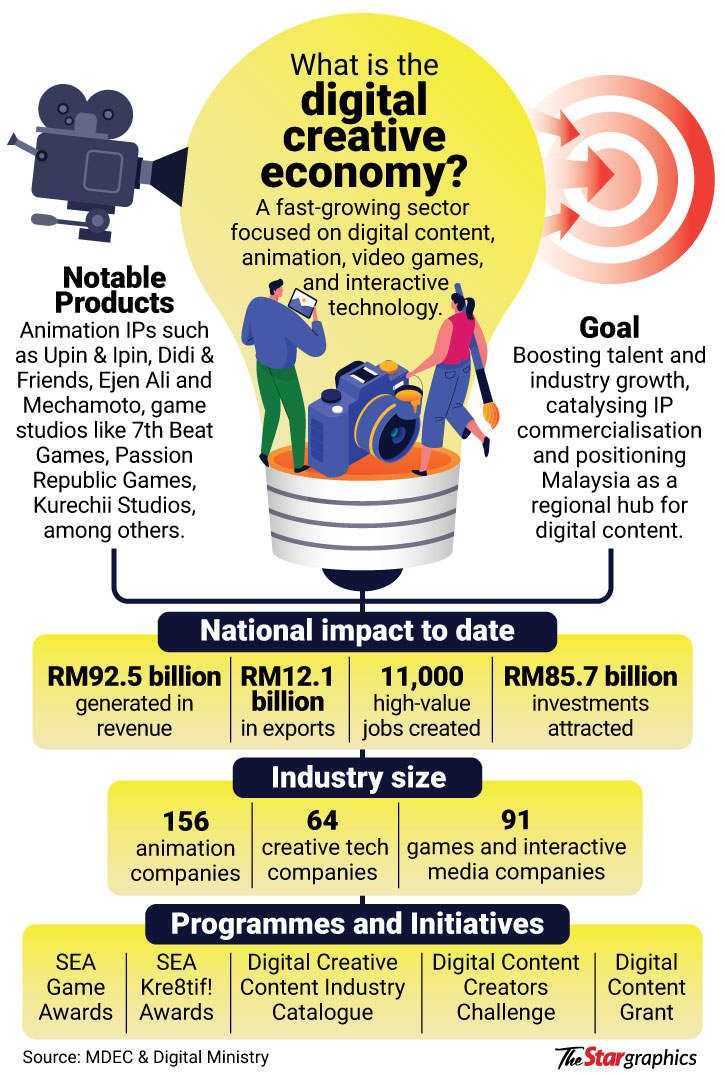
As the agency responsible for advancing Malaysia’s digital creative industry, MDEC is contributing industry perspectives, data, and market insights to the policy development process.
We are also engaging relevant stakeholders across animation, digital games, immersive technologies and digital content to ensure that the sector’s priorities and challenges are properly represented.
The updated DIKN should align with broader national priorities under the 13th Malaysia Plan (2026-2030), while supporting the nation’s wider digital ambitions through stronger intellectual property commercialisation, talent development and export growth.
Looking ahead, the updated DIKN will strengthen Malaysia-owned intellectual property, improve access to financing that enables studios to scale internationally, develop future-ready talent through stronger industry- academia collaboration, accelerate international market access and strengthen whole-of-government coordination to improve implementation and maximise industry impact.
> As Malaysia’s digital and creative industries continue to evolve rapidly, how important is collaboration between government agencies, industry players and the media in helping the public better understand these developments and ensuring important issues remain part of the national conversation?
Collaboration between government, industry and the media is essential. No single organisation can drive this transformation alone.
From MDEC’s perspective, each stakeholder has a distinct but complementary role.
The government creates an enabling ecosystem through policies, talent development and funding, while industry players drive innovation and understand evolving market needs.
The media plays a critical role by bridging these efforts with the public by helping raise awareness about emerging technologies, showcasing Malaysian success stories and highlighting career opportunities in the digital creative sector.
This is particularly important in changing perceptions that animation, games and digital content are not just forms of entertainment but high-value industries that generate exports, attract investment, create quality jobs and contribute to Malaysia’s digital economy.
The media also plays an important role in scrutinising claims, asking difficult questions and holding institutions accountable, helping to ensure that public discussion remains informed, balanced and grounded in evidence. This collective approach will be instrumental in realising Malaysia’s aspiration to become a leading regional digital creative hub and a recognised producer of world-class digital content and original intellectual property.
> In today’s rapidly changing media landscape, what more can media organisations do to better serve the people while shaping public discourse and supporting Malaysia’s nation-building efforts?
In an increasingly digital world, trusted journalism remains essential in helping people distinguish fact from misinformation and make informed decisions.
Media consumption habits have also changed significantly over the past decade. Statistics show that Malaysian print news usage fell from 45% in 2017 to 18% in 2025; and that 40% of Malaysians use TikTok for their weekly news consumption.
Beyond informing the public, media organisations can also support Malaysia’s digital transformation by helping Malaysians understand the opportunities and challenges presented by emerging technologies.
This includes promoting digital and AI literacy, explaining complex technologies in accessible ways, and enabling individuals and businesses to embrace digital transformation with confidence.
Equally important is fostering constructive public discourse by bringing together government, industry, academia and communities to discuss opportunities, challenges and policies that support Malaysia’s digital economy and AI Nation aspirations.
By continuing to champion trusted journalism, fostering digital literacy and highlighting Malaysia’s innovation journey, media organisations will remain an indispensable partner in advancing the nation’s digital aspirations and long-term development.