
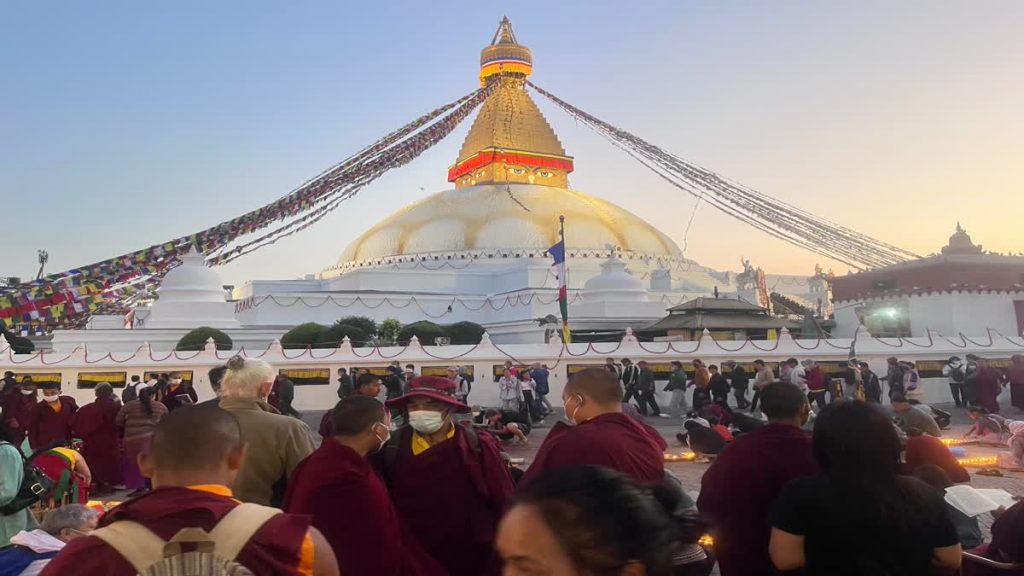

Buddhist monks at Kathmandu’s Boudhnath stupa in Nepal. (Surendra Phuyal via ETV Bharat)
Kathmandu: Despite recent perceptions in China that the new youth-led government in Nepal might tilt towards the West and not China, the abrupt cancellation of an international meet on Tibetan studies proved otherwise.
That move illustrated that Kathmandu continues to remain responsive to Beijing’s sensitivities, especially when it comes to Tibetan issues, and that it doesn’t matter whether it’s cultural, religious, political or even academic matters.
Nepal shares its northern border, measuring some 1,450m, with the Tibetan Autonomous Region of China, and has been home to nearly 15,000 Tibetan refugees – who fled Tibet, alongside their spiritual leader the Dalai Lama, after the 1959 uprising.
That Kathmandu’s close ties with Beijing remain as intact became clear this week when Nepal’s Chief Secretary Govinda Bahadur Karkee requested the organiser of the Tibetan studies gathering, Kathmandu University (KU), to cancel the 17th International Association for Tibetan Studies (IATS) seminar, due to take place in Kathmandu from August 23 to 29.
It was expected to see a gathering of over 7,000 scholars of Tibetan and Buddhist studies from nearly 40 countries, including 159 from the United States and nearly 100 from China.
Karkee’s move followed last-minute Chinese concerns about the gathering, conveyed on July 21 to Nepal’s Foreign Secretary Amrit Bahadur Rai by Chinese Ambassador to Nepal Zhang Maoming.
China was particularly concerned about possible representation of delegates close to, or sympathetic to, the Tibetan exile administration based in Dharamsala, India, who, it feared, could have used the forum to criticise Beijing’s recent policies, including those currently being implemented in Tibet promoting national unity, reports said.
“We advised the organisers that it would be better not to hold the event,” a report in The Kathmandu Post quoted Chief Secretary Karkee as saying.
“It could be sensitive, several concerns might arise, and it could pose security risks. So we advised the organisers, in good faith, to cancel the event.”
The Post report noted that the sudden order to cancel the meet, which is said to have taken four years for the university to prepare, came despite clearance from Nepal’s Home Ministry and security officials who earlier said that the international conference would not throw up any security risks.
China is an important neighbour of Nepal.
On October 13 2019, visiting Chinese President Xi Jinping famously warned that “anyone attempting to split China will end in crushed bodies and shattered bones”.
He issued such a statement during his meeting with then Nepali prime minister KP Sharma Oli, according to China’s state broadcaster CCTV, now renamed CGTN.
He did not directly refer to the Tibetan activities that occasionally happen in Nepal.
Bipin Adhikari, a professor of law at Kathmandu University, which was organising the now-cancelled Tibetan studies seminar, observed that it was a wise move on the part of the Balendra Shah government to demonstrate such sensitivity in the interest of geopolitics.
“Politically speaking, if such meetings make one of our close neighbours, China, unhappy, it is always better to drop such programmes,” Adhikari told ETV Bharat.
Considering China’s sensitivity over all matters Tibetan, he suggested: “It would have been better if the name of the seminar could have been changed to Himalayan Buddhism studies as we in Nepal also share similar cultural, religious and philosophical traditions and values. We should call it Himalayan Buddhism as opposed to Tibetan Buddhism.”
Exiled Tibetan activists have expressed shock and dismay at Kathmandu’s decision to call off the international meet.
India-based Tibetan researcher Tenzing Dadul wrote on X: “What I find curious is that this seminar was announced several years back and it took #China just a few weeks to cancel it in #Nepal. Why did #Nepal bow down to Chinese pressure? Why did #China apply pressure and raise the issue only now, just a few weeks before the seminar was actually set to take place?”
Another India-exiled Tibetan activist and writer, Tenzin Tsundue, wrote: “Nepal is neither free nor independent, even the youth government buckled under #China pressure and cancelled Tibet Studies conference yesterday. Why did Nepal agree to host this academic conference in the first place? IATS is an international scholars’ association. Scholars come from India, Nepal, the West and China. It dispassionately discusses Tibet studies not from any political stance, neither Chinese nor Tibetan.”
Nepal has traditionally maintained good ties with China and, as a result, has been cautious of activities of the Tibetan community.
Still, veteran Nepali journalist and founder of Himal Southasian Magazine, Kanak Mani Dixit, felt the cancellation of the Tibetan event set a poor precedent.
“Nepal should be evolving as an open hub for scholarship in South Asia and Asia as a whole, the government cancelling a Tibetan studies conference four years in the planning sends a chilling message.”