
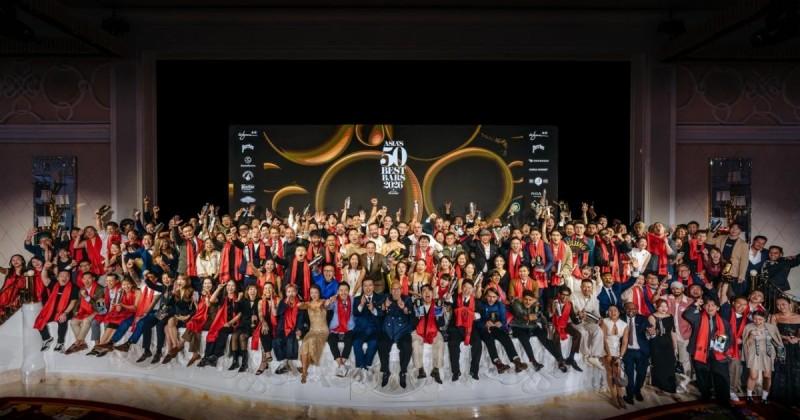

Class of 2026 – Asia’s 50 Best Bars
At 8pm on July 28, under the lights of the Grand Theatre at Wynn Palace, the countdown hit zero on a giant screen, and more than a thousand members of Asia’s bar industry watched a Cantonese speakeasy with no sign on its door become the most talked-about bar on the continent. Hope & Sesame, hidden behind a traditional grocery store in Guangzhou’s Dongshankou district, was named The Best Bar in Asia 2026, sponsored by Perrier: the first mainland Chinese bar to top the ranking in its eleven-year history.
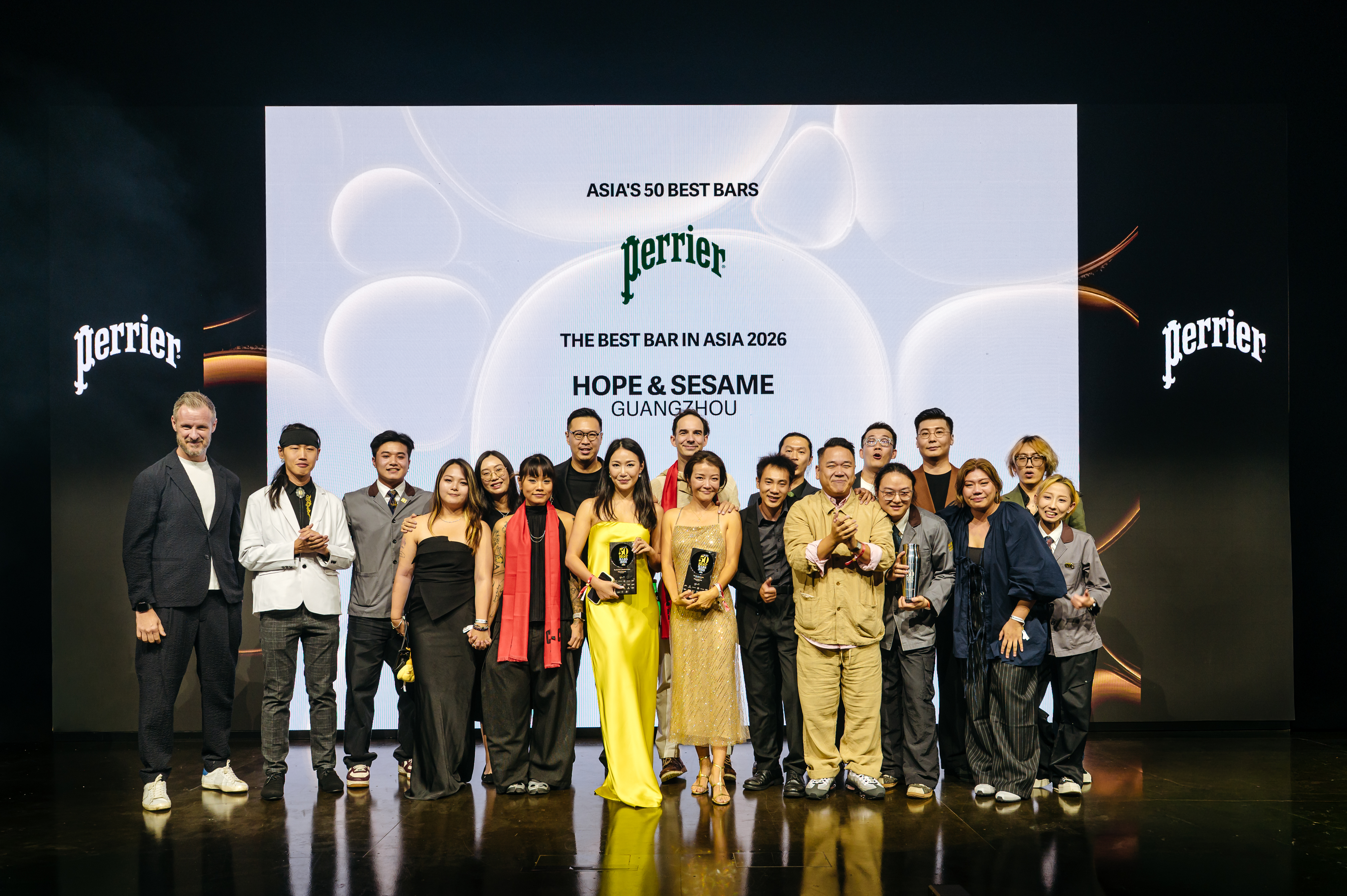
Team Hope and Sesame – No. 1 on the list – Asia’s 50 Best Bars 2026
It capped a genuinely surprising year on the list itself. Three of 2025’s top ten bars vanished from the top 50 entirely. Japan failed to place a single bar in the top ten for the first time since the awards began in 2016. And Wynn Macau and Wynn Palace, hosting for the second consecutive year, ran a six-day programme of guest shifts, feasts, and after-parties that told you as much about the state of Asian hospitality as the list did.
Here’s the full read on what happened, on the rankings, on stage, and everywhere around it.
The coronation: Guangzhou’s decade pays off
Hope & Sesame’s rise is one of the more patient success stories in the region’s cocktail scene. Andrew Ho and Bastien Ciocca, who met at hospitality school in Switzerland, opened the bar in March 2016 as the first speakeasy in southern China, at a point when Guangzhou barely registered on the region’s drinking map and neither founder had actually run a bar before.
Seven consecutive years on Asia’s 50 Best Bars followed: a steady climb to No. 7 in 2025, a debut appearance on the World’s 50 Best Bars at No. 29 that same year, and, tellingly, Ho picking up the Altos Bartenders’ Bartender Award, the programme’s only fully peer-voted honour, in 2025. In hindsight, that felt less like a consolation prize and more like the industry telling you where this was headed.

Hope & Sesame
What got the bar over the line technically is a house-style built on clarification, sous-vide infusion, and in-house distillation, applied almost entirely to Cantonese and diasporic Chinese flavour memory, a savoury Truffle Banana Bread riff up front, and a chrysanthemum-and-wintermelon Wintermelon-High poured in the live-jazz secondary room out back. The win landed on the bar’s tenth anniversary, and Ho took the stage with a visibly emotional team that had grown from four people to over a hundred, then put the moment about as plainly as anyone could when asked how it felt: the only real question, he said, was why not sooner.
It matters past Hope & Sesame’s own four walls, too. Mainland China posted seven bars in the top 50 this year, its highest tally ever, more than double 2025’s three, with Shenzhen alone landing two bars in the top ten (MO Bar Shenzhen at No. 5 and Obsidian Bar debuting straight into the top ten at No. 10) alongside first-timers in Shanghai, Chengdu, and Beijing. Hong Kong bars had held the No. 1 spot for five consecutive years running into this ceremony, Coa’s three-peat from 2021 to 2023, then Bar Leone’s back-to-back wins in 2024 and 2025.
This is the year that streak broke, and it broke to a neighbour rather than a challenger from across the region, which is a very different story for Hong Kong’s bar scene to sit with than losing to Seoul or Bangkok would have been.
Reading the movement: who rose, who fell
The comparison against 2025 is where this year’s list gets genuinely interesting, because the churn wasn’t confined to the usual shuffling in the 30s and 40s; it reached into the top ten.

The List
Zest is the quiet story of consistency here, steady at No. 2 for a second straight year and Korea’s best bar for a third, while Jigger & Pony’s slide from No. 3 to No. 9 is a reminder that even a bar with seven straight top-ten finishes behind it isn’t immune to a strong year from everyone else. It’s still Singapore’s best bar and still comfortably top ten, so this reads less like a stumble than gravity.
Beyond the top ten, a handful of moves stand out on pure magnitude:
Biggest climbers
- Bar Sathorn (Bangkok): 48 → 17, ▲31, and the official Nikka Highest Climber Award to go with it
- Cosmo Pony (Jakarta): 38 → 15, ▲23
- Boilermaker (Goa): 30 → 8, ▲22
- Opium (Bangkok): 43 → 25, ▲18
- MO Bar Shenzhen: 21 → 5, ▲16
Biggest fallers
- Bar Cham (Seoul): 6 → 33, ▼27
- Argo (Hong Kong): 11 → 37, ▼26
- Penicillin (Hong Kong): 27 → 49, ▼22
- Three X Co (Kuala Lumpur): 15 → 32, ▼17
- Smoke & Bitters (Hiriketiya): 14 → 29, ▼15, though it held onto both The Best Bar in Sri Lanka and picked up the Michter’s Art of Hospitality Award
At the city level, the clearest riser isn’t really a city at all; it’s mainland China as a block, jumping from three bars to seven. Vietnam went from zero representation to two, with Workshop14 debuting at No. 34 and taking both The Best Bar in Vietnam and the Three Cents Best New Opening Award, alongside Hanoi’s The Hudson Rooms at No. 46. Macau and the Philippines each landed their first-ever entrant (The St. Regis Bar and Problem Child, respectively), and Bangkok and Hong Kong both nudged up by a bar apiece to 8 and 7, keeping their positions as the two most densely represented cities on the list.
The bar stars of 2026
Andrew Ho and Bastien Ciocca are the obvious headline, but what’s notable is how little their day-to-day has changed on the way to No. 1. Both still work guest shifts themselves, and the group they’ve built around the original speakeasy, San You, DSK Cocktail Club, The August, and outposts of Hope & Sesame and San You in Shenzhen, plus a consulting arm called Spirits Architects, has grown organically rather than through outside investment. Ciocca likes to describe the build in blunt, tools-and-timber terms: he and Ho put the original bar together themselves, from the studs up, with no hospitality experience and no real playbook for what a Guangzhou cocktail bar was supposed to be.
Shelley Tai of Mius is this year’s other major individual story. Her Altos Bartenders’ Bartender Award is peer-voted only; bartenders from every ranked venue cast the ballots, which makes it the single most credibility-dense honour in the entire programme.
Tai’s route there ran through FINDS and Quinary in Hong Kong, five years as operations director of Singapore’s Nutmeg & Clove, a Diageo World Class regional title in 2019, and then a return home to open Mius on Gough Street in Sheung Wan, where queues now form before the 5pm opening. The bar’s whole philosophy is subtraction: fourteen cocktails, none built from more than six ingredients, a no-ice Highball and a stripped-back Dirty Margarita finished with fennel pollen and gentian. Mius debuted at No. 36 and also picked up the SevenRooms Best Bar Design Award, a rare double for a bar not yet a year old at the time of voting.

Altos Bartenders Bartender Award – Shelly Tai – Mius
Newly minted dad to baby Olivia, Indra Kantono of Jigger & Pony took home the Roku Industry Icon Award, recognising two-plus decades of shaping Singapore’s bar scene since co-founding Jigger & Pony with Gan Guoyi in 2012. The timing was almost comically good: he’d picked up the Best International Bar Mentor title at the Spirited Awards in New Orleans just five days before flying to Macau. His own read on the honour was that hospitality is one of the most powerful ways to bring people together, and he was careful, accepting it, to redirect credit to the Jigger & Pony teams in both Singapore and Jakarta rather than keep it for himself.
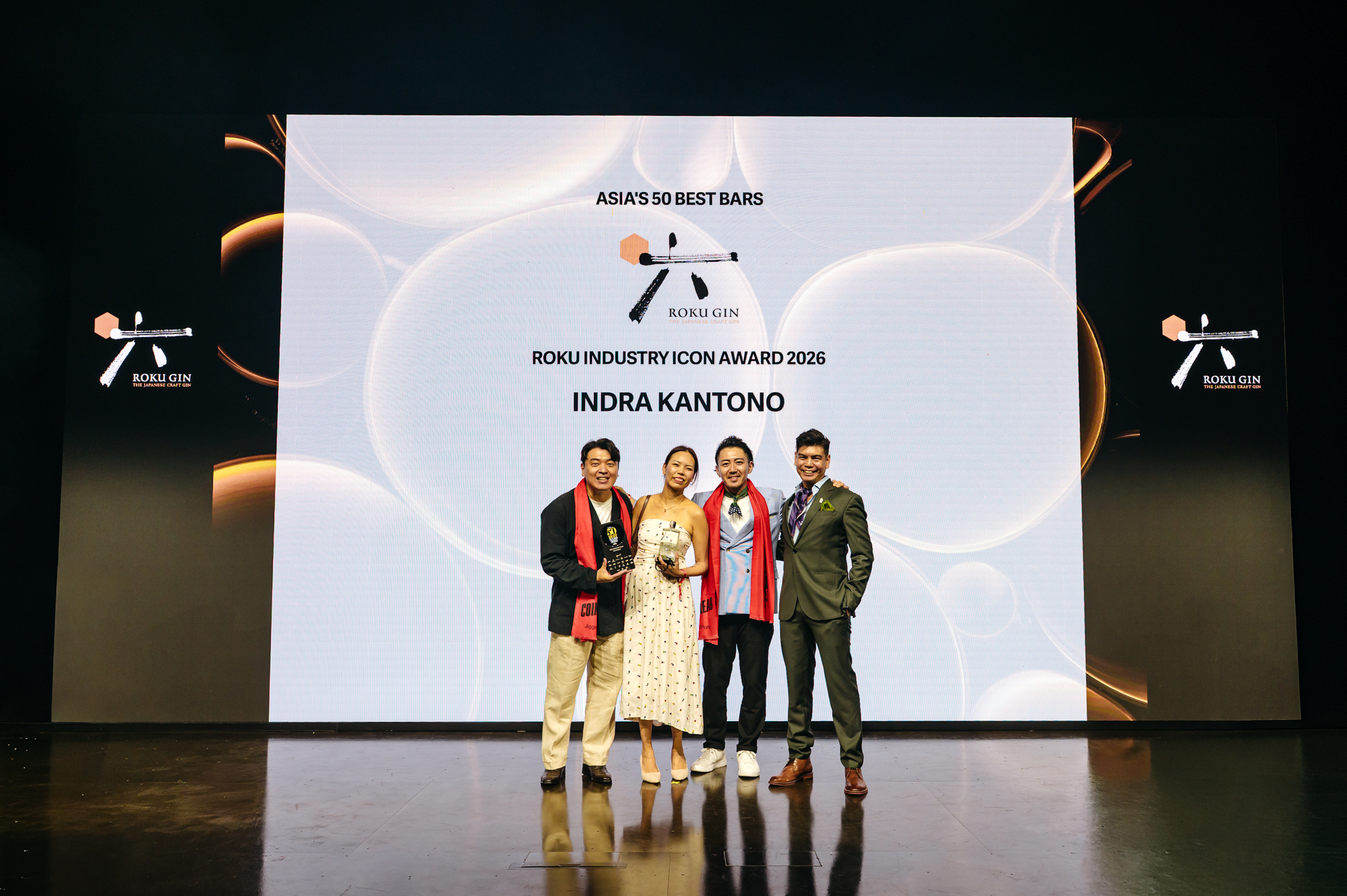
Roku Industry Icon Award
Worth a mention alongside them: Coa, which picked up the Rémy Martin Legend of the List Award in recognition of a run that includes three consecutive No. 1 finishes between 2021 and 2023, proving the programme still has a mechanism for honouring bars that shaped the region even as their raw rank drifts. And Kinsman, a Cantonese-leaning Hong Kong bar that doesn’t even appear in the top 50, walked off with the Siete Misterios Best Cocktail Menu Award anyway, a useful reminder that the extended list beneath the marquee fifty is where a lot of next year’s story is quietly being written.
Indian bars received their well-deserved share of the spotlight with 3 spots between 1 to 50 and massive respect from the industry veterans. Boilermaker in Goa is the standout: a brand-new entry at No. 30 just twelve months ago, it rocketed 22 places to No. 8, claimed The Best Bar in India title, and landed inside the top ten in only its second year on the rankings—one of the sharpest two-year trajectories anywhere on this list. Bengaluru backed that up by asserting itself as a genuine two-bar cocktail capital: Soka climbed ten places to No. 18 on the back of its high-energy, izakaya-style riff on the city’s own food culture, while Bar Spirit Forward moved up seven spots to No. 30 with its Japanese omakase-inspired approach. When viewed as a whole, India is a country whose bar scene has experienced a meteoric rise!

The winner takes it all! – Pankaj Balachandran, Co-founder of Boilermaker being lifted up by his peers
Where the list needs a re-jig
Japan is the clearest casualty of this year’s list, and the one that deserves the most attention heading into next year. The country went from five bars across three cities in 2025 (Tokyo, Kumamoto, Nara) to three bars in a single city in 2026 (Tokyo only), and, per contemporaneous reporting , failed to crack the top ten for the first time since the rankings launched. Bar Benfiddich, previously the country’s flagship at No. 9, isn’t on the list at all now; Punch Room Tokyo, the new standard-bearer, sits at No. 23. For a country whose bartending craft the rest of the region has spent a decade citing as the technical benchmark, that’s a genuine wake-up call rather than a blip.
Kuala Lumpur went down from four bars to two after Penrose and Reka both dropped off, leaving Three X Co to inherit the Best Bar in Malaysia title almost by default. And two markets that had real foothold stories in 2025, Nepal (Barc, which had also won the Michter’s Art of Hospitality Award) and New Delhi (Lair, which held India’s national title), have no representative in the 2026 top 50 at all.
If there’s a critique of the week itself rather than the list, it’s one of abundance rather than execution: with dozens of simultaneous guest shifts running across both Macau and Hong Kong over six overlapping days, even committed industry attendees were forced into a level of triage that meant missing as much as they caught. That’s a good problem to have and clearly deliberate, but a slightly more curated “essential eight” for time-poor press and out-of-town buyers wouldn’t hurt.
Inside the week: how Macau actually ran it
None of that abundance was an accident, and it’s worth walking through, because the surrounding programme is now as much a part of the story as the list itself.
Wynn Macau and Wynn Palace hosted for a second consecutive year, timed to Wynn’s own 20th anniversary in the city, and expanded its “Wing Lei Bar & Friends” platform from a single-bar residency into a resort-wide festival spanning six days (July 24–29) and pulling in more than fifty bartenders and chefs from Asia, Europe and North America. It opened on the Friday with Mark Lloyd, Wynn’s director of bars, unveiling UNITY 2.0, the second chapter of Wing Lei Bar’s signature menu, twelve cocktails built from a year of his own travel stories, paired that same evening with a six-course Chef Tam’s Seasons dinner matched to Michter’s whiskey.
The week built steadily from there: a takeover from Barcelona’s Danil Nevsky and Milan’s Lorenzo Querci, an all-female showcase called “Behind Her Bar” bringing together talent from Singapore, Hong Kong, Leeds and beyond, and “The Road Less Traveled,” a deliberately unglamorous showcase for bars from Ulaanbaatar, Kathmandu and the Isle of Man , places most attendees would otherwise never get a pour from. The Bartenders’ Feast on July 27, at Wynn Palace’s Gourmet Pavilion, put Wing Lei Bar behind the stick alongside Shanghai’s Pony Up and Goa’s Boilermaker for a night of live music ahead of the main event, while the official Meet the Bartenders media roundtable gave writers and press direct access to the people actually shaping the list, a genuinely useful corrective to a week that otherwise runs almost entirely on spectacle.
The ceremony itself, on Tuesday, drew more than a thousand guests into Wynn Palace’s Grand Theater for a red-carpet reception and cocktail hour ahead of the live countdown, followed immediately by a post-ceremony reception showcasing Wynn’s own culinary range. From there the night split two ways: a chiller, house-party-style reunion at Wing Lei Bar, where Lloyd poured alongside three former colleagues now running their own Shanghai bars, and the official after-party proper at the Palace Reserve Club, sponsored by Campari, where Cat Bite Club, The Cocktail Club, Opium, Soka and Carrots kept the room going long past the point most attendees had planned to leave. The whole thing wound down on Wednesday with a closing brunch at Wynn Macau’s Drunken Fish overlooking the Performance Lake, Wing Lei Bar joined by Dry Wave and Carrots for one last round, guests sent home with personalised Portuguese tile magnets as a genuinely nice, low-key touch rather than the usual branded tote bags.

The Winners – Asia’s 50 Best Bars 2026
Judged purely on execution, a six-day, multi-venue, cross-border programme that hit every stated beat from opening showcase to closing brunch without any of the visible scrambling that dogs events at this scale, it’s hard to argue the week wasn’t run close to flawlessly. Whether that’s sustainable as a template for a third consecutive year is the more interesting question.
What to watch for in 2027
A few predictions, offered with the appropriate humility that comes with forecasting an industry vote:
Mainland China keeps climbing. Seven bars and a No. 1 finish is a watershed, not a ceiling, expect continued investment and attention flowing into Guangzhou, Shenzhen, and the wider Greater Bay Area bar scene, and don’t be surprised if an eighth or ninth Chinese city shows up on the extended list by next July.
Japan has something to prove. A first-ever shutout from the top ten is the kind of result that either triggers a real correction, Tokyo’s next generation reasserting itself, or Osaka, Kyoto and Fukuoka finally cracking the main list, or turns into a longer structural decline. 2027 will tell us which.
Bangkok’s ceiling is still unclaimed. Eight bars and counting, yet none has ever finished inside the top three. Dry Wave at No. 4, two years running, is the closest anyone from Thailand has come; watch that bar specifically as the one most likely to break through.
The extended list is the real farm system now. Obsidian Bar, Pony Up and Workshop14 all rocketed into this year’s top 20 or better having barely registered, or not appearing at all on 2025’s main list. If you want an early read on 2027’s climbers, the current 51–100 ranking is a better source than any prediction column, this one included.
A third Macau edition looks likely, on current form. Nothing has been confirmed publicly, but a host partnership that’s just delivered two consecutive, expansively produced editions and that’s explicitly tied its own anniversary programming to the event has every incentive to run it back.
The last word
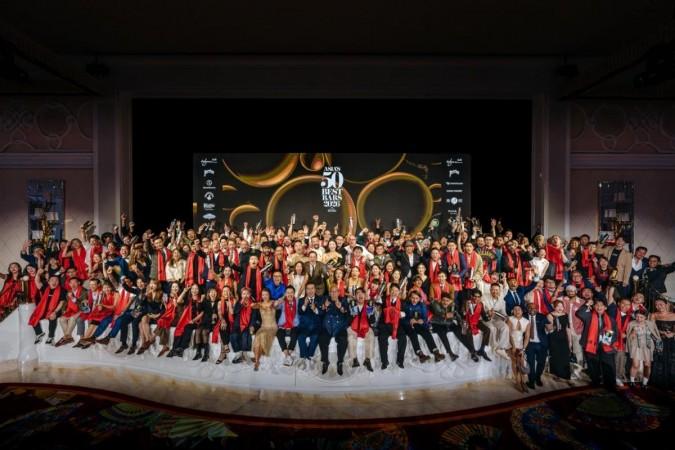
Asia’s 50 Best Bars has always sold itself on regional breadth, and this year it delivered on that promise more vividly than usual: a winner from a city most of the room needed a map for two years ago, mainland China’s tally more than doubling, and a week of programming so generous that nobody who attended saw all of it. Look past the churn at the top, and what’s left is the best evidence yet of how much room this region still has to grow, proof that patient, unglamorous craft like Hope & Sesame’s decade of work still finds its audience, and that no single city gets to hold the crown by default anymore.
Japan has both the history and the talent to answer this year’s setback with a louder comeback. And if the last twelve months are any guide, the bar that electrifies next year’s list probably hasn’t opened its doors yet, which is, for anyone who loves this industry, the best possible reason to be looking forward to next July.