
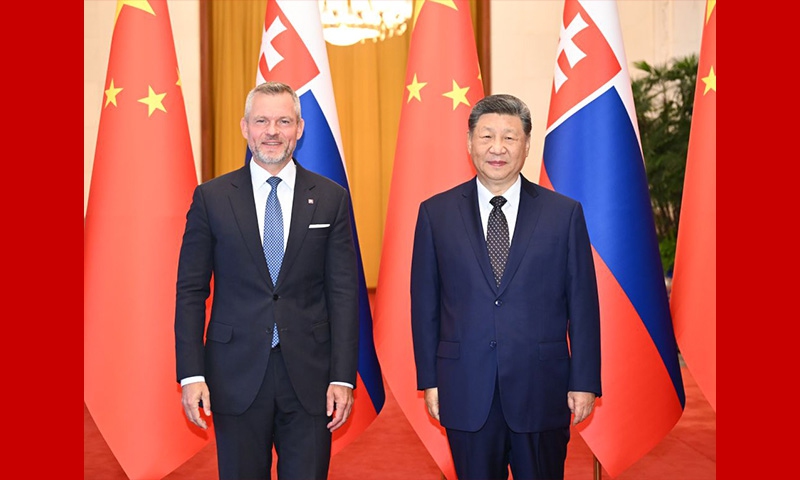
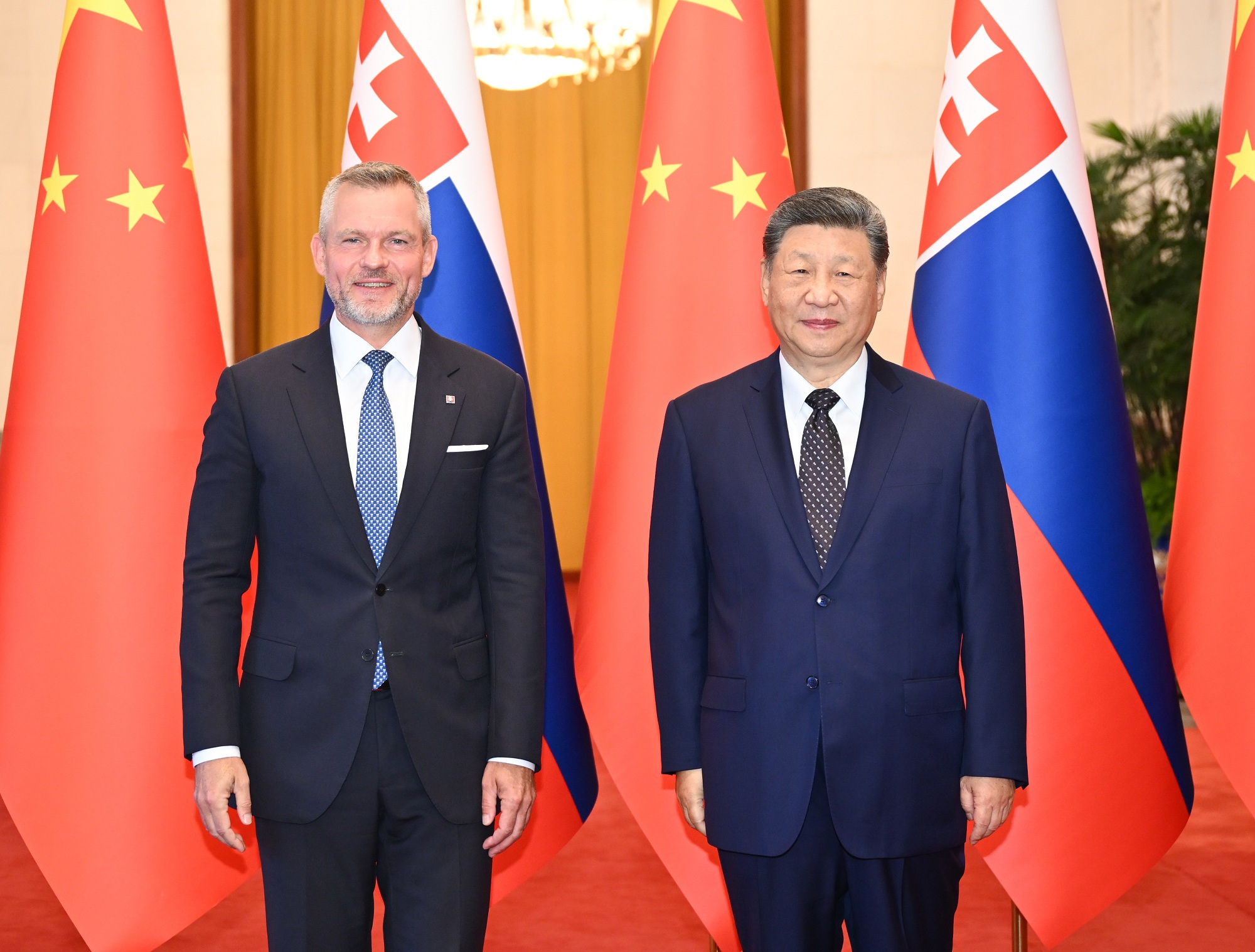
Chinese President Xi Jinping holds talks with Slovak President Peter Pellegrini, who is on a state visit to China, at the Great Hall of the People in Beijing on July 28, 2026. Photo: Xinhua
China stands ready to join hands with Slovakia in forging a strategic partnership that features mutual respect and trust, equality and mutual benefit, as well as stability and resilience, Chinese President Xi Jinping said on Tuesday, during talks with Slovak President Peter Pellegrini, who is on a state visit to China from Monday through Wednesday.
Xi stressed that mutual respect for each other’s development paths and a firm commitment to friendship and cooperation have been the foundation for the sound and rapid growth of China-Slovakia relations.
He called on the two countries to tap the potential for collaboration in emerging sectors and frontier fields, including clean energy, digital economy, robotics and AI, to create new highlights in bilateral cooperation, per Xinhua.
The two sides should broaden cooperation in culture, sports, tourism, youth and subnational exchanges, and make it easier for people to travel between the two countries, he said.
Noting that Slovakia values the strategic partnership with China, Pellegrini expressed expectations for more outcomes in cooperation in economy and trade, AI, digital economy, robotics and new energy. He added that Slovakia welcomes more Chinese enterprises to invest there, according to Xinhua.
Prior to the talks, Xi held a welcome ceremony for Pellegrini. A welcome banquet was also held for him around noon, Xinhua reported.
Analysts noted that the state visit carries far-reaching implications for both China-Slovakia bilateral ties and broader China-Europe relations. It will inject fresh momentum into bilateral pragmatic cooperation. Meanwhile, as Slovakia is a consistent advocate of pragmatic engagement inside the EU, the high-level dialogue with China will be constructive for rational and stable China-Europe collaboration prospects at a time of lingering China-EU trade tensions and growing divisions over China policy across the bloc.
Cui Hongjian, a professor at the Academy of Regional and Global Governance at Beijing Foreign Studies University, told the Global Times that stability and sound progress constitute a hallmark of China-Slovakia relations, with political mutual trust between the two countries deepening steadily over recent years. Against the backdrop of many European countries readjusting their China policies and experiencing volatile bilateral ties as a result, such steady mutual trust is particularly valuable.
While China holds strong competitive advantages in green energy, digital sectors and smart manufacturing, with Slovakia maintaining a pragmatic stance on cooperation, complicated European political realities pose constraints on bilateral collaboration. As such, delivering more tangible cooperation projects to land locally would be a key priority for joint efforts, Cui noted.
Inject fresh impetus
In an X post released on Tuesday afternoon, Pellegrini described his meeting with the Chinese leader as an “inspiring and forward-looking” one.
“Together, we reaffirmed the importance of our strategic partnership and our shared ambition to build stronger bridges between Slovakia and China… I am confident that this dialogue marks another important step toward a dynamic, future-oriented partnership that benefits both our nations and contributes to global cooperation,” he added.
During Slovak Prime Minister Robert Fico’s official visit to China in November 2024, the two countries decided to elevate China-Slovakia relations to a strategic partnership.
Per Chinese Foreign Ministry data, bilateral trade volume between China and Slovakia stood at $8.63 billion in 2025, with China’s exports amounting to $4.39 billion.
The two countries feature prominent economic and trade complementarity, and the president’s China visit offers a vital opportunity to tap into their potential for practical cooperation, Kong Tianping, a senior research fellow from CEEC Economic and Trade Cooperation Institute, Ningbo University, told the Global Times.
According to Kong, automotive manufacturing is Slovakia’s pillar industry, while China holds leading strengths in new energy vehicles (NEV) and power batteries. The two sides enjoy broad prospects for collaboration across the NEV industrial chain, battery production and automotive industrial transformation.
A key participant in the China-CEEC (Central and Eastern European Countries) cooperation framework, Slovakia is one of the most active promoters of China-CEEC scientific and technological collaboration, said Kong, adding that Pellegrini’s visit may deliver further progress for both sides in technological innovation, joint research and high-end manufacturing.
A release from the website of Slovakia’s Presidential Office notes that President Pellegrini’s state visit in Beijing features trips to major tech innovation hubs. His schedule includes a visit to Baidu, a Chinese company leading in AI, cloud computing and autonomous mobility, as well as a tour of a robot mall.
Playing constructive role
President Xi said China and Slovakia should safeguard the UN-centered international system and the international order underpinned by international law, jointly promote an equal and orderly multipolar world and a universally beneficial and inclusive economic globalization, and contribute to building a community with a shared future for humanity, per Xinhua.
China has always viewed the EU as a partner and develops its ties with the EU with sincerity and goodwill, Xi said, calling on Slovakia to play a constructive role in promoting the sound and steady growth of China-EU relations.
Pellegrini said that as an EU member state, Slovakia is willing to actively promote cooperation between the EU and China and the proper settlement of differences through dialogue and consultation.
Slovakia is willing to work with China to uphold multilateralism, safeguard the purposes of the UN Charter and international law, and promote regional and world peace and stability, he said, adding that his country is willing to closely coordinate with China to strengthen global governance of AI.
As a member of the Visegrád Group, Slovakia also maintains close ties with the Balkans, commanding certain regional influence across Central and Eastern Europe and the broader European Union, Cui said.
According to the expert, Slovakia occupies a uniquely valuable position in China-Europe relations.
“Rather than echoing the hawkish, irrational rhetoric on China prevailing in some parts of Europe, the Slovak government has consistently kept regular, constructive communication with China. Boasting substantial autonomy in its foreign policymaking, Slovakia can to some extent offset various negative narratives about China inside the EU and amplify voices in favor of pragmatic China-EU cooperation,” he said.
In addition, built on stable and amicable bilateral relations, the two sides are well-placed to turn their economic and trade partnership into a model, serving as an example for the rest of the EU, Cui noted.
High-level exchanges between China and Central and Eastern European countries have been frequent in the first half of this year. Apart from the President of Slovakia, Serbian President Aleksandar Vucic paid a state visit to China in late May. Vucic told the Chinese leader that Serbia looks forward to working with China to deepen high-quality Belt and Road cooperation, with the two sides signing over 20 cooperation documents after a heads-of state meeting.
In June, Chinese Premier Li Qiang met with Prime Minister of Montenegro Milojko Spajic in the coastal city of Dalian in northeast China’s Liaoning Province, where Spajic was attending the 17th Annual Meeting of the New Champions.
Views on China remain divided within Europe. Nevertheless, if some European countries, particularly Central and Eastern European countries, continue to voice support for pragmatic cooperation with China, it will help stabilize China-Europe relations and foster a sound environment for overall collaboration, Kong said.