
Ras al-Ahmar, occupied West Bank – The drive to Thaer Bisharat’s home should take less than 10 minutes from the main road. Instead, it took three hours.
Every gate leading into Ras al-Ahmar, in the northern Jordan Valley, is shut these days. Such road closures have become the norm rather than the exception, patrolled in shifts by Israeli soldiers and settlers whose roles on the ground have become increasingly difficult to tell apart. The sole access point that remained was a single, winding dirt road, passable only by four-wheel drive vehicles and requiring drivers to evade the roving Israeli patrols.
Recommended Stories
list of 3 itemsend of list
During the drive to Thaer’s house, Israeli forces had the area under an even greater lockdown than normal as they were nearby in the al-Buqaia plain, destroying three wells belonging to local Palestinians – including one owned by a relative of Thaer’s.
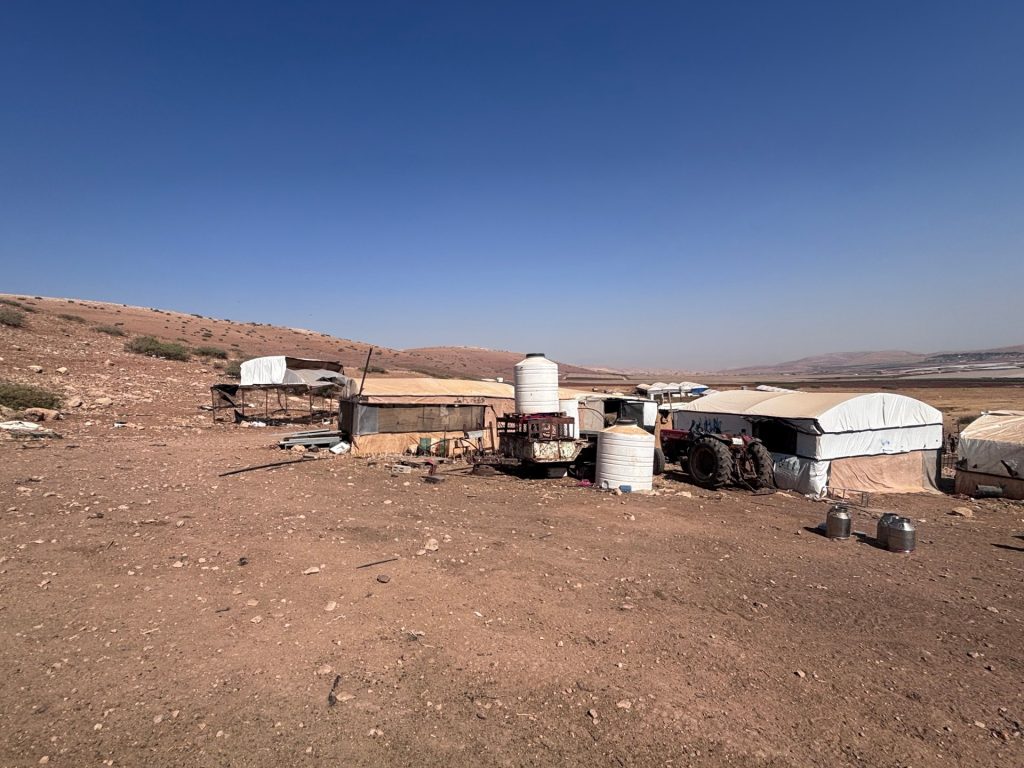
This is some of the most fertile land in the occupied West Bank, where farmers normally tend rows of banana trees alongside crops such as grapes, olives and potatoes. But along the dirt road leading to Thaer’s isolated home, the farms stand half-abandoned, with plastic greenhouse doors open and flapping in the breeze, as crops go thirsty after water was cut off in the area weeks ago by Israeli authorities.
“I can’t even run an errand,” said Thaer. “From Tamun, the village, it used to take me ten minutes. Now, with the current [dirt] road… it takes an hour, at best.”
He was spending the afternoon alone – his brother and sister-in-law had gone into town that morning for basic necessities. Left by himself, it was easy to feel like a sitting duck.
“Just this morning, there was a car – two people in it, dressed in military gear, army-backed,” he said. “They went to the people living near the banana houses. They took down ID photos, names, phone numbers. And they tell them, ‘You’ve got 24 hours to leave. Otherwise we’re coming to confiscate everything you’ve got’.”
In recent weeks, that pressure has escalated from long-standing “closed military zone” orders issued by the military into outright seizures of private land, alongside the destruction of irrigation pipes, water wells and greenhouses in the barrier’s path – the sharpest expression yet of an advancing takeover in which settler-outpost expansion and land seizure now work in tandem to squeeze out the Palestinians who remain.
“They cage us in and suffocate us,” Thaer said.
![Thaer Bisharat is always fearful of attack by Israeli settlers or soldiers [Al Jazeera]](https://www.aljazeera.com/wp-content/uploads/2026/07/Thaer-Bisharat-beside-his-home-1784311543.jpg?w=770&resize=770%2C578&quality=80)
A trench, an outpost and a series of seizure orders
That tightening isolation is the result of one of Israel’s newest infrastructure projects in the occupied West Bank: the ‘Crimson Thread’ barrier. Announced in 2025, the first part of the project combines a trench and military road running roughly 22km between the Ein Shibli and Tayasir checkpoints – severing the northern Jordan Valley from Tubas to the north and Nablus to the south. Israel says it is intended to prevent weapons smuggling from Jordan, but the route runs several kilometres inside the occupied West Bank rather than along the already-fenced Jordanian border.
The plan is for the barrier to eventually run for 500km, splitting Palestinians from thousands of hectares of land and creating a barrier that – in its consequences – mirrors the separation wall on the other side of the West Bank.
On March 8, Israeli military commander Gilad Shriki visited several Palestinian communities, and, in their words, warned residents they should leave in preparation for a complete Israeli takeover of the area.
Then, last month, an Israeli Supreme Court ruling cleared the way for construction of the ‘Crimson Thread’ barrier to proceed. Since then, the Israeli Civil Administration has moved aggressively. Roughly three kilometres of trenches have already been dug, destroying Palestinian infrastructure in its path – including irrigation pipes, farmland and greenhouses, all while severing farmers from land on the other side.
The route of the ‘Crimson Thread’ project was stitched together with nine land seizure orders – a “clear escalation” of a decades-long effort by Israeli authorities to remove Palestinians in the area, according to Dror Etkes, who tracks Israeli land policy for Israeli NGO Kerem Navot. What started as checkpoints, settlement building and the designation of Palestinian lands as military firing zones “have in recent years become much more aggressive – through settler attacks, military raids, confiscation of property and denial of access to firing zones”.
Now, such military land seizure orders allow Israeli authorities to “seize whatever land it deems necessary” for security purposes, says Etkes.
According to the Colonisation and Wall Resistance Commission, Israeli authorities issued 49 military land-seizure orders in the first half of this year – already exceeding the 47 issued in all of 2025.
Thaer scoffs at the official rationale. “It’s not a military road,” he said. “You don’t dig a trench two and a half, three metres deep for that.”
![Israel’s ‘Crimson Thread’ barrier has broken irrigation pipes and damaged wells that are vital to local Palestinian populations [Courtesy of Thaer Bisharat]](https://www.aljazeera.com/wp-content/uploads/2026/07/Locals-observe-leaking-irrigation-pipes-due-to-crimson-thread-pic-courtesy-of-thaer-1784311720.jpg?w=770&resize=770%2C578&quality=80)
‘Effectively in a prison’
Etkes said the barrier accomplishes two things at once: “blocking Palestinians’ ability to enter everything east of the barrier” – where most of their farmland is – while linking existing illegal settlements to a new outpost being built along the route, on Jabal Tamun, that he expects to further impact 8-9,000 dunams (8 to 9sq km) of Palestinian agricultural land, most of it in Area B.
“The majority of communities aren’t there anymore – they’ve been forced to leave, which convinced [Israeli authorities] that the time was right for the next move,” said Etkes, listing emptied communities such as Khirbet Samra and Khirbet Yarza.
A Kerem Navot map shows the ‘Crimson Thread’ barrier route curling around Khirbet Yarza – but by the time construction reached it, Khirbet Yarza was already gone, with its residents displaced by settlers months earlier.
Mahdi Daraghmeh, who heads the al-Maleh village council, has watched the same pattern unfold throughout the hamlets he oversees. “Settler terror and fear have pushed many families to leave,” he said. “In the communities here, 130 families have been displaced – they’ve abandoned their structures, their homes, their land. And now they’ve lost their livelihoods – they have nothing left to live on.”
Since the June Supreme Court ruling, Israeli authorities have carried out near-daily operations in the area, cutting water supplies, destroying tanks and confiscating tractors and other farming equipment.
“They confiscated the tractors and water tanks from us here,” said Thaer. “So they claim these tractors and tanks are a threat to their security. A threat to your security, how?”
At the same time, settlers brought caravans into the area east of Ras al-Ahmar, positioning themselves inside territory expected to be cut off from Palestinian communities.
On June 16, bulldozers demolished livestock infrastructure at the home of Bilal Bani Oudeh, a friend of Thaer’s, and warned him to leave within 24 hours. He refused, so that night, settlers returned and brutally assaulted him.
“He nearly died,” Thaer said. “After they attacked him, they talked about tying him to a rope behind a vehicle. They took everything he owned.”
With authorities working assiduously to keep observers from documenting or photographing the ‘Crimson Thread’ operation, excavation has uprooted hundreds of olive and grape trees while repeatedly severing irrigation pipelines serving tens of thousands of dunams. On the morning of July 14 alone, Israeli authorities destroyed three wells in al-Buqaia – including one belonging to Bisharat’s relative – and confiscated pumps and equipment.
The Atuf village council – one of those affected by the new barrier – put that single day’s damage at more than four million shekels ($1.3m).
Already, this destruction has decimated the local economy in weeks, wiping out the summer harvest. “There’s no agricultural season to speak of,” Daraghmeh said. “Most of the land hasn’t been cultivated and what has been cultivated is for the settlers’ benefit.”
When the trench is finished, cutting communities off from each other and their farmland, residents fear it will mark the end of a Palestinian presence here. “Our communities will have no services, no infrastructure whatsoever,” said Daraghmeh. “No hospital, no emergency centre, no schools; for all of that, people have to go to the neighbouring town and that will be impossible.”
“Once this trench cuts people off,” he said, “the people here will effectively be in a prison.”
![A long-established illegal Israeli settler outpost located right above a Palestinian village in the Jordan Valley [Al Jazeera]](https://www.aljazeera.com/wp-content/uploads/2026/07/Long-established-settler-outpost-located-right-above-another-Palestinian-in-the-area-1784311895.jpg?w=770&resize=770%2C578&quality=80)
‘Give us the rights of the animals’
With Israeli authorities having shut off water into the area for weeks, one tank now costs Thaer more than 300 shekels ($100), more than triple the previous price. But even transporting water is a perilous pursuit; his brother was recently beaten and held at gunpoint by marauding settlers, who he said stole his phone and robbed him of his money.
Thaer estimates that agricultural production in the area has collapsed by as much as 90 percent, while many families have already lost half their livestock because they can no longer reach grazing land.
But among neighbouring communities now erased, Thaer has seen this playbook before: once Palestinians are removed, he says, the settlers take over their lands. “Then suddenly there’s no more ‘firing zone,’” Thaer said. “A road appears, water arrives, sheep arrive. Life comes back to the place, thank God!
“So why do I get told it’s all a military zone?”
Thaer looked out at the Israeli settlement farms, lush and green in the distance. Around his own property, the ground was parched, littered with half-abandoned equipment. “Under their ‘law’, we are treated like animals,” he remarked.
Thaer paused. “Israel always talks about ‘rights’, ‘rights’, ‘rights’,” he said. “When someone hits a dog, suddenly, there’s animal rights advocates everywhere.”
“So actually, we don’t even want human rights,” he said. “Just give us the animal rights they talk so much about. At this point, we’d settle for living under that.”