
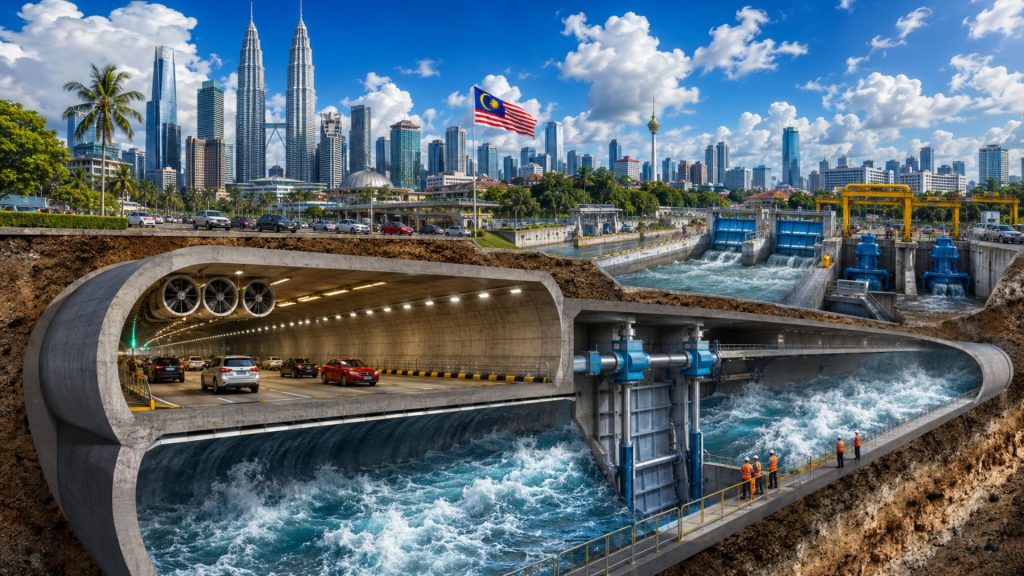
The SMART tunnel is 9.7 kilometers long under Kuala Lumpur and operates in four distinct modes depending on the intensity of the rain. On a regular day, cars circulate inside it. When the storm arrives and the Klang River exceeds certain limits, the vehicles exit, the gates open, and the entire structure becomes an emergency drainage for the Malaysian capital.
Kuala Lumpur has a long-standing problem with rain. The capital of Malaysia is located in a basin surrounded by hills, and when tropical storms hit hard, the city center fills up quickly. The solution the Malaysian government found was not simply to build a drainage channel. It was to build a tunnel that does two things at the same time: under normal conditions, it serves as a highway for those entering and leaving the city; when heavy rain threatens to cause flooding, the cars are removed, the gates open, and the entire tunnel becomes an emergency drainage capable of diverting gigantic volumes of water in a matter of hours.
Named SMART, an acronym for Stormwater Management and Road Tunnel, the project has a total length of 9.7 kilometers, with 3 kilometers in a dual-function section that combines highway and drainage system in the same structure. The total capacity of the system is 3 million cubic meters of water storage, distributed between the tunnel, reservoirs, and diversion structures connected to the Klang River. Since it began operation in July 2007, SMART has prevented flash floods in downtown Kuala Lumpur in almost 600 rain events, including nine major storms, according to the system’s own records.
The problem that led to the tunnel
The impermeabilization of urban soil, caused by the expansion of asphalt, concrete, and buildings, has reduced the land’s ability to absorb rain. Water that once infiltrated the hills now runs directly into the rivers, accelerating the time it takes for natural channels to reach maximum capacity.
The result was recurring floods in the city center, especially in areas near the Klang River and the Ampang River.
Conventional solutions, such as widening rivers or building open concrete channels, faced an obvious problem: the city was already built on top of all that.
There was no space for surface works on the necessary scale without demolishing entire neighborhoods or expropriating densely occupied areas. Going underground was the only viable option.
The underground tunnel allowed for the creation of a drainage corridor where the city already existed, without interfering with the existing urban fabric.
How the tunnel was built and what it contains
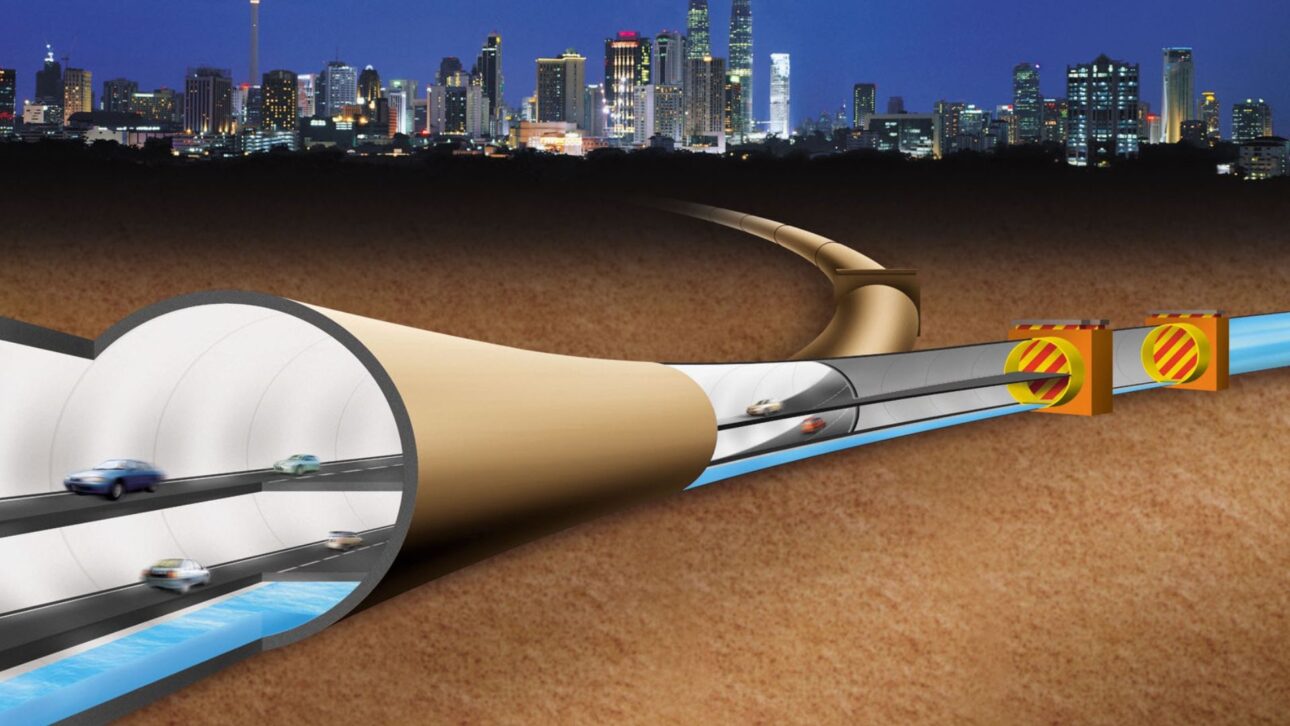
The dual-function section, the 3 kilometers where highway and water system coexist in the same structure, is the most ingenious part of the project. It has two levels: the lower level is a permanent drainage channel, which can be activated even with cars circulating on the upper level.
The upper level is the roadway, which is only closed when the rain situation requires the full use of the structure.
The complete system includes a diversion structure that captures water from the rivers, an entry reservoir called Berembang, the tunnel itself, and a reception reservoir in Taman Desa, from where the water is returned to the natural course by the Kerayong River before flowing into the Klang River.
All this is connected to a real-time monitoring system that continuously measures precipitation, river flow, and reservoir levels.
These are the data that feed the hydrological model and determine which of the four operating modes should be activated.
The four modes of operation: from asphalt to sewage
The operation of SMART is defined by four distinct states, activated progressively as the rain increases.
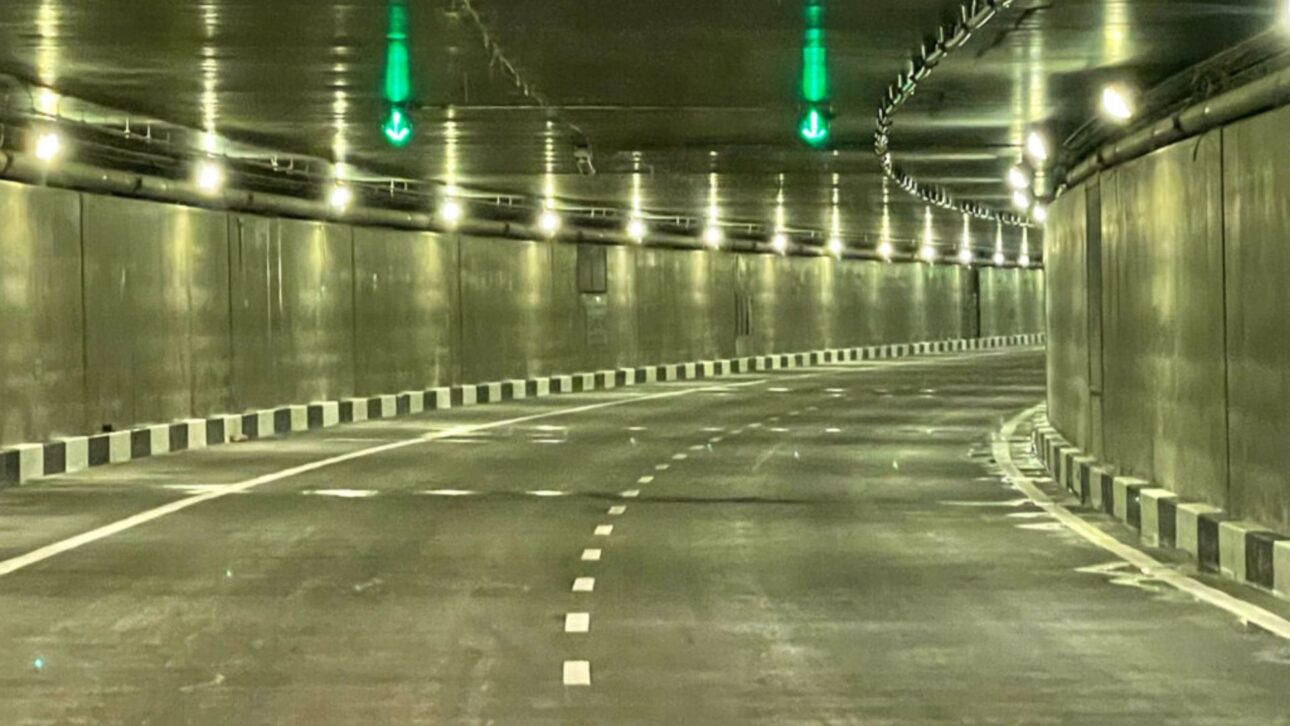
In Mode 1, which is the normal state of operation, the Klang River flows without exceeding safety limits and the tunnel is completely dry.
Cars circulate normally on the highway, and nothing indicates to those passing by that this road is also an emergency drainage channel.
When the river flow exceeds 70 cubic meters per second, Mode 2 is activated. The lower section of the tunnel, the permanent drainage channel at the lower level, begins to receive floodwater.
Cars continue to circulate on the upper level, unaware of what is happening beneath their tires.
If the rain worsens and the flow reaches 150 cubic meters per second, Mode 3 comes into play: traffic is stopped, vehicles are removed from the highway, and the tunnel is on standby for the most critical phase.
Mode 4 is activated when the storm persists and requires maximum capacity: the entire tunnel, including the roadway, becomes a drainage channel. No cars. Only water.
The logic behind the decision to close the road
Transforming a highway into flood drainage requires a strict safety protocol. It is not possible to simply open gates with vehicles still inside the tunnel.
The detection and monitoring system exists precisely to provide enough time to evacuate the road before the water enters.
Real-time readings from rain gauges, level sensors, and flow meters allow for advance prediction of when the situation will require Modes 3 or 4, providing time to close access and safely remove road users.
The transition between modes is not instantaneous. There is an evaluation and decision process that involves data collection, transmission to the control center, processing by the hydrological model, and analysis before any activation.
This interval between prediction and action is the operational heart of the system. If it fails, the consequence is not just a flood: it is a flood with cars inside the tunnel.
The control and monitoring engineering is as critical as the concrete and steel of the physical structure.
Almost 600 rain events and nine major storms
Since July 2007, when it became operational, SMART has accumulated a history that justifies the investment.
Almost 600 rain events have been managed by the system without the center of Kuala Lumpur being flooded, including nine storms classified as high intensity.
These are events that, before the existence of the tunnel, would have caused the same damages that frequently repeated in previous years: street flooding, traffic interruption, commercial losses, and risk to the population.
The economic impact of the floods that did not happen is difficult to calculate precisely, but it is real.
Cities like Kuala Lumpur, with a service and commerce economy concentrated in the urban center, suffer significant losses with each flooding event: closed stores, damaged vehicles, cleaning and repair costs.
A tunnel that prevents 600 floods in seventeen years is a project that pays for itself in ways that do not appear in any financial statement.
The SMART model is not simply a drainage solution.
It is an engineering response to a problem that almost all major tropical cities face: accelerated urban growth on land with a history of flooding, without surface space for conventional water infrastructure. Bangkok, Jakarta, Mumbai, São Paulo, and dozens of other cities live with variations of the same problem that Kuala Lumpur solved by going underground.
The main lesson of SMART is not technological. It is about planning.
The project began in 2003, the city had already had the problem for decades, and the solution required political decision to drill the subsoil of a populous and expensive capital.
Other countries studied the Malaysian model, but few reached execution. Building a tunnel that turns into a road and sewer at the same time is easier to describe than to approve, finance, and execute in the real world.
The SMART exists because someone in Kuala Lumpur decided that the problem was big enough to require a response of equal magnitude.
Should Brazilian cities like São Paulo or Recife study more seriously using a tunnel that alternates between highway and drainage channel? Or do the challenges of financing and urban planning make this type of project unfeasible in practice? Leave your opinion in the comments.
Source link