
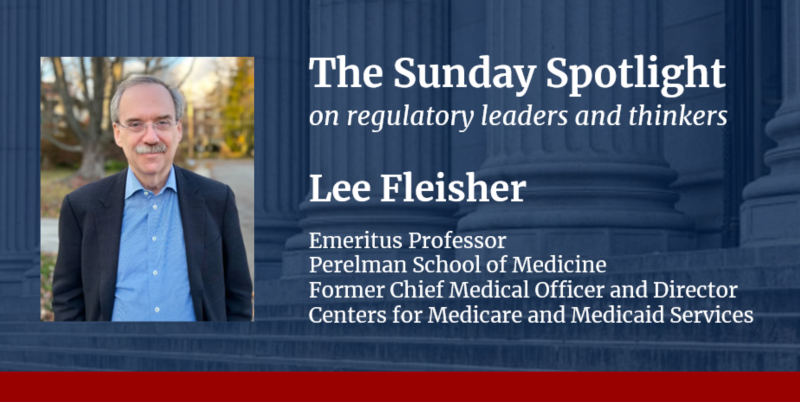
Lee Fleisher examines current trends and challenges in the regulation of health care quality.
In a conversation with The Regulatory Review, health care leader Lee Fleisher discusses the successes and gaps in improving health care quality through state and federal regulation.
Fleisher notes that federal regulators have increasingly relied on outcome-based quality measures, payment models, and transparency initiatives to improve health care quality. He explains, however, that challenges remain in measuring quality, coordinating state and federal oversight, and implementing quality measures that improve outcomes without imposing a substantial burden on health care providers. He emphasizes that improved coordination, lower administrative burdens, and careful regulation of emerging technologies could improve future quality oversight.
Fleisher is an emeritus professor of anesthesiology and critical care at the Perelman School of Medicine, and he practices anesthesiology at the University of Pennsylvania. He is the former chief medical officer and director of the Center for Clinical Standards and Quality at the Centers for Medicare and Medicaid Services (CMS). In this role, Fleisher oversaw national clinical quality and safety standards for health care facilities and providers. Fleisher is the cofounder and chief executive officer of Rubrum Advising, a consulting firm that provides clinical, regulatory, and strategic counseling across the health care industry. Modern Healthcare named Fleisher one of the 50 most influential clinical executives in 2023.
The Regulatory Review is pleased to share the following interview with Lee Fleisher.
TRR: How have state and federal regulators, including CMS, sought to improve health care quality in recent years?
Fleisher: As the payer for a substantial portion of the population, CMS oversees quality in Medicare-certified facilities through its statutory authority to ensure the safety of individuals receiving care in those settings. In contrast, states regulate the practice of medicine itself. CMS exercises its oversight authority through the survey and certification process, holding hospitals, nursing homes, and other providers to the Conditions of Participation (CoPs), the minimum quality standards that every facility must meet. Public quality metrics then capture how far above these minimum standards care is actually delivered, shifting the emphasis from compliance to performance.
The current Administration has prioritized outcome measures over process of care measures, building on the previous Administration’s initiative to align quality measures across all CMS programs. This approach strives to align quality measures across all payers, since there is significant variability across the payer landscape. The Administration is also moving toward electronic measures to reduce administrative burdens. Beyond measurements, the Administration has framed its emphasis on eliminating fraud, waste, and abuse, as well as its push for price transparency, as complementary levers for driving quality improvement.
TRR: What are the most significant problems in the regulation of health care quality?
Fleisher: Measuring health care quality has always been difficult for several reasons. First, the absence of electronic collection of patient data directly from electronic health records makes data collection burdensome. Second, adjusting measures for patient comorbidities is complex. Third, attributing quality to individual providers is challenging, since most clinical care involves teams of clinicians, and patients frequently see providers from multiple systems. Finally, the appropriate time horizon for measurement remains contested.
The result of these challenges has been a persistent struggle to develop measures that are both meaningful and low burden. In addition, each specialty and provider type—hospitals, physician groups, and post-acute care facilities—tends to advocate quality measures that can be directly attributable to them and within their control. For example, in my own specialty of anesthesiology, I frequently advocated using 30-day surgical mortality as a quality measure. But my colleagues often questioned how much of that outcome could reasonably be attributed to the anesthesiologist, particularly when payment was tied to the result.
TRR: When should policymakers consider voluntary quality standards rather than mandatory regulation?
Fleisher: The CoPs represent mandatory regulation and truly define the minimum standards of acceptable care. Performance below these thresholds is, by definition, subpar. During my tenure at CMS as chief medical officer and director of the Center for Clinical Standards and Quality, I terminated one hospital and multiple nursing homes for not meeting those mandatory standards. Termination from the Medicare program means a facility can no longer receive Medicare or Medicaid payment, but it does not affect its license to operate, since licensure is a state function. However, in practice, most facilities cannot remain financially viable without Medicare or Medicaid payments.
By contrast, quality measures represent voluntary goals rather than mandatory thresholds. Results are published on the Care Compare website and tied to financial incentives, creating accountability above the baseline that the CoPs establish.
TRR: What roles do payment and reimbursement models play in shaping health care quality?
Fleisher: Payment and reimbursement are strong drivers of quality. Hospitals, for example, receive a single payment for an entire episode of care, known as a diagnosis-related group, and therefore are financially responsible for any costs associated with complications. This structure incentivizes high-quality, efficient care, since the goal is to achieve the best outcomes at the lowest cost. As part of the Affordable Care Act, the CMS Innovation Center can test models designed to reduce costs, improve quality, or both. For example, CMS recently extended a prior Innovation Center model for comprehensive joint surgery to cover care through 90 days post-surgery. New models, such as the Advancing Chronic Care with Effective, Scalable Solutions Model, go further by withholding payment unless providers meet defined quality thresholds. CMS has also created total cost of care models, in which a hospital or physician group takes responsibility for all costs incurred by a patient over an entire year. These models are based on the assumption that higher quality reduces costs.
TRR: How might regulators partner with health care providers to ensure successful implementation of quality initiatives?
Fleisher: CMS and other federal regulators conduct regular listening sessions to inform the design of new programs. Changes to the CoPs, quality measures, and CMS Innovation Center models must go through rulemaking, including a notice of proposed rulemaking with public comments. CMS leadership and career staff take the comment process seriously, and final rules often reflect modifications made in response to stakeholder input. Leadership also engages directly with provider groups through site visits and meetings to ensure ongoing engagement.
TRR: How can state and federal policymakers coordinate to advance effective quality reforms?
Fleisher: States and federal officials already coordinate nursing home and hospital oversight through state survey agencies, which conduct surveys when facilities fall out of compliance with the CoPs. However, there is room to strengthen that coordination in other areas. Medicaid, for instance, varies considerably by state, reflecting its structure as a state-administered program with minimal federal oversight. More broadly, since the practice of medicine is state-regulated, stronger coordination between state and federal standards would be a positive development. Telehealth illustrates the benefits of stronger state–federal coordination well: Current standards vary by state, and clinicians must hold separate state licenses or rely on reciprocity agreements to practice across state lines. Also, variation in how state survey agencies conduct surveys of Medicare-certified facilities—for hospitals, skilled nursing facilities, and others—can impact what gets flagged as poor quality. CMS has made consistent national survey oversight a priority as a result.
TRR: What regulatory reforms hold the most promise for enhancing health care quality?
Fleisher: The development of fast healthcare interoperability resources, enhanced interoperability, and AI hold the promise of transitioning to direct, real-time measures of quality. This shift would reduce administrative burden while enabling more meaningful outcome assessment. AI in particular presents a significant opportunity to improve quality, provided that implementation is done thoughtfully and with appropriate safeguards. How AI is ultimately regulated within health care will be a determining factor in whether its potential is realized.