
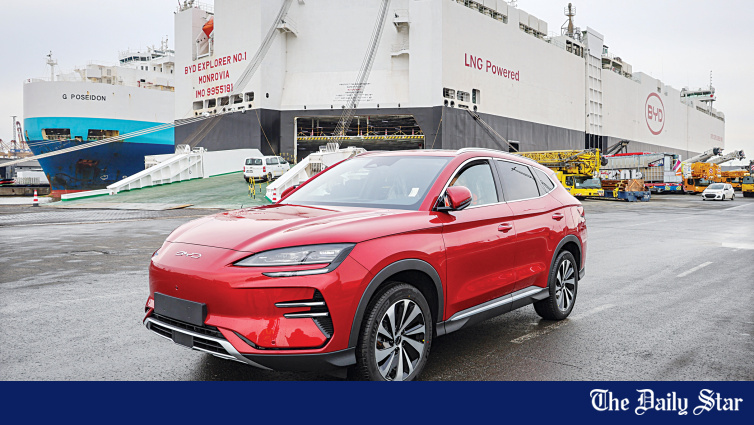
The seemingly inexorable rise of China’s trade surplus, which hit $1.2 trillion last year, is petrifying policymakers around the world. They fear a second “China Shock” – a nightmarish sequel to the original, which eviscerated US manufacturing and jobs two decades ago. Nowhere is the topic hotter than in the European Union, whose bilateral trade deficit with the People’s Republic has doubled in the last five years to top €1 billion a day in the first quarter of 2026. EU leaders will meet next week to formulate a response. Coming up with an appropriate reaction will be a tough ask.
The members of the EU Council – the block’s ultimate political decision-making body – are split. France favours US President Donald Trump’s approach of imposing tariffs and other trade restrictions to displace Chinese imports. Germany, Italy, and the Netherlands meanwhile want to secure access to the Chinese market so that European exporters can challenge local rivals, following carmaker Volkswagen’s revamped business model of relocating wholesale to the People’s Republic.
Both approaches look questionable. The EU’s proposed Industrial Accelerator Act, which requires public procurement to favour locally made products, is weak beer next to Trump’s all-out tariff war. And prying open the Chinese market does not ensure success. Volkswagen’s vaunted “in China, for China” strategy is already struggling amidst merciless price competition from local rivals.
Yet the focus on shrinking China’s headline trade surplus is too narrow in any case – as my Breakingviews colleague Jon Sindreu noted. The economic roots of the second China Shock lie in three distinct government policies. The EU should consider each in turn before determining whether to relax, retaliate, or replicate what China is doing.
Start with industrial policy. Beijing set out to build supply chains independent of geopolitical rivals under its “Made in China 2025”, strategy unveiled eleven years ago. The results have been prodigious. China now accounts for around a third of all global manufacturing. Its auto exports have rocketed from 1 million vehicles a year in 2020 to an annualised total of 12 million last month.
These achievements rest on massive fiscal subsidies, easy finance, free grants of land, and other state aid. The Organisation for Economic Cooperation and Development (OECD) estimates that in the two decades to 2024, Chinese firms received on average between three and eight times more government support than members of the rich countries’ club. It attributes nearly 60 percent of the global market share gains by Chinese companies to subsidies. To level the playing field, the tariffs and other trade defences such as those the EU has already imposed on imports of Chinese-made electric vehicles (EVs) are a reasonable and potentially effective option.
Indeed, the EU will find allies within the People’s Republic itself. China is mired in “involution”: a spreading crisis of overcapacity which has fuelled deflation and rendered huge swaths of industry unprofitable. A recent report by the Korean Automotive Research Institute found that by 2024 just four out of the country’s 130 electric vehicle makers were profitable. Beijing recognises the current trajectory is unsustainable. State planners recently announced an intensification of its two-year-old campaign against “rat-race competition”. Retaliatory action by the EU may therefore push at an open door.
It would be a major mistake to think that China’s ascent to global manufacturing dominance is simply down to hand-outs, however. The second major driver of China Shock 2.0 is the country’s remarkable and very real record of technological upgrading and innovation.
The numbers are stark. The Australian Strategic Policy Institute think tank finds that China is now the global research leader in 66 out of 74 critical technologies, including such building blocks of the new economic age as cloud and edge computing, computer vision, and generative artificial intelligence.
What is more, China has made strategic policy choices in several critical areas which are rapidly emerging as superior to those prevailing in the West. In AI, Chinese firms have focused on the development and dissemination of open-weight models designed to run on local devices, in contrast to their US competitors’ reliance on selling access to proprietary models running in cloud-based data centres. In energy, China has rapidly accelerated the electrification of economic activity by prioritising cheap power generation regardless of the fuel. The EU, by contrast, adopted the opposite sequencing. It expanded the share of the electricity generation provided by renewable energy before sufficiently stimulating electrification. The result is that European economies remain far more dependent on imported oil and gas.
In these areas, replication rather than retaliation should be the order of the day. The EU should learn from China’s technology and innovation policy and, where appropriate, imitate its approach.
Yet there is a third and more basic driver of the China Shock 2.0 which dominates all the others. This will be obvious to anyone who has travelled to the country recently: for European visitors China is unbelievably, inordinately cheap. The reason is simple. The exchange rate is massively undervalued, by between 12 percent and 21 percent in real, trade-weighted terms, according to the latest International Monetary Fund estimates. For an economy the size of China’s, that is a globally significant economic distortion which gets into all the cracks.
It is also the result of deliberate policy. China’s central and state-owned banks actively manage down the renminbi’s value relative to other countries. At the same time an oversupplied economy, low household share in national income, and sky-high savings rate have kept domestic inflation materially lower than foreign counterparts. As a result, the “China price” remains unbeatable for most foreign consumers,fuelling the trade imbalance that is now such a headache for the EU.
In its latest annual consultation with China, the IMF therefore prescribed the opposite of its usual medicine. Its normal mode is ordering chronic borrowers to devalue their currencies and rein in government spending. Instead, it urged China to allow the renminbi to appreciate and aggressively pursue reflation. There is no sign that Beijing is inclined to heed this sound advice.
At next week’s EU confab, trade retaliation and innovation imitation will be the easy bits. The hard question is how Brussels can convince Beijing to undertake structural adjustment in reverse. Without that the China Shock 2.0 is indeed incoming.