
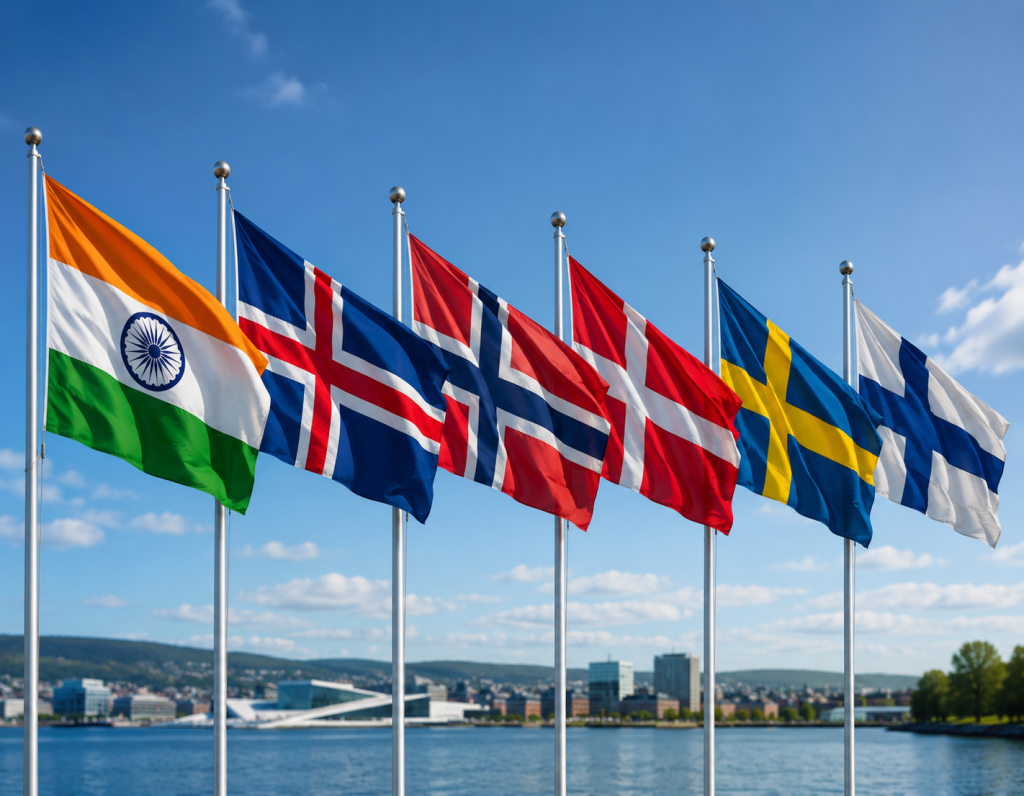
Leaders from India, Iceland, Norway, Denmark, Sweden and Finland met in Oslo on 19 May for the 3rd India–Nordic Summit, where discussions focused on strengthening cooperation in green technology, innovation, trade, sustainability and digital transformation.
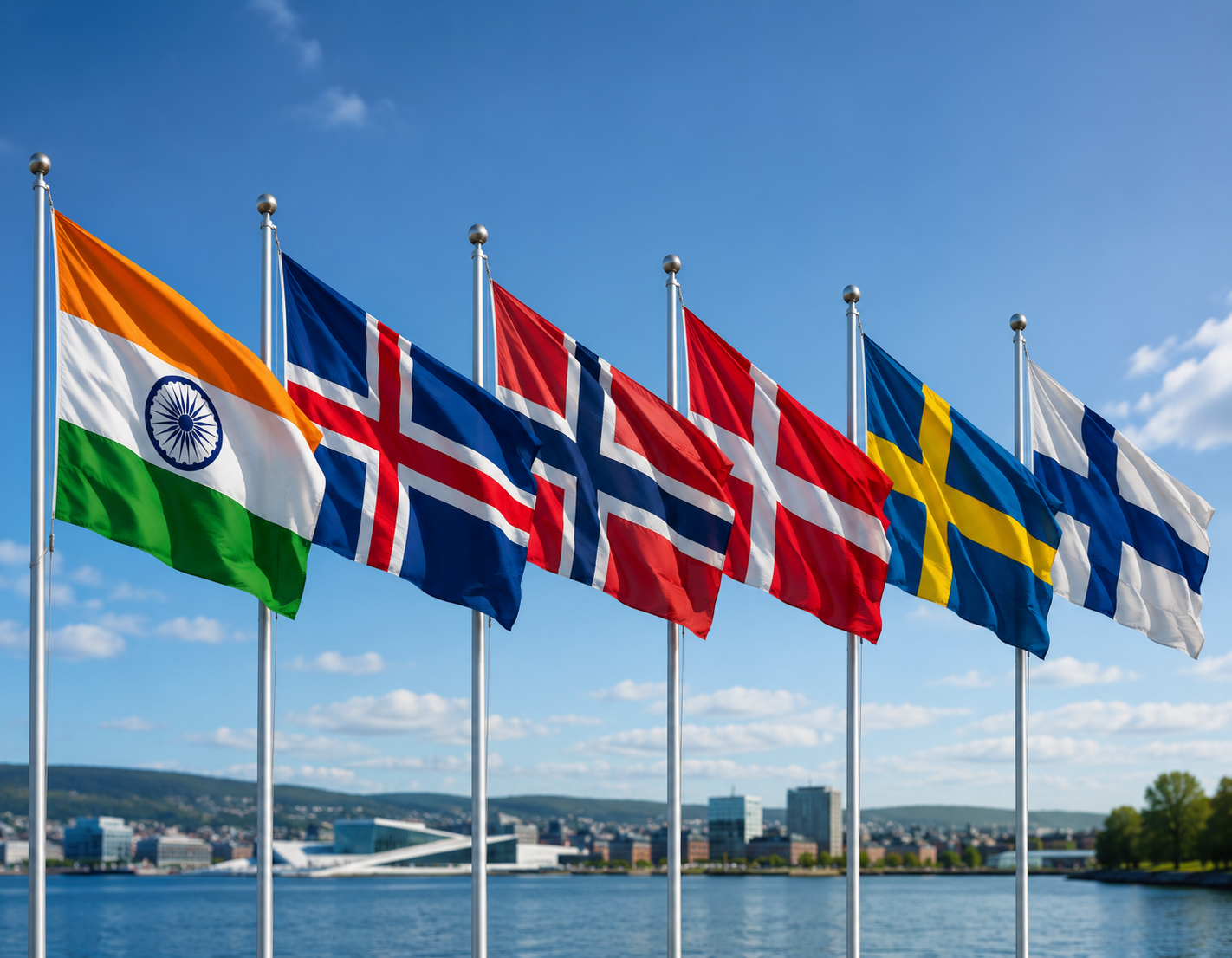 In a joint statement issued following the summit, the participating countries agreed to deepen collaboration through a new “Green Technology and Innovation Strategic Partnership.” The leaders emphasized the importance of democratic values, multilateral cooperation and joint action in addressing global challenges including climate change, energy transition and sustainable economic development.
The summit highlighted opportunities for expanded cooperation in clean energy, Arctic research, digital solutions, healthcare innovation, education and economic resilience. The Nordic countries and India also underlined the importance of strengthening business ties, investment and technological partnerships in the years ahead.
The leaders reaffirmed their commitment to continued dialogue and cooperation on international issues, emphasizing the value of strong partnerships between India and the Nordic region in an increasingly complex global environment.
On the margins of the summit, Icelandic Prime Minister Kristrún Frostadóttir also held a bilateral meeting with Indian Prime Minister Narendra Modi. The two leaders discussed opportunities for further strengthening relations between Iceland and India, including cooperation in areas such as renewable energy, innovation and trade.
Joint Statement from the 3rd India–Nordic Summit in Oslo
Joint Statement: 3rd India-Nordic Summit, Oslo, 19 May 2026
Published 19 May 2026
1. Today in Oslo, the Prime Minister of India, Shri Narendra Modi, the Acting Prime Minister of Denmark, Ms. Mette Frederiksen, the Prime Minister of Norway, Mr. Jonas Gahr Støre, the Prime Minister of Finland, Mr. Petteri Orpo, the Prime Minister of Iceland Ms. Kristrún Mjöll Frostadóttir, and the Prime Minister of Sweden, Mr. Ulf Kristersson, held the 3rd India-Nordic Summit hosted by the Norwegian Prime Minister. This Summit builds upon the previous two Summits held in Copenhagen in 2022 and Stockholm in 2018.
2. The Prime Ministers noted that they are meeting at a time of global geopolitical flux and rapid economic and technological transformation and agreed on the need to deepen the partnership between India and the Nordics for mutual benefit based upon shared interests and values and to cooperate in addressing global challenges. In this context, they decided to elevate the India-Nordic relationship to a trusted Green Technology and Innovation Strategic Partnership.
3. As leaders of vibrant democracies and large open market economies, they underscored their shared interest in fostering a robust and resilient global order based on international law that promotes peace, stability, inclusive economic growth and sustainable development.
4. They reaffirmed their commitment to upholding international law, shared values and obligations including democracy, freedom, human rights, gender equality, rule of law, respect for sovereignty and territorial integrity and international peace and security in accordance with international law, including the United Nations Charter.
5. The Leaders discussed international peace and security including the conflicts in Europe and the West Asia/Middle East.
6. They discussed opportunities for collaboration in trade and investment, blue economy, circular economy, digital infrastructure, digitalisation and artificial intelligence, climate action and energy security, fighting pollution, water, research and education, talent mobility, healthcare, space & geospatial sectors and defence.
UN, multilateralism and international cooperation
7. The leaders reiterated the importance of an effective multilateral system, with the United Nations at its core. They confirmed their commitment to work towards reforming the UN, including the UN Security Council, to make it more representative, inclusive, transparent, efficient, accountable, effective and reflective of the contemporary geopolitical realities. The Nordic Prime Ministers reiterated the support of the Nordic countries for permanent membership for India in a reformed and expanded UN Security Council. The Nordic leaders welcomed India’s application to the Nuclear Suppliers’ Group (NSG), and emphasized the importance of the international multilateral export control regimes in upholding non-proliferation and international peace and security.
Trade, investment and economic cooperation
8. The leaders emphasised the importance of a continued central role for the World Trade Organization in the multilateral trading system and global trade governance. They underscored the importance of a fair, open, transparent, equitable, non-discriminatory, inclusive and rules-based multilateral trading system, with WTO at its core.
9. They acknowledged the significant economic exchanges in the form of trade and investments between India and the Nordic countries in promoting sustainable economic growth, prosperity, circular economy, bioeconomy, sustainable development and supply chain resilience.
10. To facilitate trade and investments and contribute to the objective of sustainable development, they particularly welcomed the entry into force of the India-EFTA Trade and Economic Partnership agreement and the conclusion of the India-EU Free Trade Agreement. The leaders also welcomed the active business exchanges in the margins of the Summit and highlighted the need of continued business exchanges to identify opportunities. The leaders stressed that in addition to the economic benefits by enhancing market access and removing trade barriers, the India-EU FTA and India-EFTA TEPA could support economic security and resilience through diversifying critical value chains and opening new markets. They welcomed the shared objectives under TEPA that EFTA states shall aim for investment of USD 100 billion leading to creation of one million direct jobs in India.
11. The leaders further emphasized the need of undertaking initiatives to improve connectivity between the Nordic and the Indo-Pacific regions, including in line with the continued development of the India-Middle East-Europe Economic Corridor.
Maritime security
12. The leaders agreed to strengthen cooperation in the field of maritime security. They reinforced their commitment to promoting a free, open, peaceful and prosperous Indo-Pacific, in accordance with international law, including the UN Convention on the Law of the Sea. In this regard, they looked forward to joint activities through bilateral dialogues as well as the Indo-Pacific Oceans Initiative (IPOI) and in keeping with vision ‘MAHASAGAR’ (Mutual and Holistic Advancement for Security and Growth Across Regions). The leaders will engage on addressing the growing challenge of Illicit Maritime Activities (IMA) including piracy, contraband smuggling, Illegal, Unreported and Unregulated (IUU) fishing, maritime pollution, safety and security of sea farers. They underscored the need for all vessels to comply with relevant and applicable international maritime regulations, to which they are part. The instituting of Maritime Security Dialogues with Norway and Denmark was noted. The leaders underscored the need to collaborate in ensuring the safety and security of seafarers through enhanced information sharing and inter-agency coordination.
Climate action, green transition and environment
13. The leaders underlined the need for sustained multilateral action to address the global challenge of climate change in accordance with the UN Framework Convention on Climate Change and the Paris Agreement, biodiversity conservation in accordance with the Convention on Biological Diversity and relevant decisions under the Convention, environmental protection and pollution prevention, while continuing to work together towards the achievement of the UN Sustainable Development Goals. Recognising the importance of sustainable lifestyles, of water resilience and a circular economy, including through India-led Mission LiFE, they underlined the role of behavioral change in addressing climate change, pollution and biodiversity loss and advancing sustainable development.
14. They underscored the need for urgent climate action in the context of Article 2 and Article 9 of the Paris Agreement, based on equity and the principle of common but differentiated responsibilities and respective capabilities, in the light of different national circumstances. In this regard, the Nordic countries appreciated India’s commitment to meet its renewable energy targets. They emphasized the importance of means of implementation, including affordable climate finance, technology transfer, on mutually accepted terms, and capacity building, particularly for developing countries, to support just, inclusive and sustainable energy transitions. In this context, they welcomed the outcomes of COP30 and strengthened collaboration on Nationally Determined Contribution implementation.
15. The leaders reaffirmed the importance of accelerating cooperation on renewable energy, zero- and low-emission technologies such as carbon capture, utilisation and storage, green hydrogen, and critical minerals to support clean energy transitions and sustainable economic growth.
16. The leaders recognized the Leadership Group for Industry Transition (LeadIT2.0) as an important platform for public-private collaboration on low-carbon industrial transition in hard-to-abate sectors and welcomed its expanded membership in the Nordics with Iceland as its new member.
17. They reaffirmed their commitment to ending plastic pollution, including in the marine environment, in line with UNEA Resolution 5/14, and stressed the importance of concluding an international legally binding instrument with a comprehensive lifecycle management of plastic pollution.
Blue economy
18. The leaders emphasized the potential of a sustainable blue economy, which can drive economic growth, create new jobs, and improve nutrition, while ensuring healthy oceans and food security. As leading maritime nations, India and the Nordic countries agreed to partner for nurturing a sustainable blue economy, including by transforming the shipping industry towards low carbon, exchange of good practices and technology transfers. In the maritime and shipbuilding sectors, efforts for collaboration have been proposed between key stakeholders like shipowners, shipyards between India and Nordic countries for working in areas of mutual interests. They agreed to pursue cooperation to support sustainable ship recycling activities, especially through the Hong Kong Convention for the Safe and Environmentally Sound Recycling of Ships.
19. The leaders reaffirmed their commitment to addressing climate change, biodiversity loss and pollution, and the need to address them in a comprehensive and integrated manner, in line with relevant international obligations and different national circumstances, and as a commitment to multilateralism.
Artificial intelligence, innovation, research, education and space
20. The leaders highlighted the transformative power of digitalization and Artificial Intelligence (AI) and underscored the importance of harnessing emerging technologies for the development of societies and solving shared challenges.They underscored the importance of inclusive and democratized access to AI including access to sustainable, energy-efficient and trusted computing infrastructure, talent and where appropriate, datasets, while encouraging human centric AI applications and open-source solutions to ensure that new technologies contribute positively to society.
21. The leaders emphasised commitment to advancing global discussions on AI governance that is inclusive, transparent, democratic, fair, equitable, rights based and upholds our shared values, addresses risks and builds trust and safety. They also highlighted the importance of including the private sector and entrepreneurs in collaborative initiatives. The leaders welcomed India’s successful hosting of the AI Impact Summit in New Delhi in February 2026.
22. The leaders expressed satisfaction at the growing cooperation between the Nordic countries and India in the field of research and education and encouraged undertaking India-Nordic joint research projects and initiatives in STEM areas and other sectors. Additionally, they encouraged strengthened cooperation in the private sector, particularly the enhanced exchanges among start-ups and incubators to drive innovation. The leaders underlined their commitment to supporting the deployment of universal, meaningful, affordable, secure and trusted digital infrastructure, including 5G and other new and emerging technologies, as well as promoting research into the next generation of communications technology, 6G.
23. Noting the importance of cooperation in Space, the leaders welcomed the Framework Agreement between Indian Space Research Organization and Norwegian Space Agency on Cooperation in the Exploration and Uses of Outer Space for Peaceful Purposes, and the proposal for a Swedish payload on India’s Venus Orbiter Mission. They also underlined the opportunities available for collaboration in space sector between private industries and startups.
Arctic and polar research
24. The leaders acknowledged the growing inter-linkages between the Arctic and Indo-Pacific regions. They recognized the potential for further enhancing cooperation in the Arctic, particularly in the fields of polar research, climate, and environmental issues. The leaders also expressed their shared commitment to advancing dialogue and collaboration in the Arctic in accordance with established multilateral frameworks.
25. Acknowledging India’s status as a valued observer to the Arctic Council, the Nordic Prime Ministers welcomed India’s continued and constructive engagement in the Council’s working groups and expert bodies.
Cooperation on Defence Equipment
26. The leaders noted the increased momentum in defence cooperation between India and the Nordic countries. They underlined the importance of defence industrial collaboration and supply of essential components and equipment. They also acknowledged investment opportunities including 100% FDI being offered to Nordic defence firms, in Indian Defence Industrial Corridors.
Europe and West Asia/Middle East
27. On Ukraine, leaders expressed concern over the ongoing war, which continues to cause immense human suffering and carries global consequences. They will continue to support efforts towards the achievement of a comprehensive, just and lasting peace through dialogue and diplomacy, based on the principles of the UN charter and of international law.
28. Regarding Palestine, the leaders called on all parties to respect the ceasefire and uphold their obligations under international law. They reiterated their concern over the humanitarian situation and emphasized the need for safe, sustained, and unhindered humanitarian assistance throughout Gaza. The leaders encouraged all parties to implement UN Security Council resolution 2803 of 17 November 2025 in its entirety, in line with international law and the UN Charter.
29. The leaders expressed deep concerns over the situation in West Asia/Middle East and its global effects. They welcomed the ceasefire announced on 8 April 2026. They underlined the importance of de-escalation and reiterated that all issues must be resolved through dialogue and diplomacy. They also called for freedom of navigation and global flow of commerce through the Strait of Hormuz, consistent with the provisions of UNCLOS.
Counter-terrorism
30. The leaders unequivocally and strongly condemned terrorism and violent extremism, in all its forms and manifestations including cross-border terrorism. They called for decisive and concerted international efforts to combat terrorism in a comprehensive and sustained manner and in accordance with international law and concerted action against terrorists and terrorist groups including those listed in the UNSC 1267 sanctions regime and their affiliates, proxies, sponsors, backers and financiers. They agreed to enhance cooperation to counter violent radicalization and violent extremism, combat financing of terrorism, promote internationally agreed anti‑money laundering standards, prevent exploitation of new and emerging technologies for terrorist purposes, and tackle terrorist recruitment. The leaders reaffirmed strong commitment to continue taking active measures to disrupt the terror financing channels including at the UN and FATF. They condemned in the strongest terms the terrorist attack in Pahalgam, Jammu and Kashmir on 22 April 2025 and the terror incident near Red Fort, New Delhi on 10 November 2025.
People-to People contact though culture, mobility, tourism
31. The leaders welcomed growing people-to-people contacts through culture, mobility and tourism. They agreed to promote legal, safe and orderly movement of talent.
32. They welcomed holding of the 2nd Nordic-India Dialogue in Reykjavik in August 2025 as an important initiative to foster knowledge exchange and dialogue between policy and research institutes of both sides which could contribute to policy recommendations. In this regard, they welcome the hosting of its third edition in India in 2026.
33. The Prime Ministers expressed satisfaction with the deliberations held at the 3rd India-Nordic Summit and reaffirmed their commitment to further expand and deepen the India-Nordic cooperation. The leaders decided that the 4th India-Nordic Summit will be hosted by Finland.