
In just over two weeks since the US-Israeli strikes on Iran triggered the closure of the Strait of Hormuz, more than 12 million barrels of oil equivalent per day (boepd) of Middle East oil and gas production has been taken offline, including 7 million barrels per day (bpd) of crude supply – equivalent to roughly 7 % of total global liquids demand. Iraq has been hit hardest, with over 60% of its pre-conflict volume curtailed. Still, the more alarming reality is that the worst is likely yet to come. Rystad Energy analysis shows that in a worst-case scenario, Middle East crude output could fall to approximately 6 million bpd, a region-wide reduction of 70% from the pre-conflict baseline.
Further cuts from major Middle East oil producers cannot be ruled out as storage tanks fill to the brim, bypass infrastructure approaches its limit, and the conflict shows no sign of a near-term resolution. Although the likelihood of oil supply falling to 6 million bpd is not our central case, it is still very much in the cards. If and when the crisis reaches an end, it will take months to restore operations to pre-conflict levels, with the questions of infrastructure integrity and a recalibrated geopolitical order still at play.
Aditya Saraswat, MENA Research Director at Rystad Energy

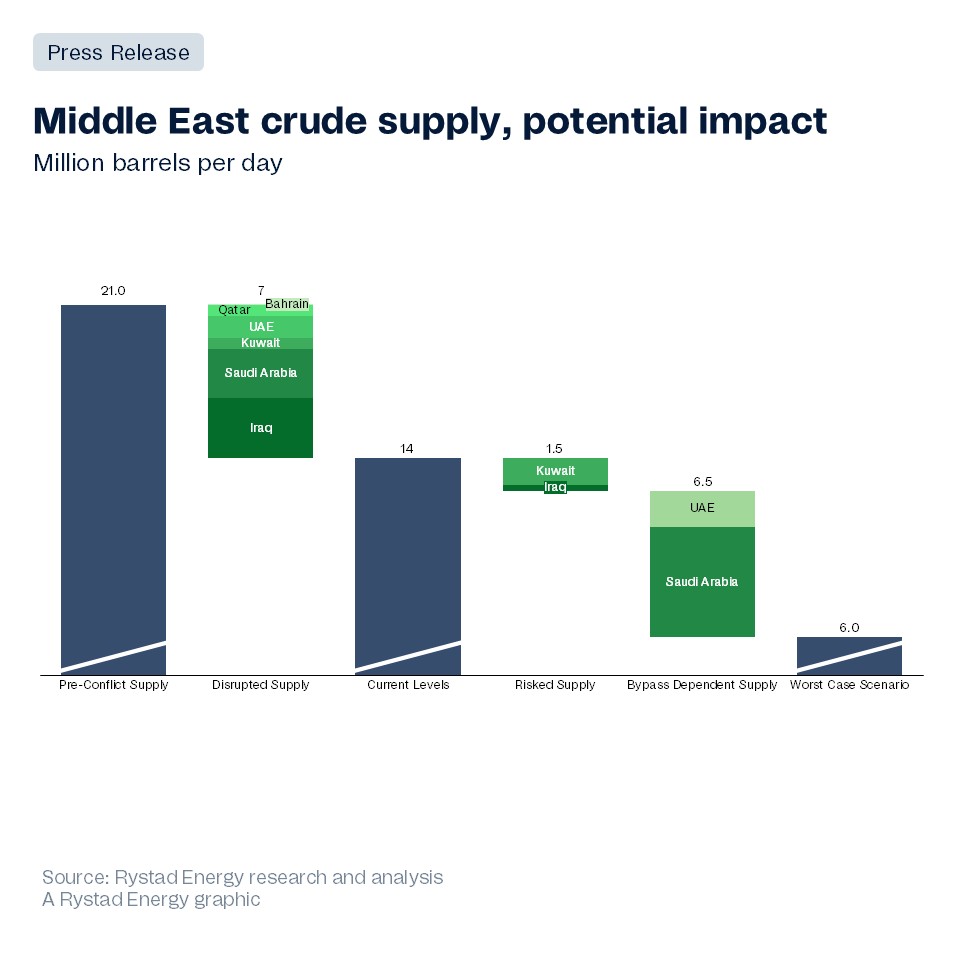
Of the region’s 21 million bpd pre-conflict base, excluding Iran, only 14 million bpd remains at current levels, a reduction of 33% in just over a week. But the 14 million bpd figure is not secure. It contains two categories of supply that carry very different risk profiles.
The first is supply that is actively at risk of further curtailment. Kuwait and Iraqi fields account for about 1.5 million bpd of output that remains online only because domestic refinery feedstock needs provide a temporary floor. Kuwait’s refineries have a combined capacity of 1.42 million bpd, but domestic demand absorbs only 360,000 bpd, and with no export routes, oil product storage is also filling rapidly even at reduced throughput rates. When those tanks fill up, runs will have to be cut further, and with them, the crude supply needed to feed them. The floor is not fixed – it keeps dropping.
The second category is supply that is bypass-dependent – approximately 6.5 million bpd – that can only continue to reach export markets via the UAE’s ADCOP pipeline to Fujairah and Saudi Arabia’s East-West pipeline to Yanbu. This supply is physically moving as of March 13, but it is moving through infrastructure that has already been subject to attack. Case in point is Fujairah, where loading capacity and tanker availability constraints remain.
In Saudi Arabia, the grade implications are as significant as the loss of volume. Arab Heavy and Arab Medium together account for the overwhelming majority of the 2.2 million bpd offline – these are the workhorse grades for complex Asian refineries configured around medium-to-heavy sour diets. Saudi Arabia is still offering Arab Light and Arab Extra Light via Yanbu spot tenders, but Arab Medium has effectively disappeared from the market.
Refineries that cannot substitute lighter grades without configuration penalties are now competing for long-haul heavy alternatives from the Americas and West Africa – adding freight cost, lead time and feedstock uncertainty to an already stressed market. Additionally, if Iranian barrels are eliminated from the market due to sustained attacks on its oil and gas infrastructure, their ideal replacements, Arab Heavy and Arab Medium, would no longer be on the table.
A potential winner here is Russia, which could provide some additional barrels, as stronger drilling activity may lift Urals supply by around 200,000 to 300,000 bpd, but even that would only cover a fraction of any potential loss of Iranian crude. As far as our analysis shows, there are no viable replacements for Arab Heavy and Arab Medium in the near term, triggering a historic supply crisis if the conflict is not resolved in the coming weeks.
By Aditya Saraswat, MENA Research Director at Rystad Energy