
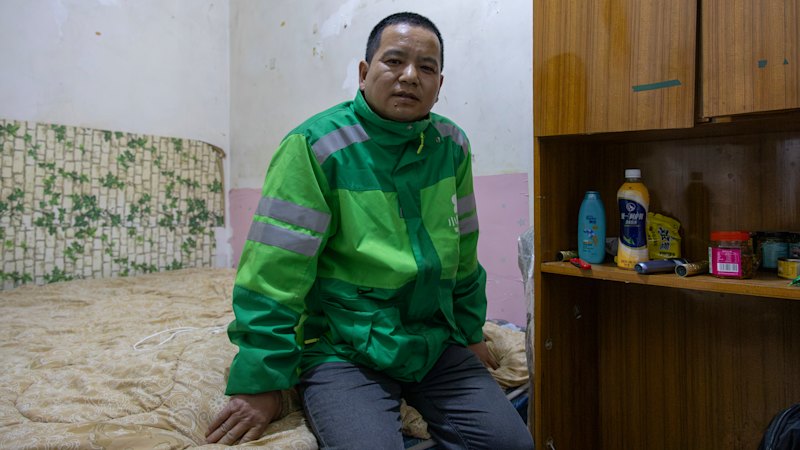
Beijing: It’s after 10pm on Thursday evening and Mu Jie has clocked off after 13 hours of delivering groceries across Beijing on his electric scooter.
He made 65 deliveries in that time, zipping through traffic to beat red lights, racing on foot through apartment complexes and, when there were no elevators, climbing as many flights of stairs as it took to hand over the groceries in person.
It’s punishing work, and Mu’s daily earnings typically don’t top 400 yuan, or little more than $1.20 an order. In the past month, he’s averaged 85 orders a day, with six days of 100-plus deliveries. He took one day off.
To reach his second-floor bedsit in Beijing’s north-eastern suburbs, he trudges through dimly lit alleyways that wind through a chengzhongcun, one of the city’s low-rise villages that is densely packed with migrant workers from regional China.
“There are thousands of people [living here],” says Mu, 49, perched on the edge of his bed. “Most of them are delivery drivers.”
As with many migrant workers, his wife and children stayed behind in their home town – in his case, in Hebei province. When his construction business failed, he had few options but to find temporary work in the gig economy.
“For the sake of family, I just have to keep working,” he says. “To be honest, I’m illiterate and unskilled. I can only earn money through hard labour.”
Windowless and no more than two metres wide, Mu’s room fits just a mattress, a small desk and a bookshelf. Hanging from a hook on the wall is the distinctive fluoro-green jacket worn by riders for Xiaoxiang (Little Elephant in English), a supermarket platform owned by Chinese food delivery giant Meituan.

Along with the one he is wearing, it’s one of the few possessions he has here.
Mu is one of more than 10 million working as food delivery drivers across China. The industry has absorbed not just migrant workers fleeing the regions for better pay, but millions of university graduates struggling to find work while youth unemployment is at 17 per cent.
China’s food delivery wars
The gig economy has exploded in China since COVID-19, and rampant demand for the delivery of takeaway and groceries within the hour has become an ingrained feature of daily life in big cities – much more so than in Australia.
Beijing’s heavily trafficked roads are peppered with riders in high-vis delivery platform uniforms, while it’s common to see their e-bikes banked up outside restaurants as riders run through shopping centres and food courts to collect meals.
For many, the job offers flexibility and comparatively good pay compared with what they could earn in China’s economically depressed regional areas.
But an influx of workers has saturated the labour market at a time when food delivery giants Meituan and Alibaba-owned Ele.me are fighting a vicious price war to lure customers and strengthen their duopoly in a segment that research firm Daxue Consulting estimates was worth $US229 billion ($320 billion) in 2024.

Liu Jie, 26, is on his first day as a rider for Meituan after moving to Beijing from Henan province. He is recently married and needs to pay off the debt on his new house. But instead of living with his bride, he is staying in a Meituan-run dormitory that houses hundreds of migrant workers.
“I made around 4000-5000 yuan per month in my hometown and expect to make 8000-9000 yuan here,” Liu says.
While he can take four days off a month, and apply for more if needed, rest means no income.
“We all are here to make money. So who will be willing to take rest unless they get sick?” Liu asks.
“I work from the moment I open eyes ’til I go to bed. The day is filled with work, nothing else.”
Competition among the Chinese tech titans intensified last year when e-commerce juggernaut JD.com, popular for electronics, expanded into food delivery.
It turbocharged a race-to-the-bottom, with platforms spending billions of dollars to entice consumers with heavy discounts, meal coupons and slashed delivery fees, while trying to outpace each other on delivery times. At its peak in July, customers were offered 1¢ deals on milk tea, flooding shops with orders and crashing ordering platforms.
By the end of the year, Meituan, the biggest player, had posted its first quarterly loss since 2022, while JD and Alibaba’s profits had also plunged.
Today, the price wars have cooled but not ended entirely. Promotions and coupons are widely deployed, and it can still be cheaper to get hot meals delivered to your door than to dine out or cook for yourself. Meanwhile, long-time drivers say they have paid the price and must work longer hours than in the past to make the same amount.
In recent years, videos have circulated on social media of drivers breaking down under the pressure. One viral incident from 2024 showed a rider screaming, “What do they want from me, do they want me to die?” and smashing his phone after receiving a customer complaint. In another, a driver is on his knees in the street appealing to a police officer after running a red light.
Harvard University’s Jack Linzhou Xing, who interviews drivers as part of his research on China’s gig economy, says while platforms offer better earning opportunities than factory or blue-collar jobs, workers “remain trapped in a state of low earnings and high financial stress”.
Despite the platforms’ efforts to improve drivers’ physical and mental health, they continue to be plagued by “profound issues of rider fatigue and burnout under these conditions, especially during peak hours”.
Government crackdown looms
Under pressure from the Chinese government to rein in the destructive competition and improve worker health and safety, Meituan and Ele.me have scrapped their system of fining drivers for late deliveries and replaced it with a points-deduction system.
Along with JD.com, the platforms each claim they offer at least some form of social insurance for drivers, while Meituan has set up rest stations and offered subsidised housing for drivers in some big cities.
Ren Fei, 42, who began working as a delivery driver for Meituan in Beijing a month ago, says that during lunch and dinner rush hours, he has to run to make deliveries in the timeframe set for him by the platform’s algorithm.
“If I walk, I’ll be late,” he says. And being late means points are deducted, and fewer points equal less money.
“When my points get low, the system automatically assigns me orders of long-distance and low-pay. They’ve got big data monitoring us,” he says.

“This is not an easy work to do. Turnover is very high.”
But Ren is sticking it out because he hopes to make double what he was earning as a railway inspector in the industrial province of Shanxi, where his monthly salary was 5000 yuan ($1000).
The trade-off, he says, is that the bigger salary is enough for a comfortable life in his hometown, but not in Beijing, where he lives in shared accommodation with two other men in his room.
In January, Chinese authorities launched a probe into the platforms’ conduct, citing excessive subsidy campaigns, price wars and road traffic concerns.
“The entire [restaurant] industry has fallen into a vicious cycle of ‘losing money to gain attention’, ultimately dragging down the recovery of consumption,” state media outlet the Economic Daily said in a commentary in March.
It declared it was “time to end the price wars”, which analysts have interpreted as presaging a further crackdown.
The first major step in this direction came in April, when authorities hit seven tech giants, including Meituan, Alibaba and JD.com, with fines totalling 3.6 billion yuan ($741 million) for running unlicensed ghost kitchens to pump out cheap meals – the most severe penalty to date levied on the food delivery industry.
Meituan, Alibaba and JD.com did not respond to a request for comment.
Last year, one of the top-performing drivers at Mu’s workstation was involved in an accident after running a red light. His thighbone was broken, Mu says, leaving him unable to work as a rider again, and with little safety net to cushion the blow.
It was a reminder of the precarious reality that confronts China’s gig workers, but Mu can’t afford to dwell on these possibilities.
“As long as I can alleviate the burden on my family and provide a sense of security and happiness to my wife and children, I feel satisfied enough,” he says.
Get a note direct from our foreign correspondents on what’s making headlines around the world. Sign up for the weekly What in the World newsletter here.