
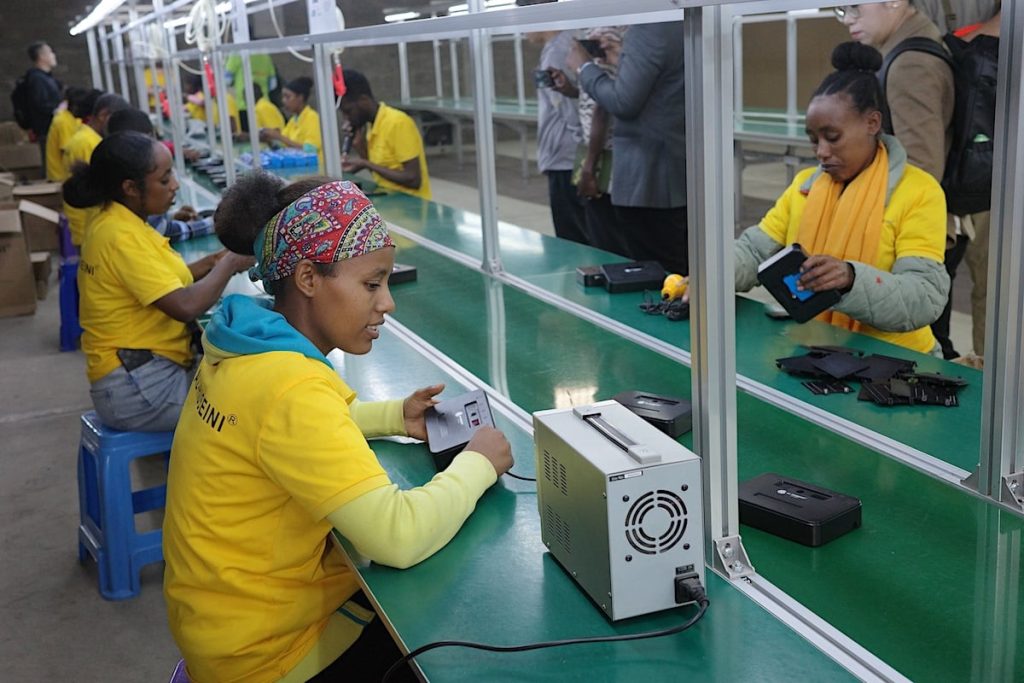
In a Beijing exhibition hall last autumn, representatives from several Chinese firms talked with government officials and businesspeople from 16 African countries. They discussed off-grid solar, clean stoves, electric mobility. What options are available, they probed, and how would they work on the ground?
The event was part of a programme to encourage business matchmaking, technology showcasing and skills transfer – known as the South-South Cooperation Renewables Centre.
Efforts like this one, which was founded by industry body the China Renewable Energy Industries Association (CREIA), are a feature of a new phase in China’s renewables sector exports. Sales to emerging markets grew last year, while to the EU and US they fell, noted China Energy News. Solar panel exports to Africa rose by 17%.
Factors behind the shift include policies on China-Africa cooperation, rapidly growing demand for energy in Africa and increasing protectionism in conventional export destinations. Meanwhile, industry associations and research organisations are helping turn potential opportunities into actual plans.
The renewables centre programme is a key part of the China-Africa Renewable Energy Partnership, which was formed in 2024 by Chinese, Kenyan, Ethiopian and Rwandan industry associations, with support from the World Resources Institute (WRI). The partnership’s aims are very ambitious, states CGTN Africa, including to “revolutionise energy access across the continent”, support local businesses via affordable energy solutions, and create green tech jobs.
Dialogue Earth spoke to Chinese and African officials to find out more about the form cooperation is taking.
Africa demands, China supplies
CREIA is a founding member of the partnership. Li Dan, the association’s secretary-general, says that unlike developed economies, which face an expensive process of dismantling established fossil-fuel energy systems, many parts of Africa are in effect starting fresh: “Africa doesn’t need to follow the same path of polluting first then cleaning up later. It can skip that stage, leapfrogging directly to distributed solar and energy storage.”
Rugare Mukanganga, a Zimbabwe-based analyst for international consultancy Development Reimagined, agrees. He tells Dialogue Earth that expansion of manufacturing and industry on the continent means more demand for energy: “Plugging these energy gaps will be critical. Why not prioritise renewables, clean energy technology, as well as climate-friendly infrastructure, given their increasingly competitive price points?”
Li Dan explains that CREIA first started looking at how to promote China-Africa cooperation on energy in 2022, at the COP27 climate negotiations in Egypt. It was then that the organisation saw energy demand it knew China could help meet.
However, working together isn’t a simple process of finding a supply to meet a demand. Li Dan says that in many African contexts the basic conditions which allow a market to operate are lacking. “At certain stages of development, the most advanced technology isn’t necessarily the best choice. It may be too expensive, or the necessary infrastructure might not be there.” She explained that Chinese companies can supply a variety of products and solutions – but matching these accurately to local need in Africa requires communication and coordination.
Doing so was an important reason for starting the China-Africa Renewable Energy Partnership, which WRI worked with local and international partners to design and set up. Zhang Cheng, a research associate with WRI’s Sustainable Transition Center, explains that China’s 2021 pledge to stop building new coal power plants overseas spurred the energy industry to look for greener opportunities. Africa was identified as a market with potential but also many obstacles. “Given this,” he says, “it would be inefficient for companies to work alone to try and find markets. A platform is needed to reduce uncertainties.”
Filling the information gap
In international investment, accurate information is essential.
Many people don’t realise that there are big differences in how African countries get their energy, and how they set their priorities, says Rugare Mukanganga. “Already, about 20 get more than half their electricity from renewables. That makes the energy transition much less pressing than it is for the remaining 35.” Chinese companies need to understand local circumstances so they can make the correct calls on what to offer.
The partnership is currently compiling information for a quarterly bulletin for Chinese firms and investors – tracking policy changes, industry news and the investment environment in Kenya, Rwanda and Ethiopia. The partnership is also organising regular trips to Africa for Chinese firms so they can meet local counterparts and project managers.

Mesfin Getachew Jenbrie, second secretary at the Embassy of Ethiopia in China, discusses solar photovoltaic solutions at a renewables exhibition centre in Beijing in April (Image: China Renewable Energy Industries Association)
This is, to some extent, changing minds. Li Dan told Dialogue Earth some Chinese firms had assumed they would need to sell their renewable generation products at rock-bottom prices. But they soon learned industrial and commercial electricity users in Kenya and Rwanda were paying the equivalent of CNY 1.50-2.00 (USD 0.22-0.29) for a kilowatt-hour, significantly more than in China, indicating greater purchasing power than anticipated. Also, some private companies are more creditworthy than government bodies, meaning Chinese firms are able to find reliable business partners. This information has affected the decisions Chinese companies make when setting prices and product offerings.
Africa, meanwhile, is learning more about what China has to offer. Yemissirach Sisay is chair of the Ethiopian Solar Energy Development Association, a founding member of the partnership. She told Dialogue Earth that most solar power equipment in Ethiopia is sourced from China and that Chinese firms there tend to work alone. One of the aims of the partnership is to bring those companies together to identify common problems and promote links with local industry.
At the event in Beijing, representatives from Africa were presented with a wide range of clean energy solutions: solar + agriculture, virtual power plants, vehicle-to-grid models. “Some participants told us the shift from a single use [application context] to [system-wide] implementation … made them reconsider how their own local systems could develop”, says Lu Lisha, CREIA’s head of international cooperation.
“In the future, we hope the centre will feature case studies from the South, not just from China. That would be real South-South cooperation and expand the scope of communication,” she says.
The right tech and skills for the right place
Partner countries are often very keen on skills and technology transfer. This means foreign firms sharing knowledge and technical capabilities, enabling local firms to use and eventually develop similar tech independently. Yemissirach Sisay and Rugare Mukanganga both point to a lack of skilled technicians in their countries.
The partnership is trying to facilitate its partner organisations improving the situation. Zhang Cheng gave Dialogue Earth the example of Chinese company Beijing Henghua, which has set up a vocational school, Forever TVET, to train local technicians in Rwanda. The school offers courses on renewable energy and has a demonstration 44-kilowatt solar power station. Students acquire skills in electrical engineering as well as power plant management and maintenance, and the local area can use the station’s electricity.
Zhang Cheng says this has also allowed localised applications to develop. The project set up a battery swap station for electric motorcycles, to allow riders to make longer journeys. This model meets local market demand and makes it more likely Chinese technology will find sustainable use cases.
However, technologies are harder to transfer than skills. Li Dan highlighted the challenges arising from isolated supply chains. Despite calls for the industry to become fully localised, the markets might not be big enough, she notes: “The aluminium produced in China isn’t just used to make solar panels. It’s used in infrastructure, in vehicle-manufacturing … If you don’t have a big enough market to support aluminium making, it’s not realistic to set it up just to make solar panels.”
Rugare Mukanganga thinks moving from “assembled in Africa” to “made in Africa” will require a “nurturing” and start-up-friendly policy environment. That could be provided directly by national governments or by harmonisation of policies across different countries. To promote these efforts, industry bodies will need to talk to those governments, he says.
Funding problems
Finance is always an issue in international development and energy transition projects. Zhang Cheng says investing in Africa is made harder by exchange-rate instability, opaque policy environments and unclear rules around how and when investors can exit projects and take their money home.
“High costs of capital get in the way of many growth opportunities across the continent,” says Rugare Mukanganga. Most of the funding available comes on commercial terms, typically involving higher borrowing costs and limited risk-sharing. This can weaken the business case for local manufacturing and reduce project viability, he added.
Yemissirach Sisay mentioned the obstacles in Africa faced by international money, meaning commercial investment and development finance. On one hand, foreign donors worry that instead of supporting local manufacturing, their funds will flow to more capable Chinese contractors. On the other, institutions such as the World Bank have set high thresholds for access to funds, meaning local small and medium-sized enterprises hoping for funding may be shut out.
In response, the members of the partnership have proposed a new financing system. Zhang Cheng thinks hybrid financing could play a role: public or charitable money would underwrite the project and get it through the initial risks, and so leverage larger private investments.
It’s also necessary to make projects more “bankable”, says Li Dan. She points out that turning Africa’s huge demand for energy into commercially viable projects requires systematic capacity building covering project design, risk assessments and commercial models that are profitable and sustainable.
Rugare Mukanganga says African start-ups need long-term funding, not short-term money in search of a quick profit. That “patient” money should be thinking in terms of fostering an industry, rather than simply evaluating risk and return. He thinks more cooperation between African- and Chinese-led multilateral financial institutions is important. “The pool of available funding could be expanded, in particular to support projects under Africa’s Agenda 2063,” he says, referring to the African Union’s long-term strategy to promote industrialisation, regional integration, infrastructure development and sustainable growth.
A new partnership, focussed on innovative financing mechanisms, is currently in the works, says Zhang Cheng. He notes that the WRI and its collaborators have so far mapped out three partnerships: the one described above, led by renewable energy associations from four countries and focusing on trade and investment matchmaking; a capacity-building initiative led by the Henghua School in Rwanda and Strathmore University in Kenya; and the financing platform in the works.