
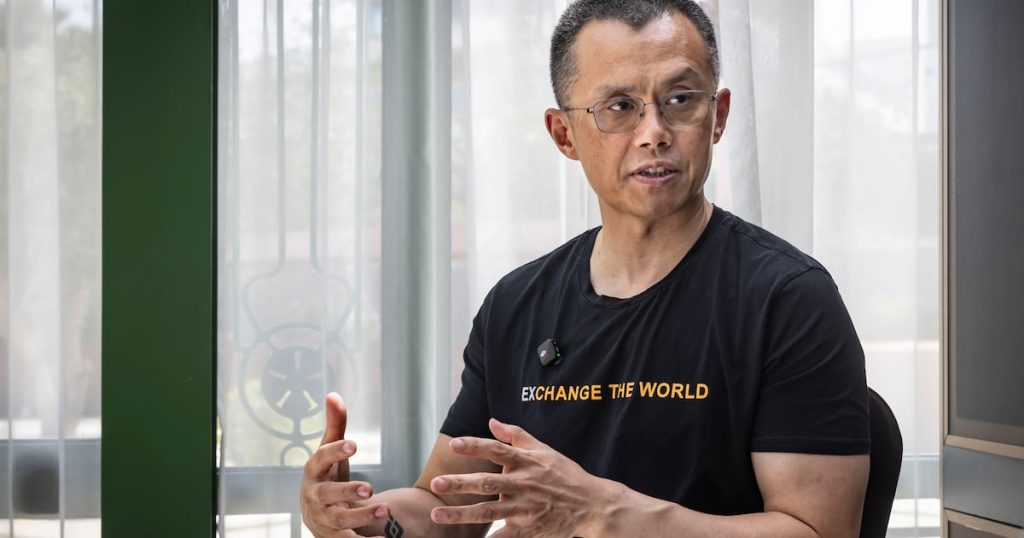
The UAE offers “freedom” in cryptocurrency and has succeeded in building a globally competitive crypto ecosystem, Changpeng Zhao has said in an interview with The National.
“They have a lot of room to experiment,” said the former Binance chief executive and founder, describing a system that balances innovation with consumer protection through a “calibrated approach”.
“That’s one of the strengths for the UAE. And the country’s leadership is very forward thinking,” he added.
Mr Zhao said the Emirates’ strategy, particularly through jurisdictions such as Abu Dhabi’s ADGM, has positioned it among the most advanced globally in regulating digital assets, while allowing companies room to innovate.
His comments come as he promotes his memoir, Freedom of Money, in Dubai, marking a return to the public stage after a turbulent period that included imprisonment and a presidential pardon.
Mr Zhao served four months in a US federal prison in 2024 after pleading guilty to a charge related to anti-money laundering controls at Binance. He was released in September and pardoned in October 2025, closing a case pursued under the administration of former US president Joe Biden.
During that period, he had limited internet access and “a lot of time to write”, he said, relying on his memory to tell his story. Reflecting on that period, said Mr Zhao, his priorities have shifted.
“I really enjoy spending time with my family … the people are the most important things in your life,” he said, adding that he is now focused on projects with long-term impact, including the company he founded called Giggle Academy, a free education platform that has reached about 200,000 children.
At the Binance-hosted event in Dubai, Mr Zhao expanded on his views of the UAE’s trajectory, calling it “the most crypto-friendly place on the planet” and predicting it would become the global hub for financial innovation.
“This is the first in the world … I think the UAE is going to become the centre for money,” he said, pointing to the country’s shift away from oil and into sectors such as blockchain and artificial intelligence.
Bitcoin recovery?
Despite global instability, Mr Zhao said Bitcoin continues to follow its historic four-year cycle, even amid geopolitical tensions.
“To my surprise … Bitcoin still followed the four-year cycle,” he said, noting a sharp drop earlier in 2026 before a gradual recovery.
Prices fell to about $60,000 in early 2026 before rebounding towards $80,000 by the second quarter of the year, reinforcing his view that long-term prospects remain strong despite short-term volatility.
The digital coin had previously surged towards $120,000 in late 2025, driven by strong institutional inflows, the launch of spot crypto ETFs and expectations of regulatory clarity in the US.
“The recovery is always slow,” he said, adding that increasing institutional participation and broader adoption will support continued growth.
He added that, contrary to expectations, global conflict had not triggered a sustained rally in Bitcoin prices, while optimism around pro-crypto political leadership in the US, including the return of President Donald Trump, has at times supported sentiment in digital asset markets.
Since his release, Mr Zhao has shifted his focus to education, investment and advisory work, including supporting blockchain ecosystems and advising governments on crypto regulatory frameworks. He noted that while many countries are still developing their approach, the UAE is already ahead.
“They don’t need a lot of consulting … they’re quite advanced here,” he said.
AI compute and its impact on crypto
The growing role of AI has also raised questions about whether crypto could become part of global cyber security infrastructure. Investor Anthony Scaramucci recently suggested Bitcoin could be valued far higher if it became essential to defending against AI-driven threats, and asked what it might be worth as a “global requirement for cyber security”.
The idea reflects a broader concern that increasingly powerful AI systems could exploit weaknesses in financial and digital systems, creating demand for secure, decentralised networks like blockchain.
Mr Zhao, however, framed the relationship in simpler terms, saying the rise of AI and compute power would increase demand for crypto rather than replace it. “I think more compute, more AI agents, is going to require more crypto,” he said.
In practical terms, he suggested that as machines begin to transact autonomously, blockchain-based systems could provide the rails for those payments, rather than acting as a direct cyber security shield.
2026 outlook
Looking ahead, Mr Zhao said multiple developments are converging to shape the next phase of crypto adoption, including stablecoins, tokenised real-world assets and the integration of AI into financial systems.
“I don’t know which one is going to be exactly … but all of those things are happening,” he said.
He highlighted the growing role of AI-driven transactions, or “agentic payments” as a central trend, alongside expanding crypto exchange-traded funds and increasing regulatory clarity in major markets.
This belief was echoed by the current Binance co-chief executive Richard Teng in December. “The world is now at the start of a five to 10-year period of huge transformation,” he told The National at the time, with AI and blockchain set to rewrite global finance systems during that period.
For the UAE, said Mr Zhao, these trends reinforce its position at the centre of a rapidly evolving financial landscape.
“This is the centre for money,” said the founder, who first set up in the UAE in 2021, adding that the country’s infrastructure, safety and leadership vision give it a significant advantage.
“That’s the reason I came,” he added. “Many crypto companies are here 1777865631 … I would encourage every crypto business to consider looking at the UAE.”