
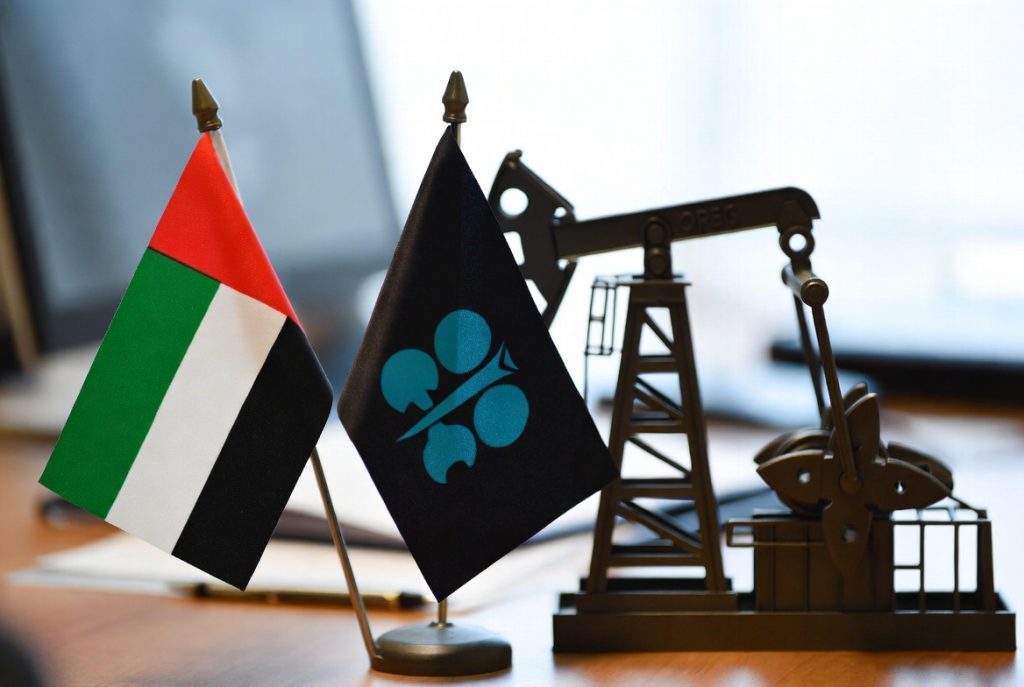
As the UAE prepares to leave OPEC from May, global oil prices will experience wider price swings and have less predictable floors in the medium-to-long term.
The evolving pricing landscape is shaped by conflicting factors.
Elevated geopolitical risk premia persist due to ongoing disruptions, particularly concerning the Strait of Hormuz, and impaired regional production.
For instance, the UAE’s actual output is only anticipated to gradually return to 3.5 million barrels per day (bpd) by the end of 2026, even in a best-case scenario, according to Rystad Energy.
“On the other, the prospect of less coordinated supply management, both from the UAE operating independently and from the signal this sends to other producers reassessing their participation, introduces a competing downward force as the market looks ahead to recovery,” analysts at Rystad Energy said.
Historically, interventions from the Organization of the Petroleum Exporting Countries and allies have provided a floor to oil prices during oversupply episodes and demand destruction scenarios.
Impact on prices
However, after losing one of the prominent members in the group, OPEC’s influence and the buffer system is now weaker.
“The UAE’s departure shows that a major producer is willing to prioritise national strategy over cartel coordination,” Esther Sholes, a senior macro analyst for Take Profit Trader, and former portfolio manager at Millenium told Invezz. Take Profit Trader is an emerging futures funding platform.
Sholes expects no immediate impact on oil prices due to the current tight supply.
However, the medium-term recovery is likely to be quicker and more volatile on the supply side compared to previous cycles, primarily because the fading of current disruptions will occur without a strong coordinating framework, according to Rystad Energy.
This lack of coordination suggests the recovery will be disorderly, characterised by wider price fluctuations and less certain price floors.
At the time of writing, the Brent crude oil contract was 4.7% higher at $123.61 a barrel.
Prices are on track for their fourth month of gains. Since the start of the year, Brent prices have more than doubled, rising to their highest since March 2022 on Thursday, and West Texas Intermediate is up more than 90%.
“Rather than moving cleanly in one direction, prices are likely to become more volatile, driven increasingly by geopolitical headlines rather than policy signals from OPEC+,” Priya Walia, vice president, commodity markets – oil, Rystad Energy, said in an emailed commentary.
Spare capacity buffer
The UAE’s departure immediately raises concerns about OPEC+’s collective capacity to address supply disruptions.
As of February 2026, OPEC+’s nominal spare capacity was about 5.98 million bpd, even after accounting for Saudi Arabia’s 750,000 bpd overproduction relative to its quota, data from Rystad showed.
Crucially, the UAE contributed 1.54 million bpd of this total, representing roughly 25% of the group’s entire buffer, the data showed.
With the UAE no longer part of the framework, OPEC+ loses direct control over this significant capacity, substantially diminishing the remaining members’ ability to respond collectively to current or future supply shocks.

That buffer is now, at least partially, outside coordinated management.
“The timing highlights the UAE’s infrastructure advantage, particularly its ability to export crude via Fujairah, bypassing the Strait of Hormuz,” Sholes told Invezz.
“While this doesn’t allow for an immediate surge in supply, it does give the UAE greater operational flexibility and resilience during disruptions, reinforcing the value of being unconstrained by OPEC quotas at a moment of heightened market stress.”
Unlike most OPEC members, the UAE has already developed enough non-oil institutional capacity to make leaving the organisation a viable option, not just a desirable one, Sholes noted. For the majority of members, exiting OPEC would not lead to strategic independence but rather to unilateral vulnerability.
In the near term, the timing underscores a desire for autonomy amid regional disruption, while over time it raises questions about OPEC+ cohesion and the durability of supply discipline.
Once the Strait of Hormuz issue is resolved, UAE’s barrels would return to the market on “commercial terms rather than managed ones,” Rystad said.
Contribution and cohesion
UAE’s action also fundamentally alters future expectations by moving beyond the existing quota system.
Further out, as the market begins to rebalance, the weakening of OPEC+ as a mechanism to coordinate supply could amplify downside risks compared with previous cycles.
The structural consequence is straightforward as the UAE’s contribution to OPEC+ output has been consistently meaningful.
Prior to the conflict, OPEC+ 8 output was approximately 34 million bpd, representing about 38% of the world’s crude and condensate supply, of which the UAE provided a significant share.
Following the UAE’s departure, the reduced OPEC+ 7 grouping now accounts for about 4 percentage points less of the global supply, according to Rystad Energy.
Consequently, the potential difference in output between the former eight-member group and the current seven-member group is expected to grow noticeably throughout the second half of 2026.
“The UAE’s decision to exit at this moment is itself a sign of weakening cohesion. The war is already affecting OPEC members very differently, and a cartel only holds together when members feel the same pain and benefit equally from the same solution,” Sholes said.
On the other hand, Sholes also said energy importers gain in an environment where there are any irregularities in coordinated supply.
“Large importers like China and India benefit most from potential increases in supply and pricing flexibility.”