
“The one thing that professional investors or sophisticated investors fear the most is uncertainty.”

Key Takeaways
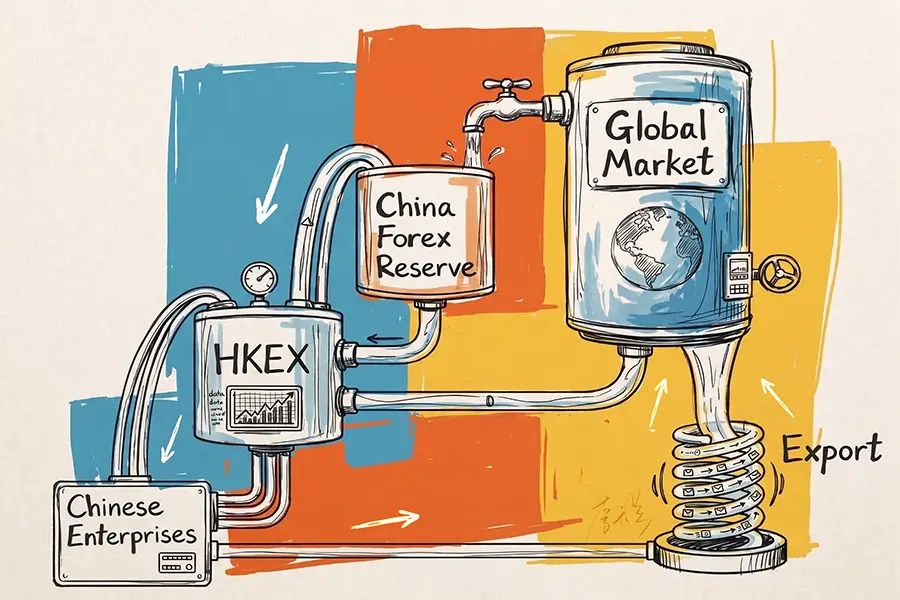
- A major portion of China’s massive $1.2 trillion trade surplus is flowing into the Hong Kong stock market, according to a Caixin analysis
- The recent passing of legendary investor Mark Mobius underscores a reality that an old guard of early China bulls is dying out and not being replaced
By Doug Young & Rene Vanguestaine
We’re currently witnessing a pair of fascinating developments in the Chinese equities space. A recent analysis by Caixin suggests that a significant portion of China’s $1.2 trillion trade surplus is unexpectedly flowing into the Hong Kong stock market. At the same time, the death of celebrity investor Mark Mobius this month highlights a broader trend: the legendary China bulls of the past are fading away, and they aren’t being replaced. These two stories underscore a profound shift in the Chinese market — one driven by surprising internal capital flows, the other by a structural decline in Western investor optimism.
Caixin’s analysis shows that instead of going into China’s forex reserves or domestic infrastructure building, a massive chunk of the country’s export surplus is being funneled directly into Hong Kong equities. This is a fascinating revelation. If hundreds of billions of dollars from China’s export machine — which really is just thousands of individual companies — are flowing into this offshore market, it helps explain the exchange’s prolonged rally and how it’s been able to effortlessly absorb so many fairly large IPOs from Mainland firms.
Inevitably, some of this surplus is being used by companies expanding overseas to build manufacturing plants in Southeast Asia, Europe, and Latin America. Yet, a substantial amount is still hitting the stock market. From a broader macro standpoint, one might wonder what this means for the Chinese economy if funds aren’t fully directed toward factory expansion or machinery upgrades.
Fortunately, one doesn’t necessarily preclude the other. Chinese state-owned banks, whose mission is to execute government policy, are still lending aggressively to companies, particularly in critical sectors like AI and high-end manufacturing. We’ve seen this dynamic over the past 15 years — money has heavily flowed into either the stock market or real estate at various times, but that hasn’t stopped the country’s manufacturing sector from growing.
However, there’s a looming question. A decade ago, surplus investment money poured into real estate, and we all know that didn’t end well. Furthermore, Beijing has a historically strict approach to managing money generated overseas by Chinese companies. It typically twists arms to bring export and IPO proceeds back to the Mainland. This raises the question of whether these current offshore stock flows are happening with the government’s approval, or if authorities are simply too busy with other economic issues right now. If it’s the latter, we might eventually see a harsh reversal rather than a soft landing once Beijing decides to wake up and intervene.
The end of a legendary era of China bulls
This brings us to the second major shift in the market. Mark Mobius, renowned for his love of emerging markets and his early bullishness on China, died this month in Singapore at the age of 89. He belonged to an elite group of early investors, alongside figures like 83-year-old Jim Rogers, who made substantial profits championing China’s growth potential when the country was on the up-and-up.
When reflecting on this bygone era, there are some cases that perfectly illustrate that golden age — like observing early offshore investments in Sinopec (0386.HK) around 2003 or 2004. Back then, it was the perfect time to go heavy into emerging markets because China clearly looked poised for substantial growth. Today, the economic promise is drastically different. In a post-Covid environment hampered by subdued consumer spending and shifting geopolitical tides, we simply don’t see younger bulls stepping in. Instead, a new generation of bears has emerged in the West. This includes super investors like Stanley Druckenmiller, who has said he exited his China positions in 2018 and hasn’t made a single stock trade there since.
Despite the recent stock market rally fueled by those trade surplus inflows, professional Western investors are hesitant to return. While sectors explicitly favored by the government for national security can still deliver substantial returns, the overarching deterrent is uncertainty. Sophisticated investors fear government-driven uncertainty above all else.
There are some cases even today where authorities abruptly intervene in private deals — such as Beijing stepping in to cancel the acquisition of Manus by Meta (META.US). Such actions destroy investor confidence, signaling that even successful investments can fall victim to interference completely out of their control.
For foreign capital to return, this regulatory heavy hand would need to reliably disappear. Right now, U.S. investors have highly attractive, predictable alternatives. The American AI sector remains a massive draw where the rules are well known and the government doesn’t step in to alter them on a whim. Other emerging markets, like India or Vietnam — though Vietnam has its own top-down state control — also appear freer at the moment. Until Beijing can prove it has permanently removed regulatory uncertainty, Western investors will likely stay away, heavily deterred by an increasingly extensive track record of unpredictable reversals.
About China Inc
China Inc by Bamboo Works discusses the latest developments on Chinese companies listed in Hong Kong and the United States to drive informed decision-making for investors and others interested in this dynamic group of companies.
Subscribe to China Inc on your favorite app: