
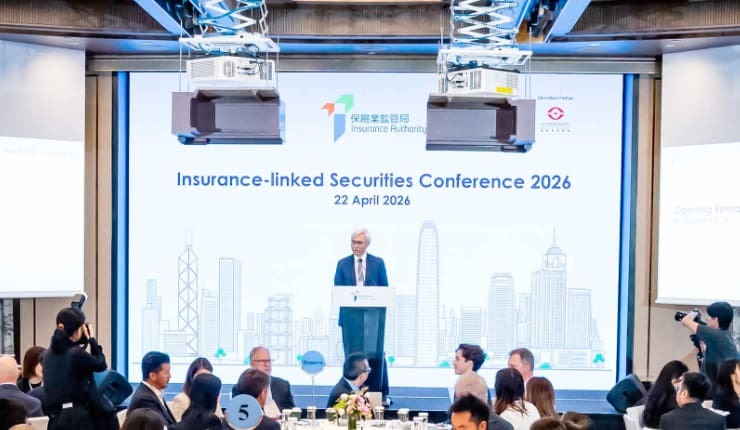
Given Hong Kong’s open and sophisticated financial market, along with its distinct connection with the Chinese Mainland and the support of roughly 3,380 family offices, the major city is ideally placed to promote the usage of alternative risk transfer tools and ILS, according to Stephen Yiu, Chairman of the Hong Kong Insurance Authority (IA).
In his opening remarks, Yiu highlighted how alternative investments are gaining more traction.
“Alternative investments are gaining more attention than ever from institutional investors looking for balanced risk-adjusted return amidst rising uncertainties, as borne out by the massive flow of capital into ILS products that propelled the outstanding amount to a historical level in the first quarter of 2026, with total assets under management surpassing US$129 billion,” he said.
“Hong Kong can and should play a role in nurturing and managing these fund movements,” Yiu added.
He continued: “On the other hand, ordinary folks in Hong Kong have lived through a period of “normalised abnormalities” in 2025 as we have 14 typhoons entered our vicinity against a long-term average of six and there were five black rainstorms which is unheard of since the warning system came into effect in 1992.”
Yiu emphasised that other parts of Asia are also not faring much better. He specifically highlighted how the interplay between monsoons and tropical cyclones has given rise to a mass of devastating floods and landslides, aggravated by rapid urbanisation and fragile infrastructure.
“You must be familiar with the sobering statistics on NatCat protection gap that stand at 52% globally and 88% for the Asia Pacific region,” Yiu added.
“Gifted with an open and sophisticated financial market, unique connectivity with the Chinese Mainland and the patronage of some 3,380 family offices, Hong Kong is ideally placed to promote the usage of alternative risk transfer tools.”
Yiu continued: “Our journey of becoming an ILS hub began in 2021 with the setting up of a bespoke regulatory regime and launching of the pilot grant scheme. We realise from the outset that rather than being an initiative geared for business development, this is a worthy course of leveraging our core strengths to support emerging markets and developing economies which are highly vulnerable to the wrath of Mother Nature. Progress achieved towards such a goal should not be gauged by the number or size of ILS issuances, but whether a stable strategic role can be put into shape.”
Since launching its ILS regulatory regime in 2021, Hong Kong has hosted nearly US$800 million in catastrophe bond issuance, with prominent issuers such as the World Bank and Peak Re raising a total of US $800 million from deals either issued there or listed on the local exchange.
During the CIB’s Annual Conference in late 2025, Yiu, who also spoke at that event, highlighted how ILS continues to gain momentum in Hong Kong. During his speech at the event, Yiu expressed how he believes that the market is a blue ocean for Hong Kong’s insurance brokers, and an opportunity not to be missed.
We also reported last June, that the government of Hong Kong is weighing additional incentives to attract more catastrophe bond issuers and investors, aimed at promoting the city as a global hub for alternative risk transfer.
“In order to reinforce our status as a risk management centre, the Government has extended the pilot grant scheme for three years until 2028 and will accord preferential tax treatment on ILS investments held by private funds and single family offices,” Yiu further added.
Yiu also explained that the IA is doubling down on efforts in order to enhance knowledge and awareness, stimulate buy-side interests, identify prospective sponsors, enrich the underlying risk types to include third-party perils and introduce more innovative product structures like protected cell companies.
He concluded: “Looking back over the past few years, we have made great strides in seeking to forge an ILS ecosystem, doing so in a methodical and assiduous manner while always bearing in mind the desirable outcome. Instead of presenting a threat to any established hubs, the decision by Hong Kong to join the foray can inject new energy that will sustain overall growth of the entire market.”
