
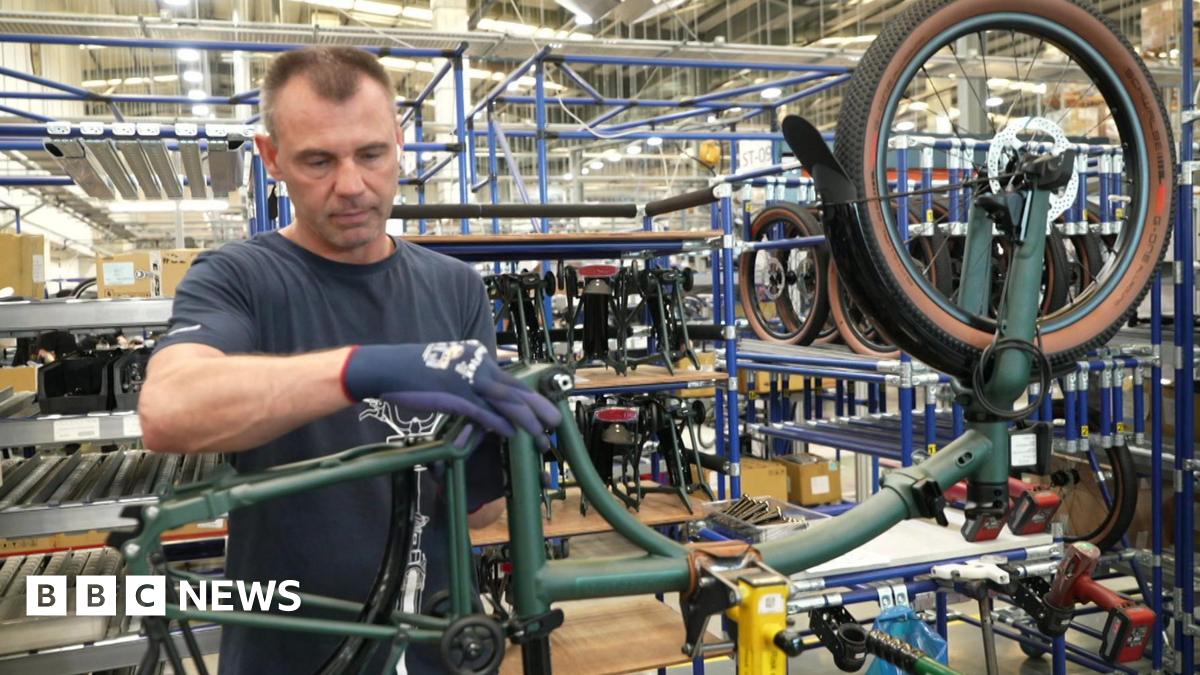
At the Brompton Bikes factory in Greenford, west London, employees are hard at work, painstakingly handcrafting each bike.
It’s been fifty years since the business set up in London, in the company of many other engineering workshops.
In that time, small machine shops that used to service big enterprises have, according to its founder Andrew Ritchie, been converted into residential units, a move which has left him sad.
The statistics support his sentiment: during the late 18th century to the mid-20th century, London was seen as a leading centre of UK manufacturing., external It now accounts for just 2% of London’s overall income.
But according to City Hall, there is still hope for the sector: production of food and beverages, textiles and clothing have all seen their contribution to London’s income grow since the early 2000s.
Academics say although traditional manufacturing has declined, an “artisanal approach” has started to replace the industry of the past.
“London should not be written off too quickly as a city that makes,” say Cities of Making, a research project funded by JIP Europe.