
People on social media occasionally tout the large profits they collect from big, one-day bets made on speculatively held stocks. For some, this form of trading is tempting. What’s better than buying a few hot stocks, waiting an hour or two, and then making more than $100,000? It seems so simple and so easy.
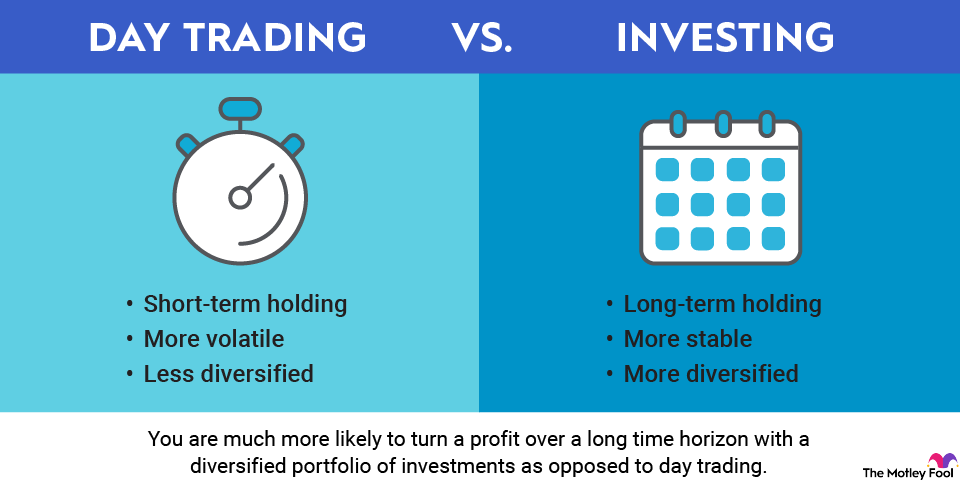
Image source: The Motley Fool.
The reality is that consistently making money as a day trader is a rare accomplishment. It’s not entirely impossible, but it’s certainly an imprudent way to invest your hard-earned cash. For people considering day trading for a living, it’s important to understand some of the pitfalls.
Day trading vs. investing
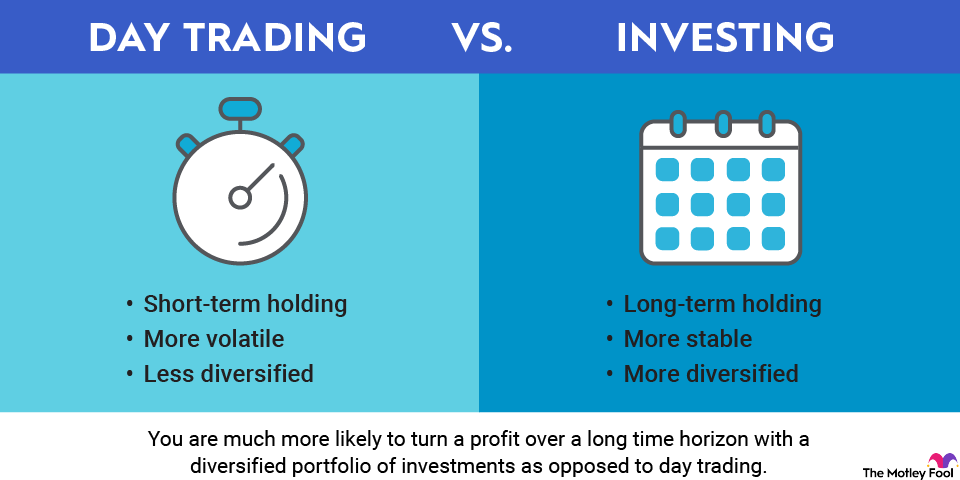
Investing in the traditional sense generally does not refer to day trading. While “investing” is a broad term, it’s well established that the most efficient way to consistently earn stable and positive after-tax returns is to simply buy stocks or bonds and hold them for the long term.
Long-term, buy-and-hold investors typically do not experience the emotional swings that afflict most day traders — even when their holdings gain value. If you were to create and maintain a portfolio of low-cost exchange-traded funds (ETFs) instead of day trading, the odds of turning a profit over a long time horizon would be overwhelmingly in your favor.
Investors with long-term holdings are well positioned to diversify their investments and mitigate the risk of large losses. Day traders who buy and sell just a few popular stocks have portfolios that are much less diversified, so the movements of any one stock have a much larger effect on their financial health.
Is day trading a good idea?
Day trading is not worth it for the vast majority of day traders. Anecdotally, it’s been widely estimated that 95% of day traders ultimately lose money, and it’s been empirically demonstrated that about the same percentage of unprofitable day traders continue despite losing money. If you’re thinking about day trading for the first time, it’s important to know that day trading profits are hard to come by. You can make money day trading, but you’d be in very limited company.
The paradox of day trading is that it may seem like a good idea, depending on how the stock market is performing. Day trading is essentially a play on the short-term volatility (or price movement) of a stock on any given day. Day traders often buy and sell stock the same day, buying at a perceived low point during the day and then selling out of the position before the market closes. If the stock’s price rises during the time the day trader owns it, the trader can realize a short-term capital gain. If the price declines, then the day trader accrues a short-term capital loss.
Realized Loss
A realized loss occurs when an investment is sold for less than its purchase price, resulting in an actual financial loss.
A primary reason day trading is a bad idea has to do with transaction costs. The two most visible transaction costs are taxes and fees, such as trading commissions. If you purchase a stock and sell it before one year has passed, then any increase in the stock’s value is taxed at your ordinary income tax rate, which is likely significantly higher than the tax rate that would be applied if you held the stock for a year or more. Depending on the trading platform you use and the type of security you’re trading, you may also pay a commission every time you buy or sell a stock. These transaction expenses can be costly for day traders.
The inherent nature of the capital markets also typically makes day trading a losing proposition. Minute-to-minute stock price movements on any particular day are little more than random, and they tend to instantaneously adjust to any new publicly available information. Further, when you place a market order to buy or sell, you’re trading against a large swath of sophisticated institutional investors and high-frequency trading machines. The probability that you know something professional investors do not — without it being illegal insider information — is extremely unlikely.
Institutional Investor
An institutional investor is a professional organization or company that invests money on other people’s behalf. Here’s what you need to know about institutional investing.
Given that successful day trading is a rare feat — and even rarer on a consistent basis — there are many reasons to stay away from day trading entirely. You worked hard for your money and should avoid putting it in unnecessary peril. Especially when you consider the significantly inflated tax rate assessed on short-term trades (sales of any stocks held for one year or less), it’s fair to say that day trading is not worth the risk.
Can you make money day trading?
Most of the time, day trading is not profitable, but it can be profitable. Investors sometimes succeed at predicting a stock’s movements and raking in six-figure profits by accurately timing the market. These traders may be dabbling in penny stocks to achieve their outsized returns, or they may simply get lucky on occasion — as many people do at casinos every day.
You may hear stories of some traders making money in professional settings, leaving their investment firms, and calling themselves “successful” day traders — but without ever having risked their own money in any trades! A non-professional investor trying to learn day trading using his or her own money is unlikely to succeed. On rare occasions, an individual investor can capture explosive gains. But far more common are the instances of day trading ruining lives or financial situations.
For most investors, the best way to grow their money, be it a $10,000 investment or a $20 one, is over the long term.
Is day trading gambling?
It’s fair to say that day trading and gambling are very similar. The dictionary definition of gambling is “the practice of risking money or other stakes in a game or bet.” When you place a day trade, you’re betting that the random price movements of a particular stock will trend in the direction that you want.
In the same way that expert poker players study and practice relentlessly to excel at the game, the few successful day traders (who may be at institutions) tend to be extremely well-versed in how markets move in the short term. If a novice poker player were to challenge a table of experts, he or she may conceivably win one or two hands but would almost certainly lose money overall. While day trading is not precisely the same as gambling, one thing remains true about the practice: Most of the time, it is not profitable.
Are penny stocks and day trading the same?
No, they aren’t. “Penny stocks” and “day trading” are two entirely separate terms, but they are often found together in various contexts. Penny stocks are simply stocks that trade for less than $5. Day trading is the act of buying and selling a stock on the same trading day or within a similarly short time period. Many day traders choose to focus on buying and selling penny stocks, but day trading is possible for all stocks, even blue chip stocks.
Some day traders buy and sell primarily penny stocks because of the possibility of a high percentage gain in a relatively short period of time. A stock priced at $1 would only need to gain $1 of value for an investor to realize a 100% return on their initial investment. By comparison, a stock trading at $100 would have to gain another $100 in value before that same 100% gain would be achieved. Day traders sometimes try to exploit quick (and random) upward movements in penny stocks to capture large percentage gains — despite stocks’ movements during any single day being incredibly unpredictable and the gains far from guaranteed.
Day trading taxes
When you buy a stock and then sell it within the same trading day, you might make money. But you’d also owe state and federal income tax on the gain, which is equal to the price at which you sell the stock minus the initial purchase price. The short-term capital gains tax rate is the same as the tax rate assessed on your ordinary income (e.g., the money you earn by working).
Ordinary Income
Ordinary income is any income taxed at ordinary income rates.
Generally speaking, this tax rate is higher than the tax rate assessed on long-term capital gains, which are levied only after a stock or other security stays in your portfolio for a year or longer. The considerably higher tax rates applied to short-term capital gains are another reason to consider holding your investments for at least a year.
Aside from its inherent riskiness, day trading is especially not worth it when you factor in the significantly higher tax rates imposed on short-term trades.
Related investing topics
How you invest your money is ultimately up to you
You get to decide how to best deploy your money. If you decide to day trade, then the most prudent approach is to keep the dollar amounts at risk relatively low — say, no more than 10% of the value of your overall portfolio. That amount might be enough to gain day-trading experience, but it won’t completely devastate your portfolio if your short-term positions incur large losses. If you’re also considering other strategies to build your net worth, you’d be wise to learn the many benefits of investing for the long term.