
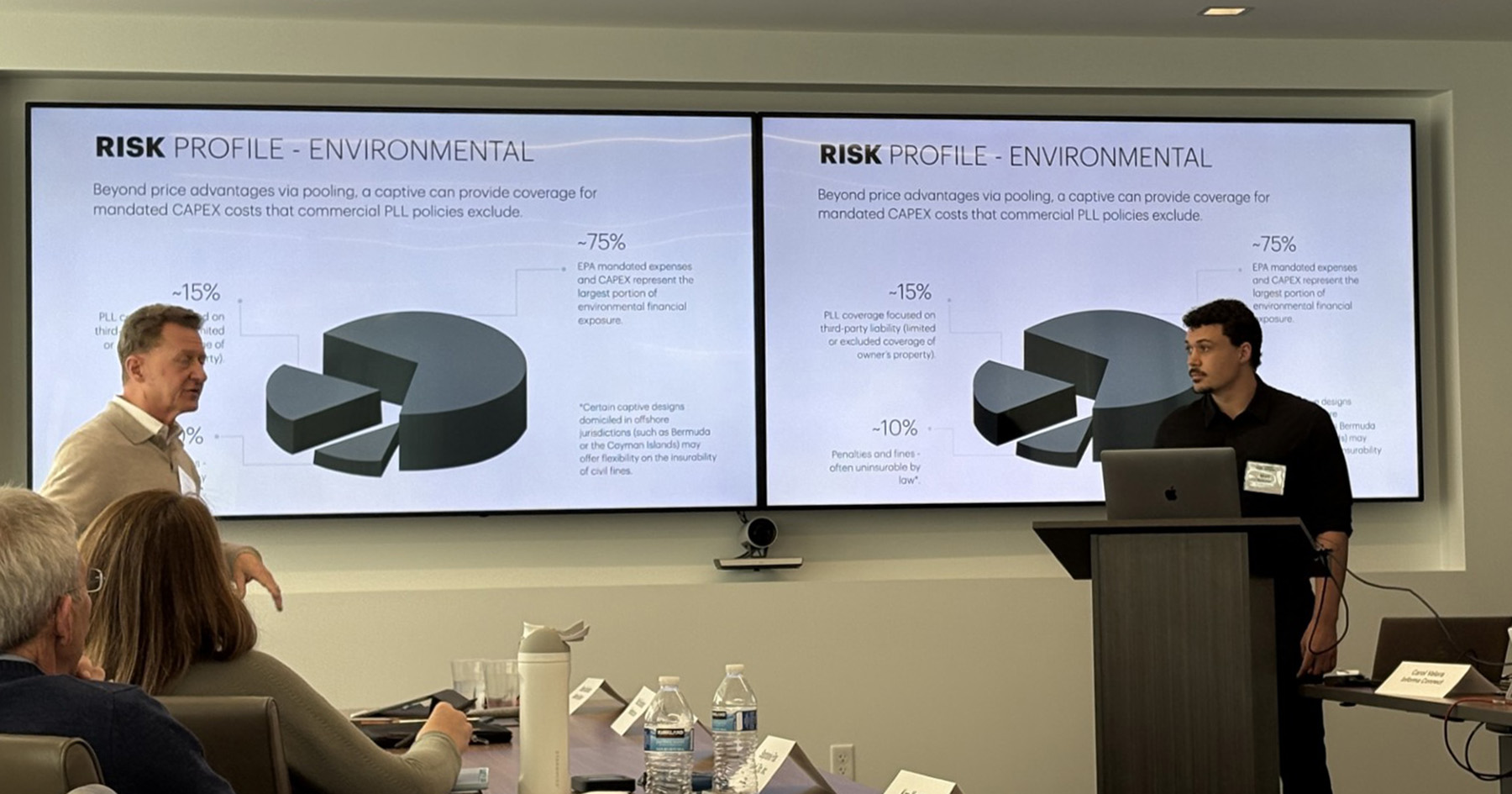

Steve Burkhart (left), Ballard Spahr, and Matt Burkhart (right), RealTech, present at CSP’s Captive Insurance Forum. | CSP Staff
A captive insurance company is an insurance entity formed and owned by a business, like a convenience-store retailer, to insure its own risks.
There are two primary benefits to a captive insurance program—improved cash flow and control, said Luke Foley, vice president of The Graham Co., an insurance brokerage and consulting firm based in Philadelphia, at CSP’s Captive Insurance Forum on Dec. 3-4 in Phoenix.
Captives can improve cash flow
Instead of buying insurance only from a regular insurer, a c-store captive insurance company can make its costs more predictable, Foley said.
A captive insurance company (known as a “captive”) improves cash flow by keeping surplus that would otherwise be paid to commercial insurers, he said. Surplus accumulation allows companies to smooth annual insurance costs, reduce volatility and strategically leverage the captive when market rates exceed actuarial loss projections. Over time, this retained surplus can also be invested, generating additional income and enhancing the overall financial efficiency of the organization, Foley said.
Retailers also can pre-fund deductibles, which can accelerate tax deductions, according to Foley.
For c-store operators, these benefits combine to make a captive a powerful tool for long-term financial stability and risk management.
“When you set up your captive, you are paying premiums to yourself. That’s a huge advantage of it,” said Matt Burkhart (pictured right), founder of RealTech, a risk consultant company, who also presented at the forum. Steve Burkhart (pictured left), special counsel at Ballard Spahr, a law firm based in Philadelphia, also presented.
Captive insurance can give c-store retailers more control
Captives give businesses direct control over risk management, Foley said.
A c-store captive can provide control over structure of insurance for high-frequency, high-severity exposures such as slip-and-falls, fuel operations, food safety and property risks, Foley said.
Beyond traditional insurance coverage, there are some unconventional but compliant ways to use a captive, Matt Burkhart said.
“There’s a lot of flexibility with captives, specifically with regionality, the different cells [insulated compartments within a captive insurance structure, where each cell’s assets and liabilities are segregated from the others] you can have,” he said. “As you’re getting creative in your captive design, it’s worth keeping that in mind, depending on where you operate and how your risks might change from space to space.”
These could be things like underground storage tanks, secondary containment or fuel infrastructure, Matt Burkhart said, “which might be subject to a mandated upgrade that can be funded through some of those premium payments you pay yourself and over time. Even if you have the idea that you want to do these upgrades, starting a captive now helps you prepare for those upgrades in the future.”
A captive insurance company also can help in the event of food recalls, to which convenience stores are susceptible, Matt Burkhart said.
“But the severity from foodborne pathogen outbreaks has been growing like crazy, so that can lead to a lot of downstream financial consequences because you are the merchants that sell this fresh food, even if you’re not the ones preparing it. Just having the prepared offering on your shelf opens you up to a lot of risk,” he said.
What a captive actually does
A captive gives a company the tools to actively manage risk rather than just transfer it, Foley said. It allows businesses to fund losses based on their actual experience, pre-fund deductibles in potentially tax-advantaged ways and create coverage for exposures that are difficult or costly to insure in the commercial market, like PFAS—persistent industrial ‘forever chemicals’ that carry significant cleanup and liability risks—as well as supply-chain interruptions or gaps in coverage. By doing so, a captive strengthens the company’s financial position, provides flexibility in handling claims and costs and offers a more predictable and efficient approach to protecting the business.
The evolving captive landscape
Captive insurance is no longer limited to Fortune 500 companies, Foley said. With more than 8,000 active captives globally—accounting for roughly 25% of the worldwide insurance market—mid-market companies are now the fastest-growing adopters. Retailers with vehicle fleets and multi-state operations are leading the trend, taking advantage of onshore domiciles like Arizona; Washington, D.C.; Delaware; North Carolina; Tennessee; and Vermont, which offer business-friendly regulatory environments and streamlined oversight, he said.
Members help make our journalism possible. Become a CSP member today and unlock exclusive benefits, including unlimited access to all of our content. Sign up here.